Insight Focus
US importers are increasingly shifting cargo westward to unlock savings. A widening freight rate gap between the US East and West Coasts is encouraging shippers to reconsider long-established routing strategies. At the same time, near-record import volumes, canal restrictions, Red Sea diversions, and rising port congestion continue to test supply chain resilience.
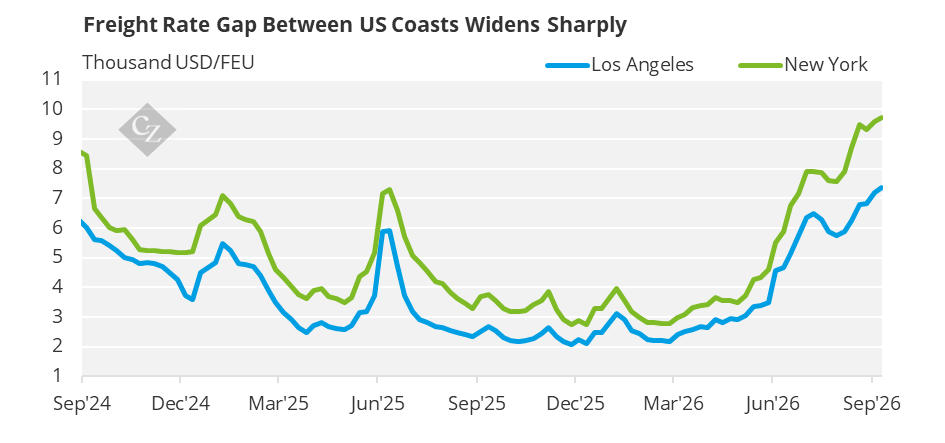
According to benchmarking data from Xeneta and fresh updates from the Drewry World Container Index, shipping a box from Asia to the US West Coast is now so much cheaper than shipping to the East Coast that it can pay to move the cargo inland by truck or rail, even to Midwest destinations.
Source: Drewry
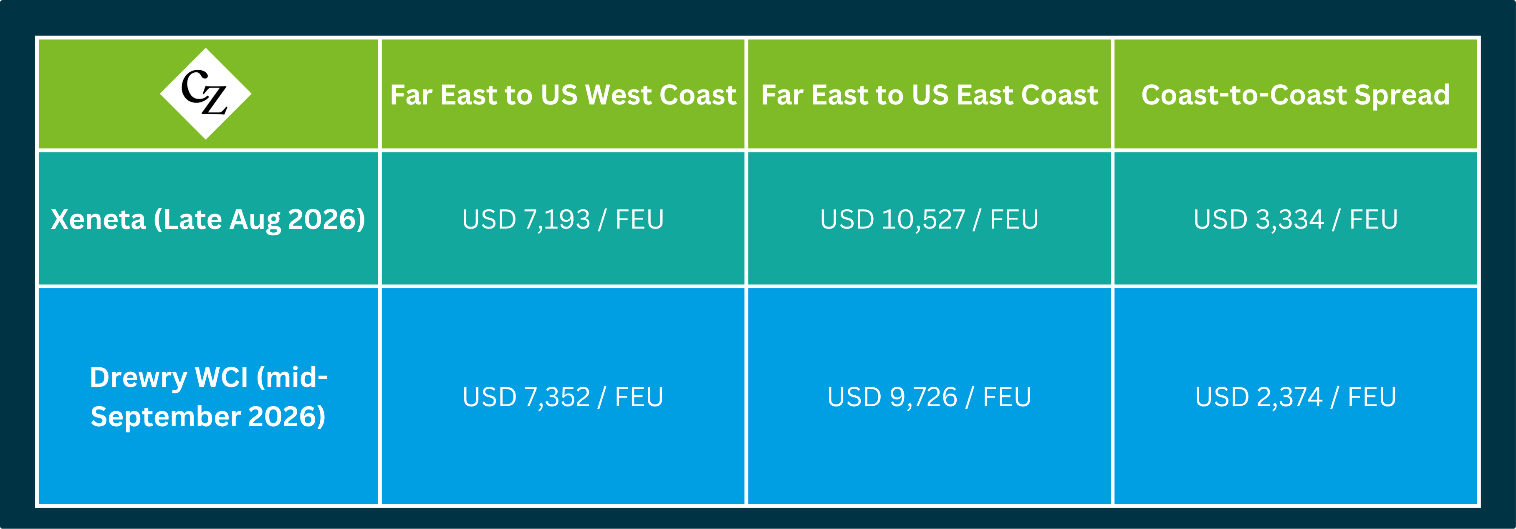
While Xeneta data from late August captured an expanded spread of USD 3,334/FEU (USD 10,527 East Coast vs. USD 7,193 West Coast), the latest Drewry WCI assessment as of September 10 confirms that the East Coast premium remains substantial.
According to Drewry, spot rates from Shanghai to Los Angeles rose 2% to USD 7,352/FEU, while Shanghai to New York increased 1% to USD 9,726/FEU, maintaining a direct ocean rate differential of USD 2,374/FEU.
Peter Sand, Chief Analyst at Xeneta, highlighted the strategic imperative for supply chain executives:

While transpacific spot rates to US gateways remain elevated due to sustained import demand, European import trades demonstrate a contrasting trend. Drewry WCI data shows Asia-to-Europe routes experiencing rate softening, underscoring that ocean carrier pricing power remains heavily concentrated on US-bound trade lanes.
Near-Historical Import Highs Drive System Pressure
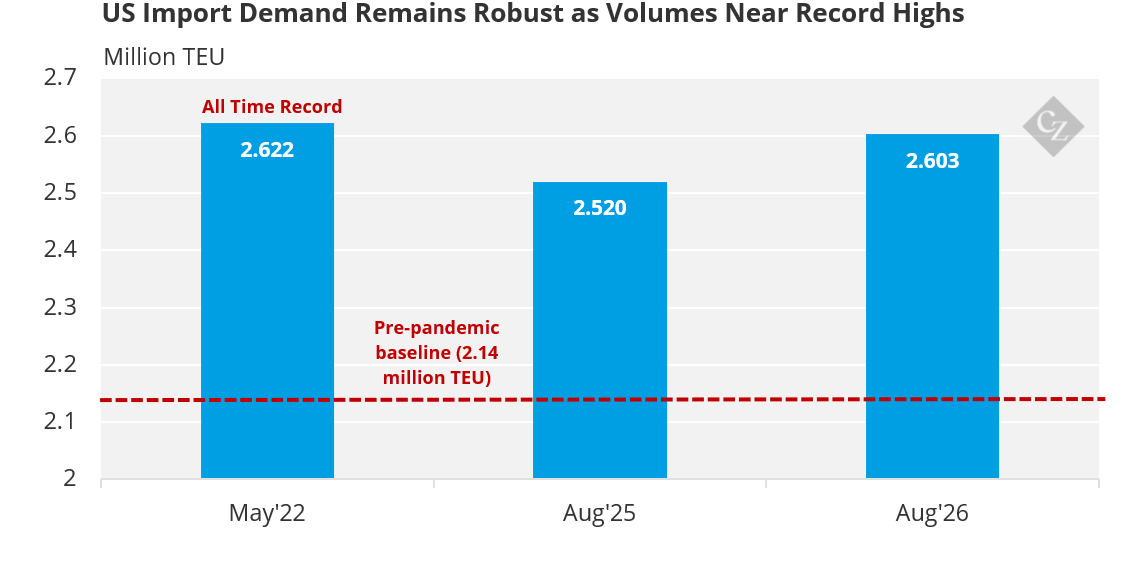
The rate gap comes as US import demand remains strong, with some shippers also bringing cargo forward ahead of Golden Week and the peak retail season. Data from Descartes Datamyne reveals that US containerised imports reached 2.6 million TEU in August 2026.
This total represents the third-highest monthly import volume in US history, trailing only May 2022 (2.622 million TEU) and July 2025 (2.621 million TEU), and stands 21.5% higher than the pre-pandemic baseline.
Source: Descartes Datamyne
Import growth was broadly distributed across Asian origins. US imports from China accounted for 884,318 TEU (34% of total US imports), while double-digit gains were recorded from Southeast Asian origins, including Indonesia (+19.5%) and Thailand (+10.4%).
Rising Import Demand Adds Pressure Across US Gateways
Despite the cost advantage of using West Coast ports, the distribution of import volumes across US gateways tells a different story.
East and Gulf Coast ports handled 40.7% of total US imports in August, driven by volume gains at gateways such as New York/Newark (+7.2% to 24,122 TEU) and Savannah (+9.2% to 22,761 TEU). West Coast gateways accounted for 43.9% of total imports.
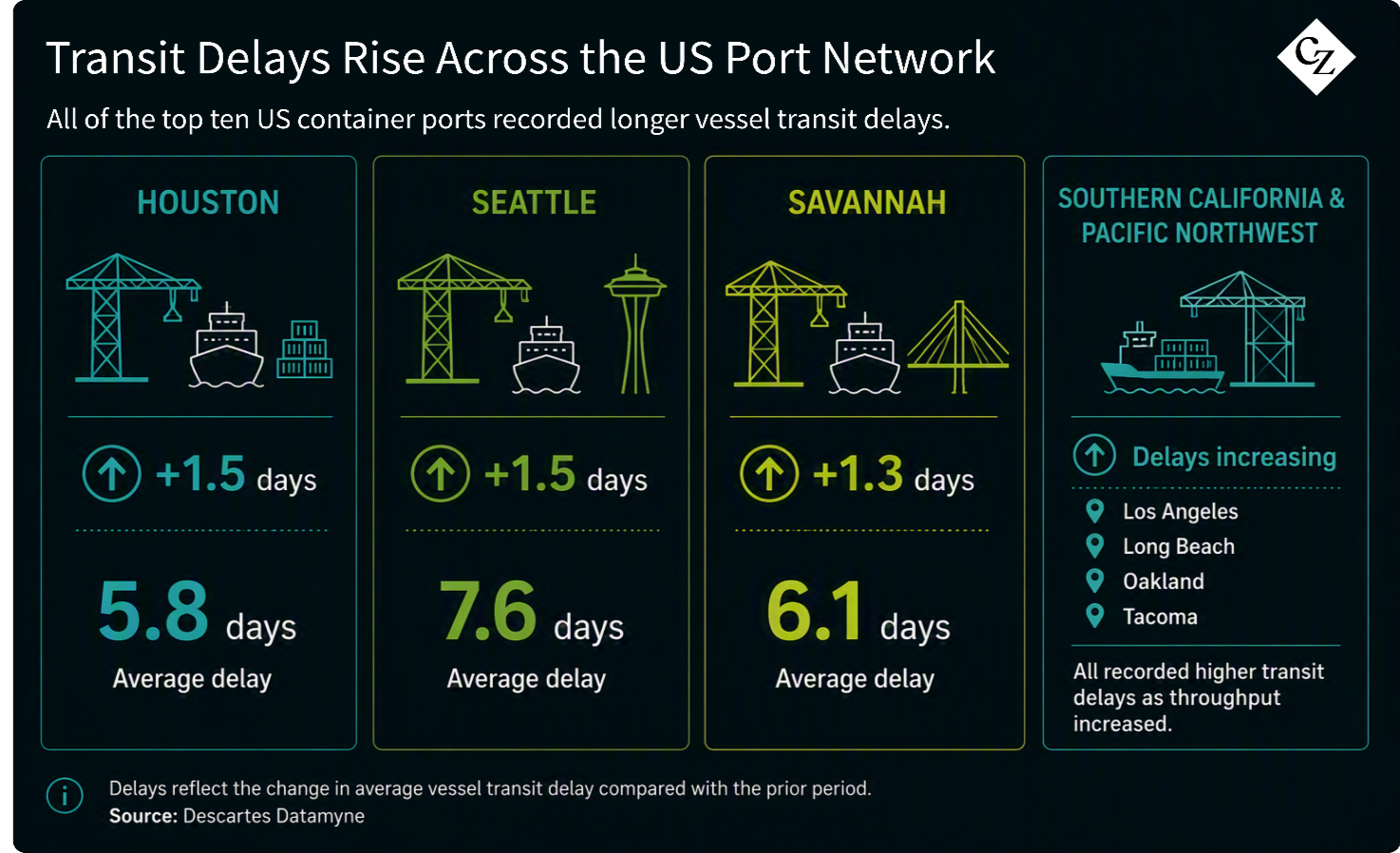
However, delays are also starting to build across the US port system. According to Descartes, all 10 top US container ports recorded increased transit delays. Below is the performance of the major US container hubs.
Ongoing Bottlenecks Add to the Pressure
Three factors are widening the rate gap and prompting shippers to reassess routing options. Firstly, Panama Canal restrictions, including draft limits and fewer daily Neopanamax slots, continue to weigh most heavily on all-water Asia-to-East Coast services.
Secondly, security risks in the Suez Canal and Red Sea are keeping carriers on longer Cape of Good Hope routes, increasing transit times and costs for East Coast calls. And finally, importers facing expanded US Section 301 tariffs of 10% to 12.5% across several product categories are looking to reduce ocean freight costs to protect margins.
Managing the Intermodal Pivot
As shippers prepare for the final months of the year, routing more cargo through West Coast ports remains an attractive way to cut costs. Rail and drayage costs will eat into part of the USD 2,300-3,300 ocean freight gap, but the savings can still be significant for cargo heading to the Midwest and other inland markets.
The challenge is whether the West Coast can handle more volume without creating additional delays and higher inland transport costs. As importers weigh their options, the potential ocean freight savings will need to be measured against the extra time and cost of moving cargo inland.