
Insight Focus
Harvest pressure continues to weigh on Chicago corn. Wheat also fell as prospects of increased Black Sea exports grew, with Russia reportedly resuming traffic from the Sea of Azov. We think corn is nearing a floor, with further downside limited and consolidation expected around USD 4.50/bushel.
Corn in Chicago falls again on harvest pressure and wheat on increasing exports out of the Black Sea. Russia resumes traffic in the Sea of Azov.
Price action last week continued to reflect the good harvesting pace in US corn and the potential increase in wheat trade flows out of the Black Sea. The latter is something that remains to be seen, but we think the market has already eliminated any risk premium due to supply disruptions, and further downside should be limited. On the contrary, if there is no confirmation of increasing exports out of Russia and Ukraine, we should see the risk premium return.
On the corn side, we also think we should be close to the market floor for Chicago corn. We could still have some harvest pressure, but the market has already priced in the new supply picture from the October WASDE, and further downside should be limited.
The November WASDE is expected next week, but we don’t expect to see any changes, as the USDA will wait for final harvest numbers to confirm its forecast. Some short-term volatility could arise depending on harvest progress, but overall, we think the correction is over and expect further consolidation around the USD 4.50/bushel region.
There are no changes to our estimate for the 2026/27 price of corn in Chicago to average USD 4.75/bushel. The average price since September 1 is running at USD 4.9/bushel.
Harvest Pressure Weighs on Chicago Corn
Corn opened unchanged in Chicago last Monday but traded lower on Tuesday following good harvest progress. It then consolidated the Tuesday losses during the rest of the week, finally closing almost 2% lower week on week.
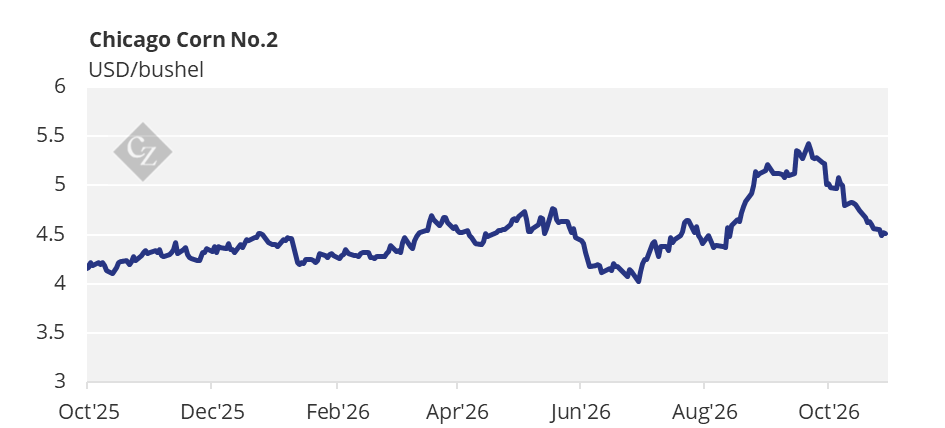
The 16-point progress in the corn harvesting pace was the trigger for the fall last week. The crop is now above 50% harvested and nothing is signalling that there will be any problems completing the harvest on time.
In Europe, the October MARS bulletin reduced corn yield by 1% versus last month to 6.42 tonnes/ha, which is now 10% lower year on year. This was somewhat unsurprising and neutral for the market.
US corn is 60% harvested, trailing the five-year average of 66%, while condition remains unchanged week on week at 56% good or excellent. French corn harvesting is 99% complete, well ahead of 81% last year and the five-year average of 71%, while 22% is in good or excellent condition, unchanged week on week.
Corn harvesting is 29% complete in Ukraine and 40.1% complete in Russia. Brazil’s summer corn planting reached 40%, slightly ahead of 39.5% last year and the five-year average of 38.9%.
Wheat Falls on Prospects of Higher Black Sea Flows
Wheat also opened lower last week and consolidated losses through the rest of the week, posting bigger weekly losses than corn, both in Chicago and on Euronext, due to prospects of increasing flows out of the Black Sea, which were confirmed later in the week.
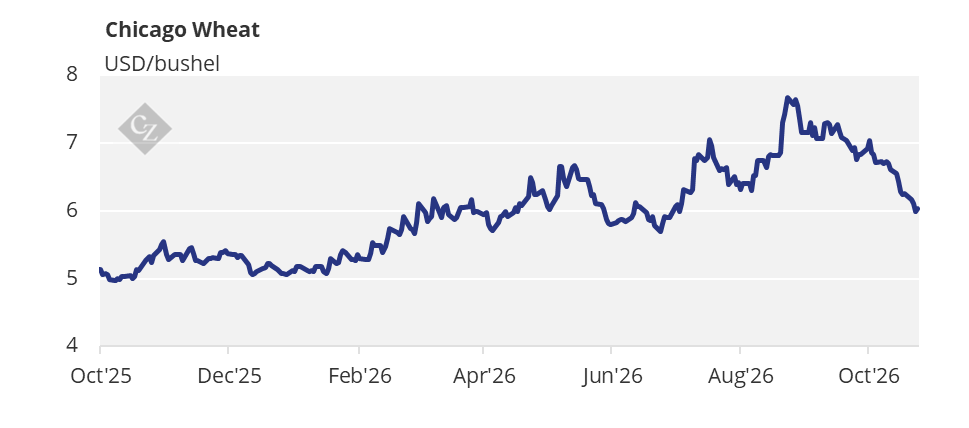
The week started with Russia considering proposals to ensure the safe transportation of grain through the Black Sea, with the Russian Foreign Minister saying he was in discussions with Turkey and several other countries. The US also planned talks with Russia to mediate discussions with Ukraine, which put further selling pressure on wheat. By the end of the week, Russia was rumoured to have allowed ships to sail out of the Sea of Azov for the first time since July.
In the Americas, the Rosario Board of Trade in Argentina increased its wheat production forecast to 23.8 million tonnes compared with its previous estimate of 21 million tonnes.
US winter wheat is 76% planted, slightly trailing the five-year average of 77%. Winter wheat planting in Ukraine is 82.6% complete, ahead of 80.7% last year. In France, winter wheat planting is 62% complete, behind 67% last year but well ahead of the five-year average of 50%. Wheat harvesting in Russia is virtually complete, with 99.4% harvested, while winter wheat planting has reached 83.4%. Wheat harvesting in Brazil is 57.3% complete, well ahead of 43.2% last year and the five-year average of 52.7%.
Rains are expected in the US, which could potentially slow corn harvesting. Brazil and Argentina are also expected to receive rains. Cold weather is forecast in northwestern Europe, but it will be mostly dry, while rains are expected in the Black Sea region.