Insight Focus
New research shows that GLP-1 users are reducing snacks, soft drinks and alcohol. GLP-1 uptake remains concentrated in developed markets, but falling prices could bring the same changes to China, India and Brazil over the next decade.
GLP-1 Users Are Changing What They Consume
Weight management has overtaken diabetes and other health conditions as the main reason US consumers use GLP-1 drugs. A new consumer survey from EY-Parthenon found this was the main reason for treatment among 54% of users. The survey covered 14,883 US consumers, including 3,602 current or former users.
The food findings broadly support what we have seen in earlier research: users are moving away from snacks and soft drinks and towards fresh produce, protein and functional drinks.
How GLP-1 Users Are Changing What They Consume
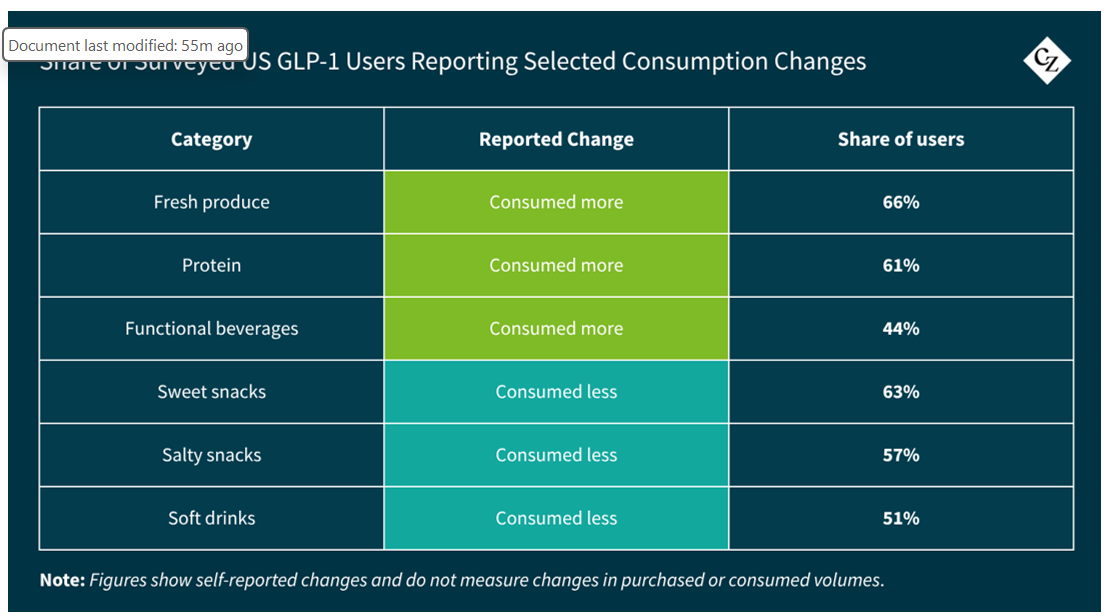
The findings are not surprising on their own, but the size and consistency of the reported changes matter. GLP-1 users are not simply eating less of everything. Indulgent categories appear to be losing consumption while products associate with nutrition and functionality are gaining it.
The effect may also reach beyond the individual user. Ninety-four per cent of those surveyed were the main grocery shopper in their household, giving them influence over shared meals and the products available at home. This does not mean every household member follows the same diet, but it means the impact of GLP-1 use cannot necessarily be estimated by counting users alone.
In our July update on how GLP-1s are changing food products, we looked at manufacturers developing smaller portions and products containing more protein, fibre and less sugar. The latest results provide further evidence of the consumer preferences behind those changes.
The Effect Is Reaching Beer Sales
The clearest sign that GLP-1s are having a wider impact is that big companies are beginning to change how they sell their products.
Heineken has warned British pubs and bars that GLP-1 use could place pressure on beer and cider sales. In a presentation sent to its UK hospitality customers, the company said the drugs could result in “fullness and fewer serves” and make traditional multi-pint drinking occasions harder to sustain. The company advised venues to promote half-pints, low- and no-alcohol drinks and smaller food plates.
There is some evidence behind that concern. Circana found that US households containing a GLP-1 user spent around 7% less per month on alcohol after two years, including 13.5% less on beer, than households without a user. However, lower alcohol consumption also reflects wider health, demographic and cost pressures, so the whole decline cannot be attributed to GLP-1s.
The more useful point is how Heineken expects consumption to change. Drinkers are not necessarily leaving pubs or giving up alcohol altogether. They may instead buy fewer drinks, choose a smaller serving or pay more for a premium or lower-alcohol option.
That is likely to be relevant across food and drink. Companies may be able to protect revenue through price, premiumisation and new formats, even while physical volumes decline. For ingredient suppliers, including sugar producers, protecting sales value does not necessarily protect the quantity of ingredients used.
Uptake Is Growing in South Korea
South Korea provides another example of how widely GLP-1 use is spreading. A survey of 2,000 South Korean adults found that 10.3% had used or been prescribed an obesity drug such as Wegovy or Mounjaro in the previous year. Uptake was highest among younger consumers, reaching 16.5% among Generation Z and 14.2% among millennials.
The figures suggest that GLP-1 use can grow quickly beyond the US, particularly among younger consumers. However, the survey combines people who used the drugs with those who were prescribed them, so the results should not be treated as the share taking GLP-1s at any one time.
Access Is Not Expanding Everywhere
Not every country is widening access. Belgium has decided not to reimburse Mounjaro when it is prescribed for obesity, following an earlier decision not to cover Wegovy for the same use. Mounjaro will remain conditionally reimbursed for some patients with type 2 diabetes, but those using it solely for weight loss will need to pay privately.
The Belgian government cited the cost of wider coverage and said medication alone would not be enough to tackle obesity. The lowest dose of Mounjaro costs around EUR 179 per month, while public spending on this group of diabetes medicines rose from almost EUR 30 million in 2019 to EUR 122 million in 2025.
Growth Could Shift Towards Emerging Markets
Canada provides an example of how generic competition could bring prices down. Health Canada has approved five generic semaglutide products, including alternatives to Ozempic for diabetes and Wegovy for weight management. Generic versions of Ozempic are already available at some Canadian pharmacies for around CAD90–120, compared with roughly CAD230–300 for the branded treatment.
Similar price pressure could eventually reach much larger markets as patents expire and local manufacturers launch generic alternatives. J.P. Morgan estimates that the weight-loss drug market across China, India and Brazil could grow from USD6.6 billion today to USD22 billion by 2035. The bank expects the combined market to grow by around 15% a year.
Uptake is starting from a very low base. Penetration is below 0.1% in China and below 0.2% in India, compared with 4%–5% in the US. Brazil currently has the largest market of the three, but J.P. Morgan expects China to overtake it in 2027 and reach USD13.7 billion by 2035, compared with USD8 billion in Brazil.
That potential growth matters for sugar consumption. India is the world’s largest sugar consumer by tonnage, while China is the second largest individual country market. Brazil is also a major consumer. Eating habits differ between countries, so we cannot assume the changes reported by US users will be repeated in exactly the same way. However, even a small change in consumer behaviour across populations of this size could translate into a significant change in the amount of sugar consumed.
What This Means for Sugar Consumption
Taken together, these latest developments suggest an impact that will be uneven across products and countries.
In established GLP-1 markets, the immediate pressure is likely to remain on categories such as sweet snacks, soft drinks, alcohol and products built around frequent consumption. Heineken’s response shows what adaptation may look like: smaller servings and products designed to preserve value even as consumers buy less.
The longer-term issue is emerging-market access. If GLP-1 use grows in China, India and Brazil, the effect on global food and sugar consumption could become much larger. But market-value forecasts alone are not enough to calculate that impact. We will need to track actual patient numbers, how long people remain on treatment and which food categories change in each market.
Our view is therefore not that GLP-1s will produce an immediate fall in sugar consumption. The more likely outcome is a gradual drag, concentrated initially in particular categories and developed markets before spreading as treatment becomes cheaper. For sugar companies, that makes the mix of consumption increasingly important: where sugar is consumed, in which products and how vulnerable those occasions are to smaller appetites.