Insight Focus
Sugar market activity remained limited as participants focused on weather risks and crop prospects. Drought concerns persisted across key growing regions, though late-summer rainfall in the Red River Valley shifted some attention toward potential harvest delays from wetter field conditions. The USDA raised its 2025-26 US sugar supply forecast on higher imports but projected a tighter 2026-27 balance sheet due to lower production and reduced imports from Mexico.
This update is from Sosland Publishing’s Sweetener Report. For more information and subscription details, CLICK HERE.
Activity in the cash sugar market was limited this week. Participants continued to monitor a range of market signals, including crop reports, changes in consumer demand, and updates to import tariff policies. Prices were unchanged but remained nominal, as many sellers continued to withhold offers from the market.
Weather and Crop Prospects Remain Key Ahead of Harvest
The focus for most participants remained on weather and crop prospects. With drought impacting nearly all domestic sugar beet and sugar cane growing areas, market sentiment was that the brunt of harvest activities in several regions likely will occur later than usual.
However, a few areas in the Red River Valley, which comprises most of the Minnesota and North Dakota beet-growing region and supplies about half of total domestic sugar beet production, received some late-summer rain. Concerns were beginning to shift from drought stress to the possibility of wet field conditions delaying harvest activities. Some growers in the region were accelerating their harvest pace to stay ahead of the weather.
As of September 6, the USDA said the sugar beet harvest in Minnesota was 8% complete (7% a year earlier, 6% as the five-year average for the date), in North Dakota was 10% complete (9%, 7%), and in Idaho was 1% complete (2%, 2%). Harvest had yet to begin in Michigan (3%, 5%) and Wyoming (6%, zero). Harvest progress was not yet reported in Colorado, Montana, or Oregon, which is typical for this period. Harvest also had not yet begun for domestic sugar cane crops, but cutting was expected to start in late September in Louisiana and mid-October in Florida, weather permitting.
Conditions were mixed for the sugar beet crop. After weeks of maintaining good-to-excellent ratings in the 90% range, conditions for the crop in both Minnesota and North Dakota began to slip. In Minnesota, the crop was rated 87% good-to-excellent as of September 6, down from 92% a week earlier but still above the year-ago rating of 83%. Conditions in North Dakota dropped to 82% good-to-excellent, down from 93% the week before and from 84% a year earlier.
Colorado was the only state to show a week-over-week improvement in its rating, jumping to 81% good-to-excellent, up from 71% a week earlier but down from 83% during the same week a year earlier. Conditions in all other reporting states were unchanged from the previous week, with Idaho at 85% (95% a year earlier), Michigan at 45% (80%), and Wyoming at 65% (86%). Conditions were not reported for Montana or Oregon.
The sugar cane crop rating in Louisiana dropped to 53% good-to-excellent as of September 6, down from 59% the week prior and well below the 83% rating a year earlier. Crop conditions were not reported for Florida.
The domestic corn sweetener market was active, with negotiations for 2027 annual contracts underway.
2025-26 US Sugar Supply Raised on Import Growth
In its September 11 WASDE report, the USDA raised its forecast for 2025-26 US sugar supply from August levels on a jump in high-tier imports but lowered projected 2026-27 sugar supply due to lower production and reduced imports from Mexico. The ending stocks-to-use ratio for 2025-26 was raised to 16.2% from 15.1% in August, while the ratio for 2026-27 was lowered to 13.5% from 14.8% as a required adjustment under the US-Mexico sugar suspension agreements.
For the current year, the USDA raised its 2025-26 beet sugar production forecast by 8,000 short tons (7,257.48 tonnes), raw value, from August to 5.076 million short tons, but left cane sugar production unchanged at 4.189 million short tons, resulting in total production of 9.265 million short tons, up 0.1% from a month earlier but down 1.4% from 2024-25. If realised, 2025-26 cane sugar production would be the highest on record.
The major change in supply for 2025-26 came from imports, with total imports forecast at 2.964 million short tons, up 121,000 short tons, or 4.3%, from August but still down 429,000 short tons, or 12.6%, from 2024-25.
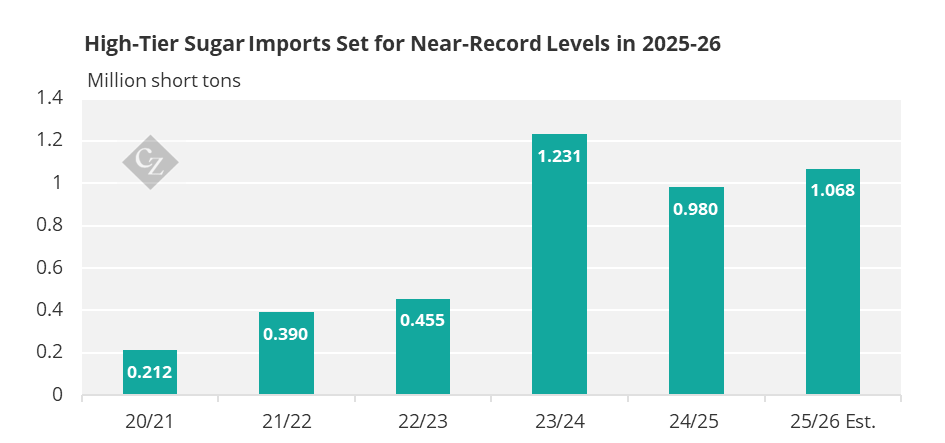
High-tier imports were forecast at 1.068 million short tons, up 86,328 short tons, or 8.8%, from August and up 88,000 short tons, or 9%, from 2024-25, “on increased raw sugar entries occurring mostly at the end of July and also in early September,” the USDA said. If realised, high-tier imports would be the second highest on record after 1.231 million short tons in 2023-24.
Source: USDA
Tariff-rate quota (TRQ) imports were lowered by 2,670 short tons to 1.313 million short tons and were down 221,000 short tons, or 14.4%, from 2024-25. Other program imports were raised 15,000 short tons from August to 340,000 short tons, and imports from Mexico were raised 22,069 short tons to 241,706 short tons, “on actual entries from Census data through July 31 and Customs data covering August and the first week of September,” the USDA said.
“The raw sugar TRQ shortfall increased by 30,673 short tons but was mostly offset by an increase in Free Trade Agreement TRQ imports of 28,003 short tons previously forecast to enter in the fourth quarter of 2026,” the USDA said.
Total sugar supply in 2025-26 was forecast at 14.604 million short tons, up 128,260 short tons from August but down 327,000 short tons from 2024-25. There were no changes from August to forecast sugar deliveries, with food use at 12.441 million short tons and total use at 12.571 million short tons.
“Deliveries for human consumption decreased below expectations in July, but not enough to warrant a decrease in the estimate for 2025-26,” the USDA said.
Ending stocks in 2025-26 were forecast at 2.033 million short tons, up 129,000 short tons, or 6.8%, from August but down 343,000 short tons, or 14.4%, from 2024-25.
2026-27 US Sugar Outlook Tightens
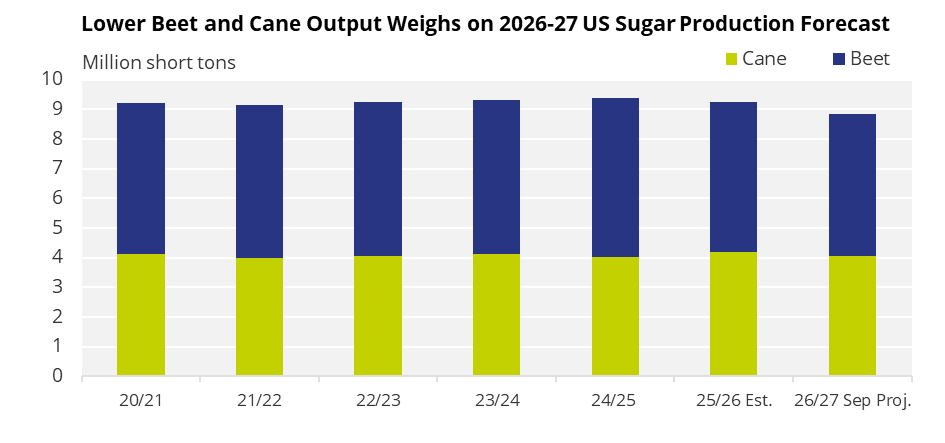
US sugar production in 2026-27 was projected at 8.839 million short tons, down 111,000 short tons, or 1.2%, from August and down 426,000 short tons, or 4.6%, from 2025-26. Beet sugar production was projected at 4.769 million short tons, down 22,354 short tons, and cane sugar outturn at 4.071 million short tons, down 88,000 short tons. Cane sugar production in Louisiana was projected at 2.252 million short tons, down 13,852 short tons from August, and in Florida at 1.819 million short tons, down 74,000 short tons.
Source: USDA
“NASS forecasts national sugar beet production at 31.763 million tons on a yield of 31.47 short tons per acre and area harvested of 1.009 million acres,” the USDA said. If realized, sugar beet production would be down about 1% from the August forecast and down 10% from 2025. Harvested area was forecast at 1.01 million acres, up slightly from August but down 5% from 2025. The average yield was forecast down 0.3 short tons from August and down 1.7 short tons from last year.
“The industry is well aware of the mealybug issues and is actively working to mitigate their effect on production. The industry maintains that it cannot make a forecast of the mealybug’s impact on production until the harvest is well underway. Two processors in Florida that did not report changes last month decreased their forecasts, likely as a consequence of the effects of the mealybug infestation. Since July, forecast production has decreased 9.8% to the current projection.”
Imports from Mexico were projected at 1.188 million short tons, down 158,000 short tons, or 12%, from August as the USDA adjusted imports from Mexico to balance for a 13.5% ending stocks-to-use ratio. Still, imports from Mexico are projected to be up 946,000 short tons, or 391%, from 2025-26.
TRQ imports in 2026-27 were projected at 1.391 million short tons, down 28,000 short tons from August, while other program imports at 300,000 short tons and high-tier imports at 517,000 short tons were unchanged. Total imports in 2026-27 were projected at 3.396 million short tons, down 186,004 short tons, or 5.2%, from August but up 432,000 short tons, or 14.6%, from 2025-26.
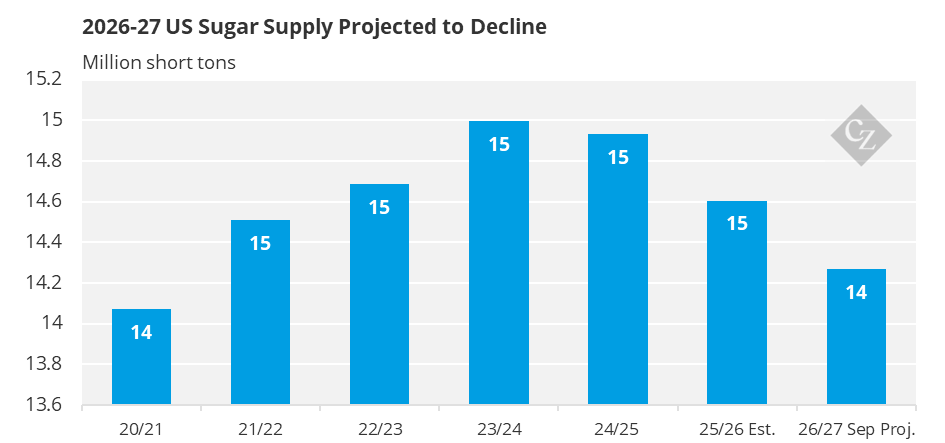
Total sugar supply in 2026-27 was projected at 14.268 million short tons, down 168,282 short tons from August and down 336,000 short tons from 2025-26.
Source: USDA
There were no changes from August or from 2025-26 to projected sugar use in 2026-27, with deliveries for food use at 12.546 million short tons, exports at 25,000 short tons, other use at 105,000 short tons, and total use at 12.571 million short tons.
Sugar ending stocks in 2026-27 were projected at 1.697 million short tons, down 168,000 short tons, or 9%, from August and down 336,000 short tons, or 17%, from 2025-26.
Mexico Balance Sheet Sees Higher Stocks
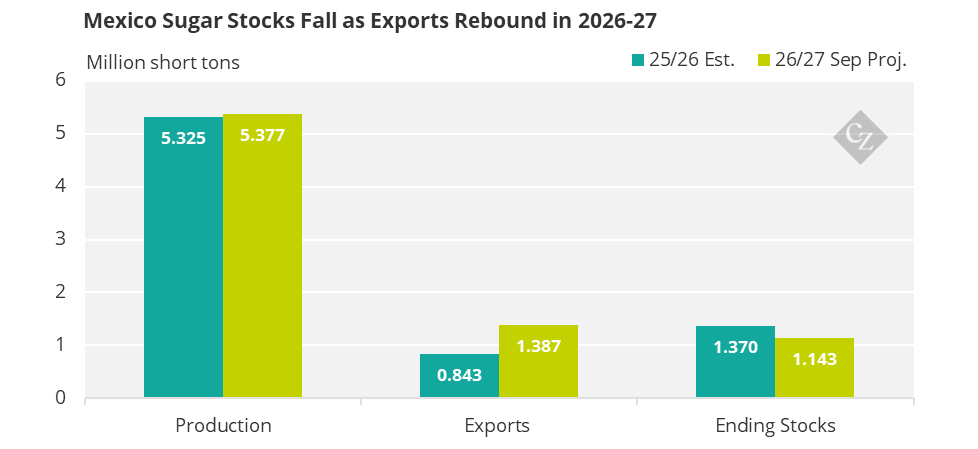
For Mexico, the USDA made no changes from August to production forecasts, with 2025-26 at 5.325 million tonnes, actual weight, and 2026-27 at 5.377 million tonnes. Imports also were unchanged for both years, with the current year at 42,000 tonnes and next year at 28,000 tonnes.
Exports in 2025-26 were forecast at 843,000 tonnes, down 138,000 tonnes from August, and at 1.387 million tonnes for 2026-27, up 30,000 tonnes. Domestic use was raised by 28,000 tonnes from August to 4.278 million tonnes for 2025-26 and by 19,000 tonnes to 4.245 million tonnes for 2026-27.
Ending stocks in 2025-26 were forecast at 1.370 million tonnes, up 111,000 tonnes from August, and were projected at 1.143 million tonnes, up 61,000 tonnes from August for 2026-27.
Source: USDA