Insight Focus
Ukraine talks and upcoming WASDE report keep grain markets on edge. Wheat fell on hopes of a Ukraine peace deal and export corridor. Markets now turn to this week’s Ukraine talks and the WASDE report, with expectations for a lower US corn yield supporting a stronger price outlook. A yield below 178 bushels/acre could provide further price support, while progress on Black Sea exports would likely pressure grain markets.
This update is from Nixal Commodities. For more information, CLICK HERE.
Grain Markets Await Clarity on Black Sea Exports and Corn Yields
Wheat sold off last week on growing optimism around a potential Ukraine peace agreement, pulling the broader grains complex lower, while corn finished largely unchanged.
Black Sea export disruptions have been a key driver of wheat’s rally over the past month, so any progress towards a grain export corridor could put further pressure on prices. This week’s focus is firmly on the outcome of Ukraine talks and Friday’s WASDE report, particularly the US corn yield estimate. The market expects a reduction from the August WASDE’s 180.7 bushels/acre forecast, but the size of the cut remains uncertain, with the Pro Farmer tour estimating just 173.2 bushels/acre.
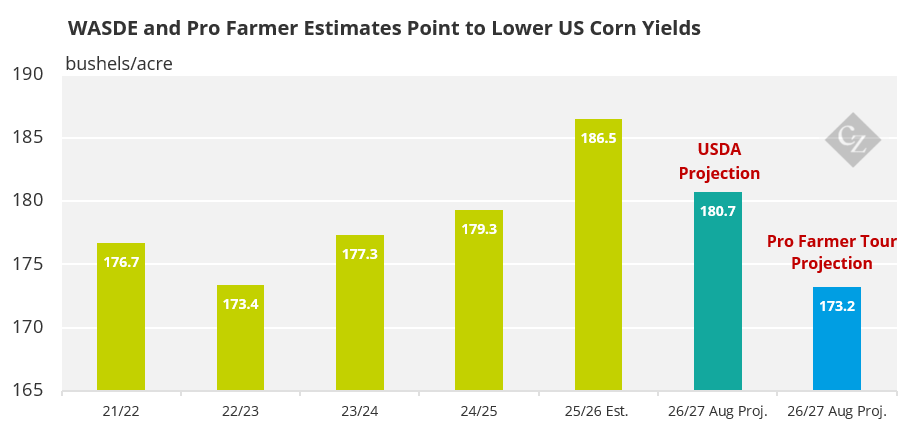
Source: USDA, Pro Farmer
Expectations appear centred around 178-179 bushels/acre, which would push the stocks-to-use ratio to around 8%, down from 11.7% last season, and support average corn prices of at least USD 6/bushel. Expect heightened volatility this week, with any Ukraine export corridor agreement likely bearish for grains, while a corn yield below 178 bushels/acre would be supportive for prices.
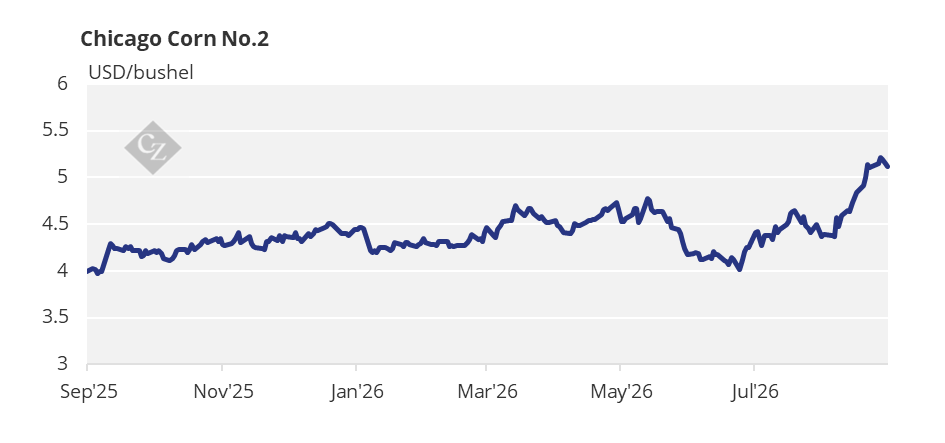
The 2025/26 (September/August) average Chicago corn price ultimately settled at USD 4.39/bushel, matching our forecast of USD 4.40/bushel, which we revised a few weeks ago from our previous USD 4.50-4.60/bushel range.
We are waiting for the September WASDE and the first European harvest data before publishing a forecast for the 2026/27 (September/August) crop year, but our initial thinking points to an average Chicago corn price of USD 5.50-6.00/bushel. Since September 1, prices have averaged USD 5.17/bushel.
Corn Rally Fades as Ukraine Peace Talks Weigh on Markets
Corn in Chicago started strong last Monday on the back of hot, dry weather expected in the US, continuing the rally from the previous week and reaching a high of USD 5.26/bushel last Wednesday. However, the market sold off later on Wednesday as wheat plummeted on peace prospects in Ukraine and pulled corn lower, finally closing the week unchanged in Chicago but negative in Euronext.
Turkey announced it is looking to secure grain shipments from Ukraine and Russia. According to the Turkish Foreign Minister, Turkey has prepared a plan for the safe passage of grain via the Black Sea and is in contact with both Russia and Ukraine.
By the end of the week, Putin said Russia and Ukraine were holding talks, which pressured the market even lower and led it to finish the week on expectations that a grain export corridor will finally be agreed. Finally, US representatives travelled to Russia over the weekend to broker a peace agreement.
In Germany, the agriculture ministry reduced its corn production forecast to 3.75 million tonnes, a sizable 24.2% year-on-year decline, due to hot and dry weather affecting yields.
Coceral forecast corn production in the EU+UK at 52.7 million tonnes, down from 57.4 million tonnes, representing a sizable 4.7-million-tonne production loss.
US corn condition is 57% good or excellent, unchanged week-on-week and versus 69% last year. Corn condition in France is 27% good or excellent, down one point week on week and versus 62% last year. Corn harvesting in Argentina is 92.5% complete, while corn planting for the new 26/27 crop has started and is 1.5% complete.
Slow Russian Exports Continue to Tighten Global Wheat Supplies
Wheat started the week with some profit-taking and posted larger losses than corn. Exports out of Russia continue to be very slow, with August exports estimated at 2 million tonnes versus 4.5 million tonnes last year and 5 million tonnes, the five-year average. September exports last year were 4.8 million tonnes, so if the slow pace continues, a deficit of around 5.3 million tonnes versus last year could accumulate.
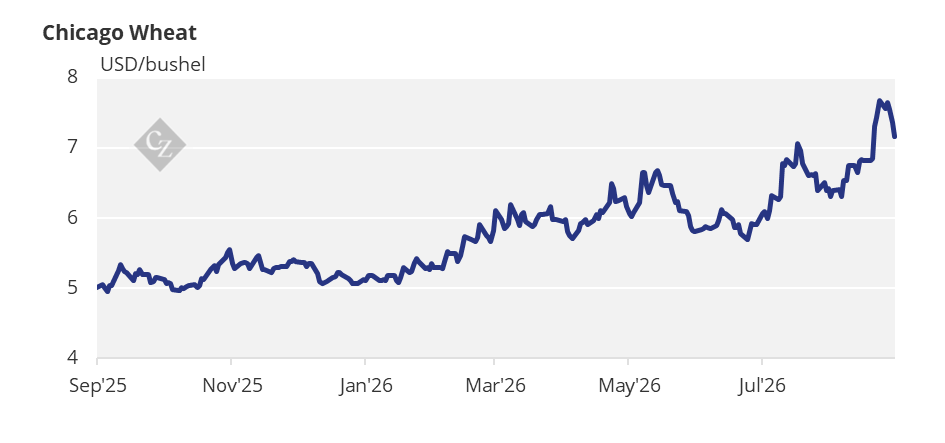
Australia raised its wheat crop forecast after strong winter rains improved growing conditions. The Department of Agriculture said it expects a 2026/27 wheat crop of 29.9 million tonnes, up 12% from its previous June forecast, although this remains below the 36 million tonnes produced last crop.
In Germany, the agriculture ministry reduced its wheat production forecast to 20.8 million tonnes, down 10.1% year on year, due to yield losses caused by hot and dry weather, particularly during June.
US spring wheat is 77% harvested, versus 69% last year and the five-year average of 68%. French wheat is fully harvested. Wheat harvesting in Russia is 73.2% complete versus 65.1% last year. Wheat harvesting in Ukraine is 98% complete. Wheat harvesting in Brazil is 6.7% complete versus 7.7% last year and the five-year average of 8%.
Frost is expected in Argentina but shouldn’t Brazil, where conditions are forecast to remain very rainy across the Centre South. US corn regions are expected to be hot and dry, with very limited rainfall and above-average temperatures. Germany is expected to receive rain, as are the Black Sea region and Ukraine, while France is expected to remain hot and dry.