Insight Focus
Supply chains face mounting pressure from conflict, trade uncertainty and weather. September saw Black Sea disruption intensify, Hormuz shipping remain constrained, and markets closely monitor the Trump-Xi summit ahead of the November trade truce deadline. Meanwhile, record-strength El Niño and rising biofuel demand are increasing concerns over global crop supplies, food security and agricultural supply chain costs.
September Sees Continued Black Sea Disruption
The Russia-Ukraine conflict in the Black Sea has been a major disruptor of agricultural trade flows, shipping activity and food security throughout 2026. According to Ukrainian officials, Russia has attacked at least 57 cargo vessels in the Black Sea since June, including ships carrying grain, while also targeting rail infrastructure, Danube export terminals and agricultural facilities.
Those disruptions intensified further in September, with Ukrainian strikes increasingly targeting Russian grain export infrastructure and reducing Russian export capacity. The conflict continued to influence multiple aspects of agricultural supply chains, from export volumes and trade flows to freight costs, maritime risk and food security concerns.
Trade Flows
The conflict’s impact on trade flows intensified in September.
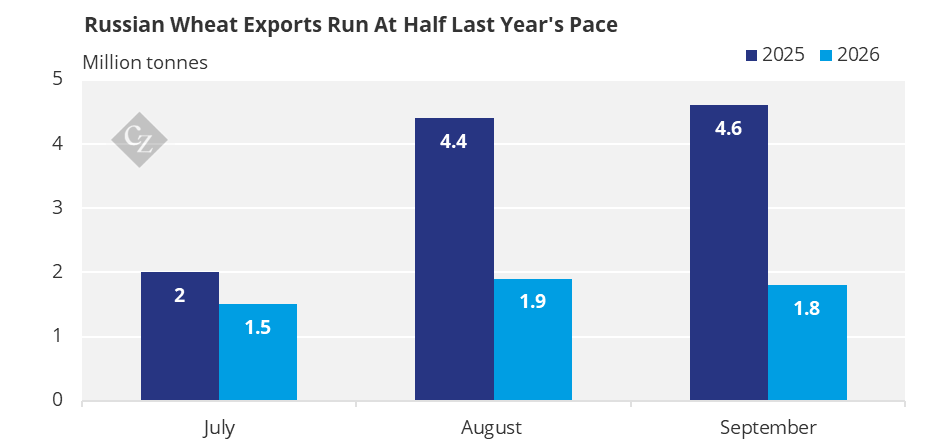
SovEcon estimates Russian wheat exports during July-September at 5.6 million tonnes, down from 11.3 million tonnes a year earlier, after Ukrainian strikes disrupted export infrastructure around the Sea of Azov and Novorossiysk. Russia has sought alternative routes through Baltic and Caspian ports, Kazakhstan and potentially China, though these remain far smaller than traditional Black Sea export corridors.
The disruption is also encouraging buyers to diversify away from Black Sea origins, with demand increasingly shifting towards suppliers such as the EU, Argentina, Australia and the US as importers seek to reduce exposure to geopolitical and shipping risks.
Source: USDA
Insurance
Security concerns widened in September when London’s Joint War Committee expanded its high-risk war insurance area from Russian and Ukrainian coastal waters to the entire Black Sea.
The change reflects the growing geographical spread of the conflict and increases reporting requirements for vessels operating through the region, adding further complexity to grain shipments and maritime trade.
Food Security
The disruption comes as global wheat supplies are already tightening. Russia and Ukraine account for around 27% of global wheat exports, while adverse weather has reduced production across several major exporters. Combined with Black Sea export disruption, these supply pressures have helped push wheat prices to their highest levels since 2023, increasing the risk of food inflation and supply shortages in import-dependent regions such as North Africa, the Middle East and parts of Asia.
Diplomacy
As of September 23, diplomatic efforts had intensified ahead of winter, with discussions focused on protecting energy infrastructure and restoring safer Black Sea shipping routes. At the United Nations, Ukrainian President Volodymyr Zelenskiy said Kyiv was prepared to support a maritime truce covering shipping and food exports, while warning that Ukraine would strike Russian energy assets if attacks on critical infrastructure continue.
Although both sides have expressed interest in a limited ceasefire covering grain and energy-related targets, no agreement has been reached.

Diesel Prices Surge as Hormuz Disruption Persists
Another conflict reshaping agricultural supply chains is the continuing confrontation between the US, Israel and Iran. As of September 23, senior US and Iranian officials had resumed indirect talks through Qatari mediation at the United Nations, marking the first significant diplomatic engagement since the collapse of the June ceasefire. While no breakthrough was reported, the talks raised hopes of easing tensions around the Strait of Hormuz.
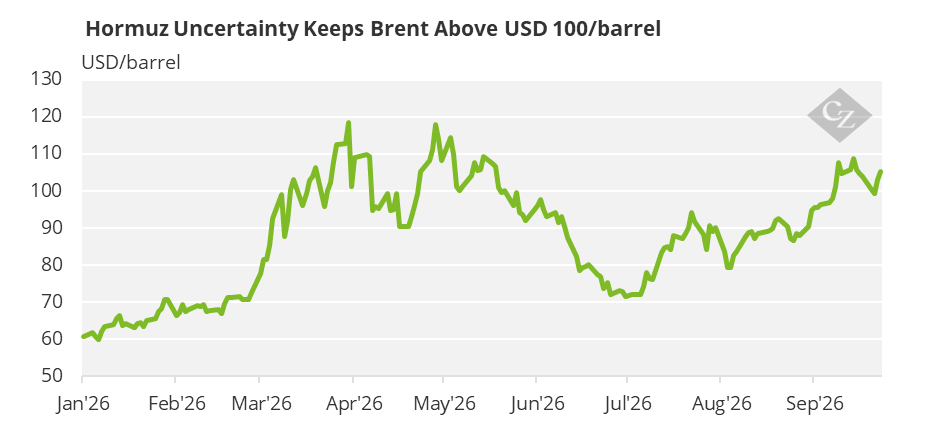
The lack of progress has kept energy markets on edge. Brent crude remained above USD 103/barrel during September as uncertainty persisted over whether and when the strait might fully reopen. Before the conflict escalated in February, Hormuz handled around 20% of global crude oil and LNG supplies.
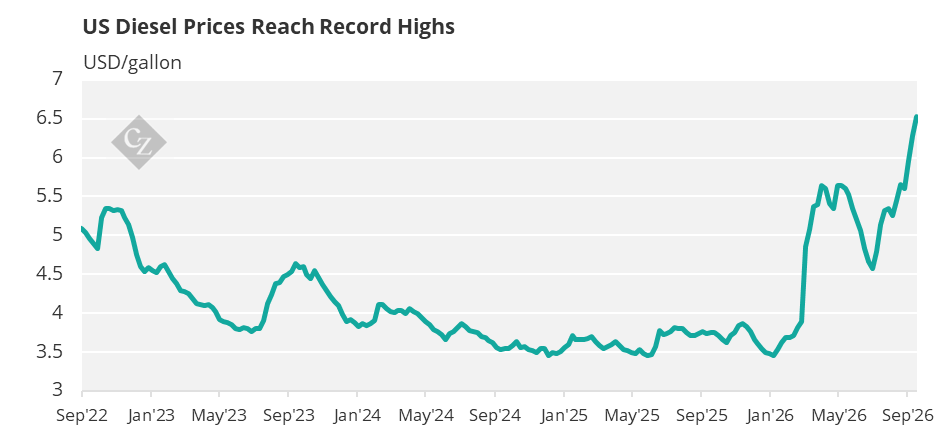
The resulting pressure on fuel markets pushed US diesel prices above USD 6.50/gallon, prompting President Donald Trump to back proposals for a temporary ban on diesel exports to bolster domestic supplies. Elevated energy costs continue to feed through agricultural supply chains via higher fuel, fertiliser, processing and freight costs.
Source: EIA
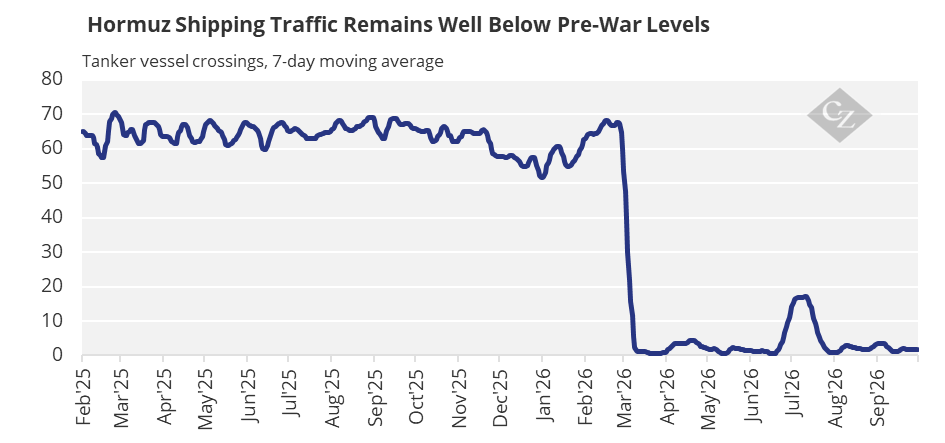
Shipping activity through the strait also remains well below normal levels. Preliminary data showed just 10 commodity vessels transiting Hormuz on 23 September, compared with around 125 commercial vessels per day before the conflict began. The reduction continues to disrupt cargoes including grain, fertiliser and energy products, adding volatility to freight markets and commodity trade flows despite renewed diplomatic engagement between the US and Iran.
Source: Lachstock Consulting, Bloomberg
Energy Security Concerns Boost Biofuel Expansion
The disruption to global energy markets is also accelerating another important trend for agricultural supply chains: rising demand for biofuels.
A study published in September projected that global biofuel production could rise by nearly 70% by 2030 compared with 2025 levels, driven by higher blending mandates across major economies. If fully implemented, an additional 36 million hectares of land could be required for biofuel feedstock production.
Evidence of this shift is already emerging across agricultural markets.
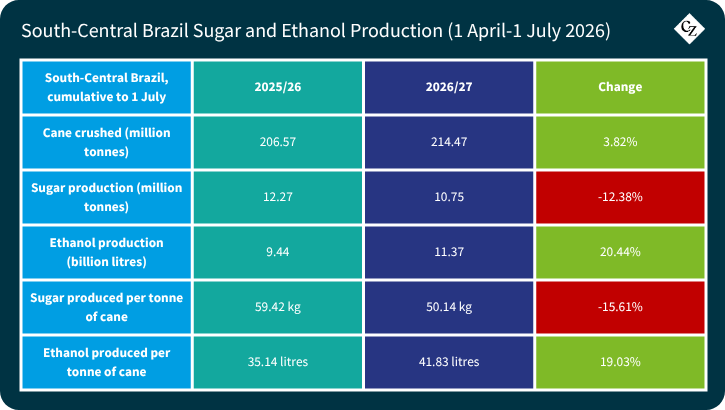
According to recent data from UNICA, Brazil’s Centre-South sugar output fell 12.38% year-on-year in July, despite higher sugarcane crushing volumes, as mills increasingly prioritised ethanol production over sugar manufacture.
Source: UNICA
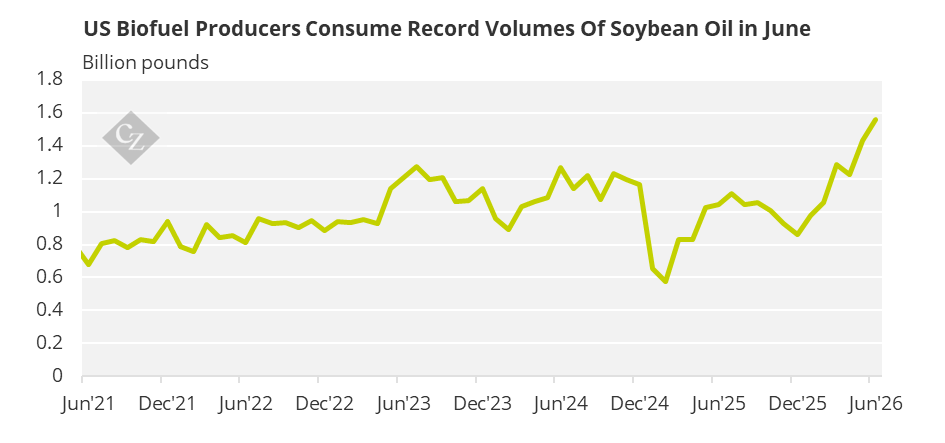
A similar trend is unfolding in the US. EIA data published in September showed that biofuel producers consumed a record 1.56 billion pounds of soybean oil in June, up 49% year-on-year, while soybean oil accounted for 41.2% of all biofuel feedstocks. Strong demand from renewable diesel and biodiesel producers also helped drive US soybean crushing to a record 222 million bushels in July, up 8.3% from a year earlier.
Source: EIA
Together, these developments highlight how energy security concerns are increasingly driving demand for agricultural feedstocks, strengthening the link between energy and food markets.
Agricultural Markets Watch Trump-Xi Summit
Chinese President Xi Jinping arrived in Washington on 23 September for a summit with US President Donald Trump. Although artificial intelligence is expected to dominate discussions, the meeting has attracted significant attention from agricultural markets given its potential implications for trade and commodity demand.
The summit comes with the US-China trade truce set to expire on November 10. Under previous agreements, China committed to purchase at least USD 17 billion of US agricultural products annually through 2028, alongside 25 million tonnes of US soybeans per year, and is estimated to have already purchased nearly 16 million tonnes.
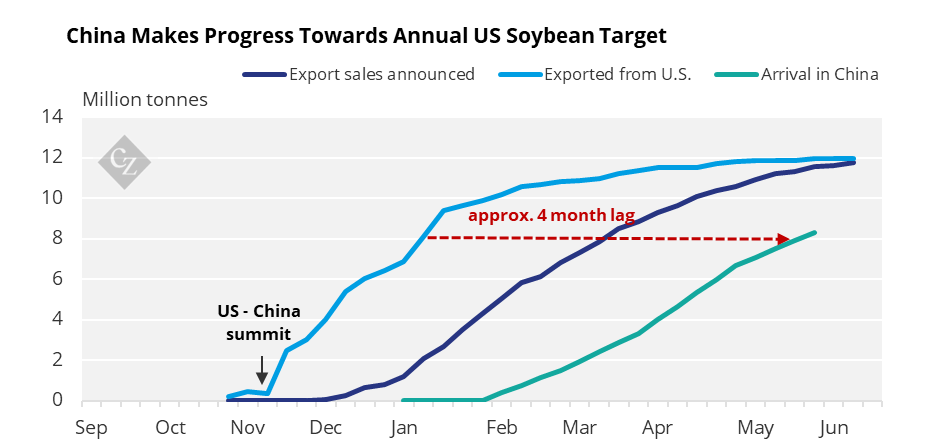
Note: Cumulative sales and exports, 2025/26 marketing year, million tonnes
Sources: USDA, China Customs
For agriculture, the most significant potential outcome would be the removal of China’s 10% tariff on US grains and oilseeds, which continues to discourage purchases by private Chinese importers and leaves US supplies at a disadvantage to Brazilian competitors. However, there has been little indication that tariff relief is under consideration.
Attention is also widening beyond soybeans. US farm groups are pushing for stronger Chinese sorghum commitments, with the National Sorghum Producers calling for annual imports of 5-7 million tonnes, up from roughly 4-5 million tonnes before trade tensions escalated. Recent Chinese purchases of Brazilian corn and sorghum suggest demand remains present, while disruptions to Black Sea grain exports could increase interest in alternative suppliers.
Most analysts expect the summit to reaffirm existing commitments rather than deliver major new agricultural concessions.
El Niño Moves into Record Territory as Crop Risks Grow
Alongside geopolitics and trade policy, weather remains a major driver of agricultural markets. September saw the current El Niño event move into record territory, with the Niño 3.4 anomaly reaching 3.11°C, surpassing the previous record of 3.08°C. The event is expected to persist into 2027, raising concerns over crop production and trade flows.
The effects are already visible across key producing regions. In Australia, major wheat-producing states received less than 25% of normal rainfall during the 30 days to 20 September. In Europe, French maize conditions continued to deteriorate, with just 23% of the crop rated good or excellent by 14 September, down from 62% a year earlier.
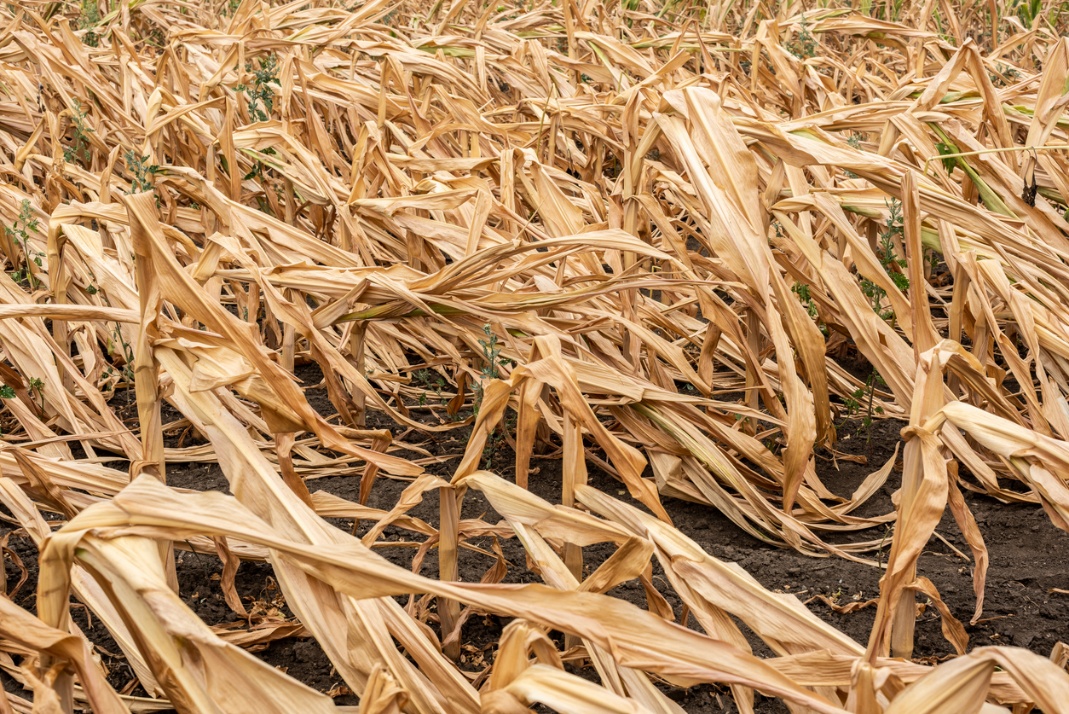
Elsewhere, South American wheat production remains under pressure. Although rain is forecast for Argentina, prolonged dryness and frost have already damaged yield potential and could reduce export availability.
Not all developments have been negative. The US Corn Belt received cooler temperatures and rainfall during September, supporting soil moisture ahead of winter wheat planting, while harvest activity begun under generally favourable conditions.
As weather risks emerge across multiple major exporters, El Niño is adding to concerns over global grain availability, food security and price volatility at a time when markets are already facing disruption from conflict and energy shortages.