Insight Focus
The Philippines consumes more sugar than it produces. With production constrained by low and variable cane yields, the country has increasingly relied on imports to meet consumption.
The Philippines Has Become a Sugar Deficit Market
The Philippines produces around 2m tonnes of sugar each year. Production has generally remained below consumption since 2016/17, with the gap widening as consumption has grown and domestic output has struggled to recover to its previous highs.
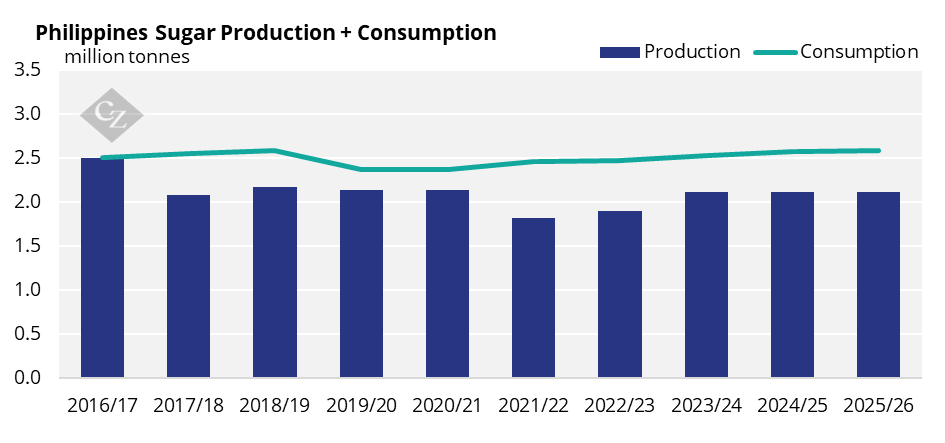
Sugar production fell from 2.5m tonnes in 2016/17 to 1.8m tonnes in 2021/22 and has struggled to recover since. Many farms are small, with limited access to irrigation and machinery. Poor weather has also affected the crop, while more recent production has been hit by flooding, dry conditions and pest damage in Negros.
The Philippines once produced enough sugar to meet most of its own needs and export small surpluses in stronger years. It now regularly relies on imports, mainly from Thailand, to make up the shortfall.
Per-Capita Sugar Consumption Has Fallen
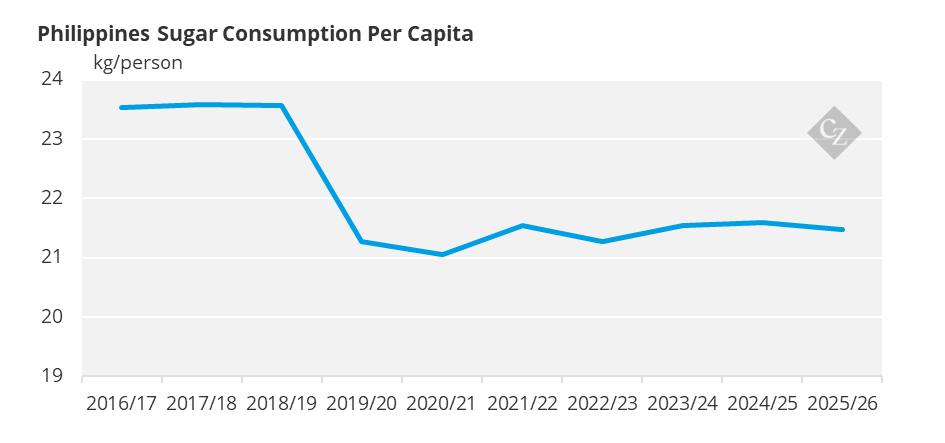
Per-capita sugar consumption began to fall after the sweetened-beverage tax was introduced in 2018, dropping from around 23.6kg in 2018/19 to 21.3kg in 2019/20. The tax appears to have contributed to the initial decline by raising the price of drinks containing added sugar. Covid then weakened demand further as restrictions affected businesses and out-of-home consumption. Per-capita consumption has since remained close to 21.5kg.
Total sugar consumption has recovered as the economy reopened, reaching almost 2.6m tonnes in 2025/26, slightly above its pre-Covid level. However, the population has continued to grow, meaning consumption per person remains below its earlier level.
The Philippines’ Key Cane Regions
Sugarcane is grown across several regions of the Philippines, but cane production is heavily concentrated in the central and western parts of the country. These areas benefit from suitable soils, regular rainfall and less exposure to typhoons than some other growing regions.
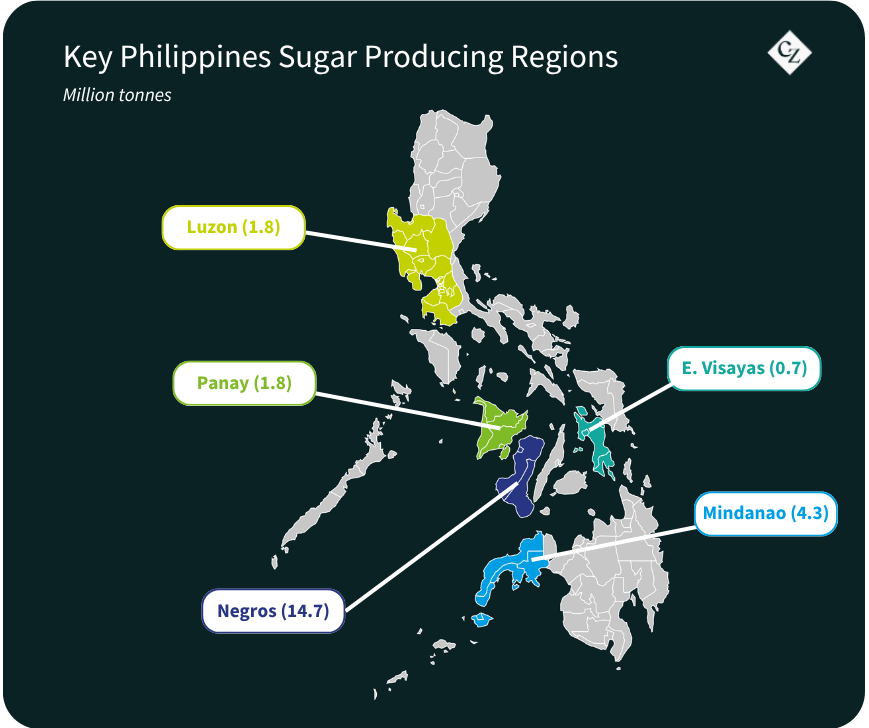
Negros produces around two-thirds of the Philippines’ sugarcane. This leaves national sugar production heavily exposed to changes in weather, pests and growing conditions on the island.
Low Cane Yields Restrict Sugar Production
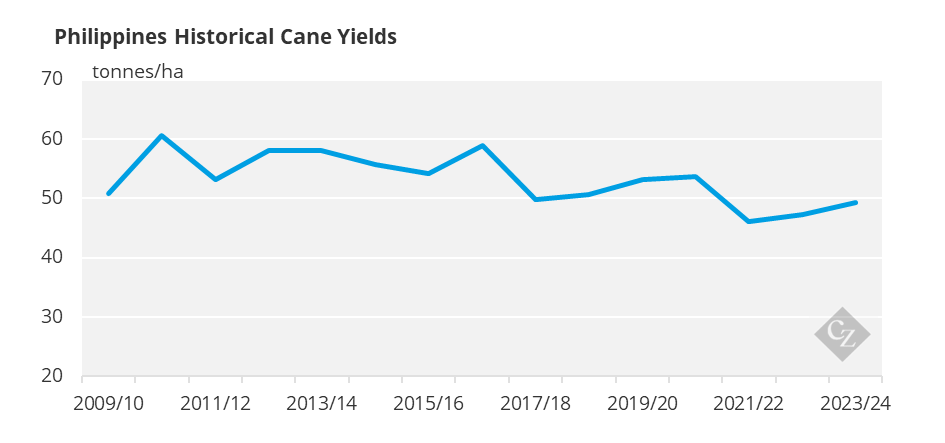
Cane yields in the Philippines have fallen from around 59 tonnes per hectare in 2016/17 to 49 tonnes per hectare in 2023/24. This is low compared with other major producers. In 2024, average yields were around 55 tonnes per hectare in Thailand, 76 tonnes in Brazil, 79 tonnes in India and 88 tonnes in Australia.
Many Philippine cane farms are small, making it harder to invest in irrigation and use machinery efficiently. Water shortages, irregular rainfall and poor soil conditions also hold back yields. The industry is trying to address this through irrigation, better cane varieties and block farming, which allows neighbouring farms to share machinery and buy inputs together.
How Are Cane Farmers Paid?
Farmers do not normally receive a simple cash price for the cane delivered to a mill. Instead, the resulting sugar is divided between the farmer and the mill under a production-sharing arrangement.
Once the cane has been processed, farmers receive a warehouse certificate known as a quedan. This gives the farmer ownership of an agreed share of the resulting sugar, rather than a direct cash payment for the cane. The split is agreed between the farmer and the mill and is commonly around 65% for the farmer and 35% for the mill. Where no agreement exists, the farmer is legally entitled to at least 60% of the sugar produced.
Sugar Is Divided Between Four Categories
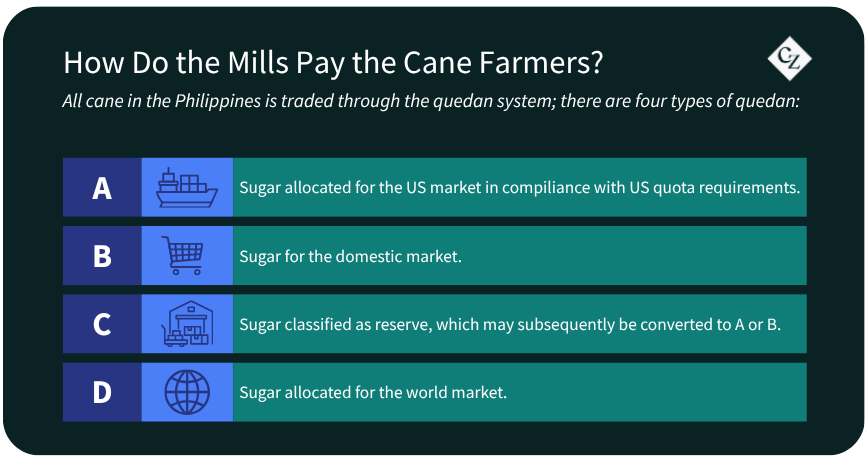
Once sugar has been produced and stored, farmers and mills can sell their quedans to traders. These traders combine the certificates into larger volumes and sell the sugar to wholesalers, refiners, food and drink manufacturers or export customers.
The Philippines receives preferential access to the US market through an annual raw sugar quota. Its allocation for 2026 was around 145,000 tonnes, but the quota is not always filled. The country did not export against it in 2021/22 or 2022/23 because domestic production was too low. Exports resumed in 2025/26, when almost 100,000 tonnes were shipped to support local prices following a stronger crop.
Domestic supply remains the priority. When sugar is tight, the Sugar Regulatory Administration can classify all production as “B” sugar for sale within the Philippines. It has done this for 2026/27, meaning the country will not fill its US quota this season.
Domestic raw sugar generally traded at around PHP2,200-2,400 per 50kg bag at the mill during 2025/26, although prices change through the season. The government uses import, export and quedan allocations to manage local availability and prevent prices from moving too sharply in either direction.
Sugar Imports Have Become More Frequent
The Philippines historically produced enough sugar to meet most of its own needs, meaning imports were generally small and irregular. This has changed as domestic production has struggled to keep pace with consumption. Imports have become more frequent since the mid-2010s, rising above 500,000 tonnes in 2018/19 and reaching almost 800,000 tonnes in 2022/23.
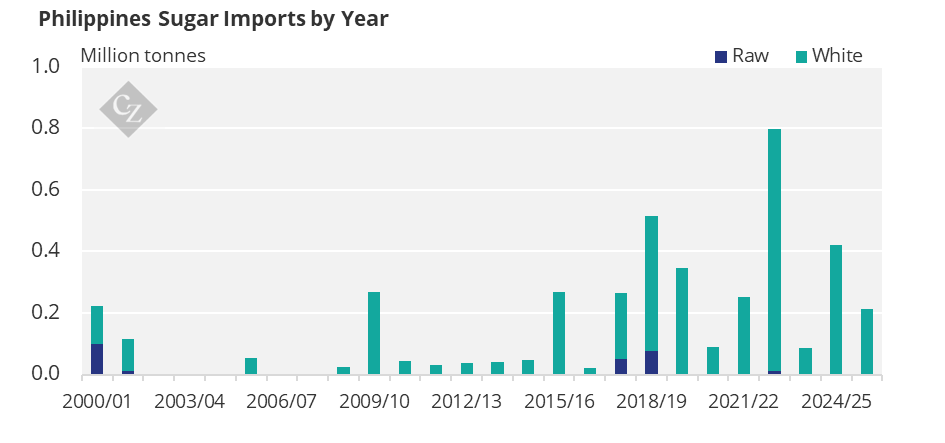
Most imports are white sugar, which can be sold directly to consumers or used by food and drink manufacturers without first being refined. Thailand is the Philippines’ main overseas supplier, reflecting its position as a major regional exporter and the preferential trade arrangements between ASEAN members.
Imports are controlled by the Sugar Regulatory Administration rather than left entirely to the market. The regulator decides when additional sugar is needed and how much can enter the country, while also trying to avoid depressing prices received by local farmers. This means import volumes can change sharply between seasons.
Imports fell back after the large programme in 2022/23 but have remained an important source of supply. Imports are forecast at around 320,000 tonnes in 2026/27, almost entirely as white sugar. Weaker domestic production and continued demand from food and drink manufacturers are expected to increase the country’s import requirement.
Sugar Exports Depend on Domestic Availability
The Philippines mainly exports raw sugar to the US under an annual tariff-rate quota. The quota gives Philippine sugar preferential access to the US market, but the country only exports when there is enough sugar left after domestic consumption has been met.
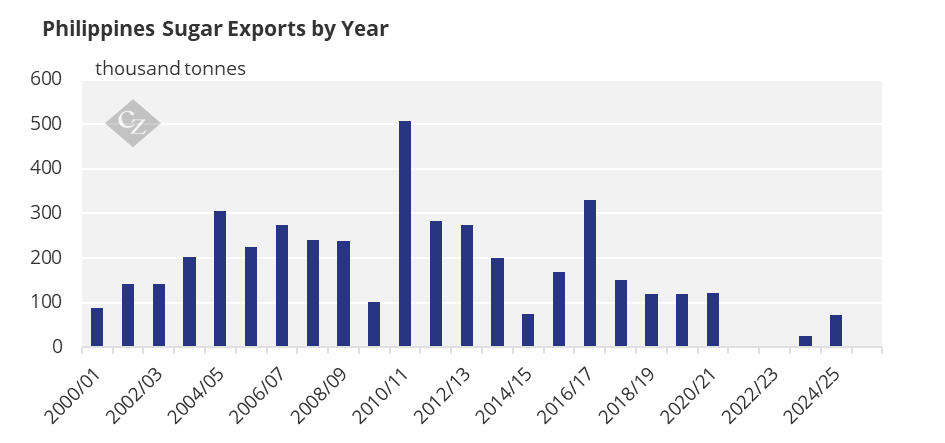
Exports have varied sharply from year to year. They reached a peak of just over 500,000 tonnes in 2010/11 but generally declined over the following decade as domestic consumption increased and production struggled to keep pace.
Exports then fell to very low levels, reaching just 3,000 tonnes in 2021/22 and 2,000 tonnes in 2022/23. They recovered to 26,000 tonnes in 2023/24 and 72,000 tonnes in 2024/25, before falling back to zero in 2025/26 as sugar was kept within the domestic market.
Under the quedan system, sugar classified as “A” is allocated to the US market, while “B” sugar is reserved for domestic consumption. These allocations can be changed during the season, allowing the government to reduce or stop exports when domestic supplies are tight.