Insight Focus
Brazilian cane mills are underhedged for sugar next season. This means it’s possible they make less sugar and more ethanol. We’ve reduced our CS Brazil sugar output projection by 700k tonnes… but it all depends on sugar and ethanol prices…
The Lowest Sugar Prices in 5 years
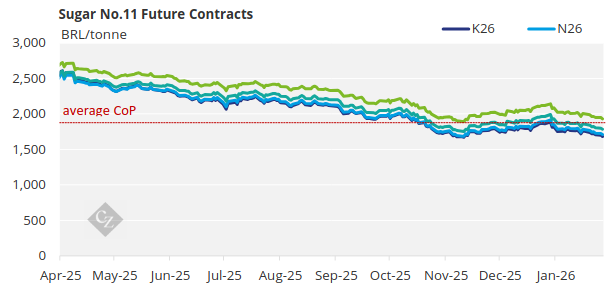
Brazilian millers are in for a rough season, which starts this April. Sugar returns in BRL/tonne are the lowest in 5 years, under BRL 1700/tonne.
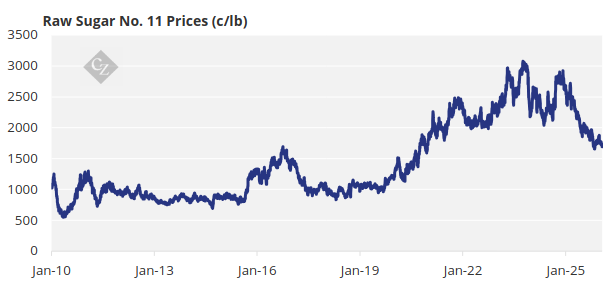
Sugar prices are now below average Centre-South (CS) cost of production, estimated at 16.3c/lb. But this is for spot prices; surely millers have taken advantage of the futures curve and priced next season?
Underhedged
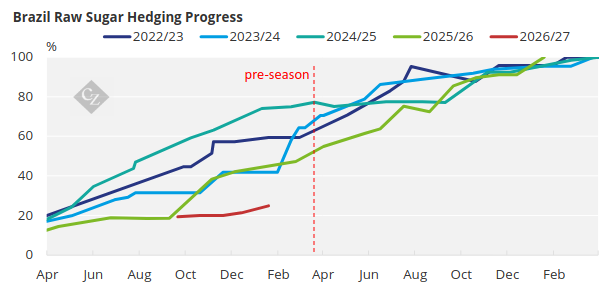
Prices have been falling for some time, but producers have not reacted. 2026/27 season is barely hedged, just over 20% is locked in, and producers are not committing more sugar than this season. We have barely seen pricing for the past 2 months – mills are not eager to price below the cost of production.
We no longer can assume maximum sugar production from CS Brazil. We are back in the same environment as before 2023, when maximum sugar was not a sure bet and production decisions were much more dynamic.
At this point, we believe any estimate of the sugar mix will surely be wrong. However, prices are giving a clear indication that CS Brazil needs to reduce its sugar mix. We have therefore reduced our sugar mix projection from 50.5% to 48.3%.
At the same time, we have increased our cane crush forecast from 610 million tonnes to 621 million tonnes due to good rains overall in the region. Still, the increase in cane is not enough to offset the reduction in the sugar mix. Our sugar output projection is now 40.0 million tonnes – down 700 thousand tonnes from the previous estimate.

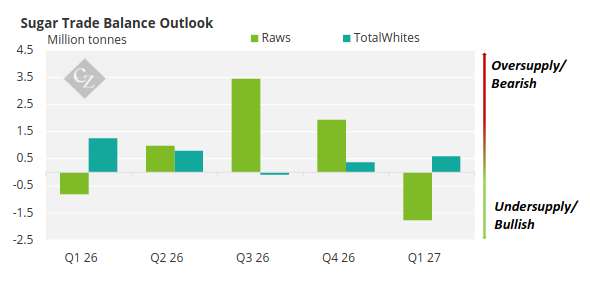
Still, this reduction is not enough to eliminate the global production surplus, nor the Trade Flow surplus as well – 700 thousand tonnes mean just 490 thousand tonnes less of raw availability.
Seeking Ethanol Parity?
Unlike these past 3 years of a bullish sugar market, now we need to pay attention to ethanol prices in Brazil. They could act as a floor for sugar prices. The problem is that the ethanol outlook is not looking very good for 2026. Why? It’s an election year, weak global demand is impacting oil prices, corn ethanol output is growing …
Just this week the weakness in the oil market spilled to domestic gasoline prices in Brazil. Petrobras reduced gasoline prices by 5.2% to BRL 2.57/litre, it is the lowest since mid-2023.
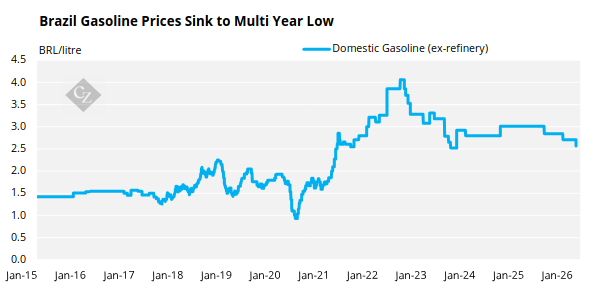
If we were to consider ethanol and gasoline parity at 65%, the recent gasoline price reduction would put hydrous ex-works prices at BRL 2.43/litre – 15.14 c/lb, No11 basis.
However, this could be the first of many gasoline price reduction – remember, 2026 is election year in Brazil and historically from June onwards we expect to see more pressure on fuel prices, independent of international market.
There is also additional supply from corn ethanol, that should grow at least 15% this year – an additional 1.3 billion litres. This combined with more cane ethanol due to the sugar mix reduction adds in total over 3 billion litres of ethanol to CS balance. However, assuming that the Otto Cycle (fuel demand, gasoline and ethanol) would grow the same as this season (3%) and hydrous share at 27.5%, demand would only grow by 1.4 billion litres.
Therefore, considering all these factors we see the ethanol market pressured, with little upside for prices.