Insight Focus
E15 remains cheaper than E10 while ethanol fundamentals stay strong. California has approved legislation aimed at expanding E15 availability, potentially increasing ethanol demand in one of the largest fuel markets in the US. Meanwhile, the USDA has raised its ethanol export forecasts for 2026 and 2027, reflecting strong international demand and expectations for record export values.
E15 Discounts Persist as Ethanol Stocks Reach Multi-Month Highs
A recent report published by the Department of Energy (DOE) found that E15 has recently been selling for an average of USD 0.47/gallon less than standard E10 gasoline, representing an 11.5% discount.
The DOE report, which is based on actual pricing data collected from the marketplace, also showed that E15 costs 8% less at the pump on an energy basis, meaning drivers choosing E15 pay less per mile travelled than drivers using E10.

“While a handful of stubborn oil refining companies continue to suggest that the Renewable Fuel Standard (RFS) somehow leads to higher prices at the pump, this new data from DOE proves that the exact opposite is true,” said Renewable Fuels Association (RFA) President and CEO Geoff Cooper. “After the Trump administration finalised the highest-ever RFS volumes back in March, the marketplace responded by expanding the supply of lower-cost E15.”
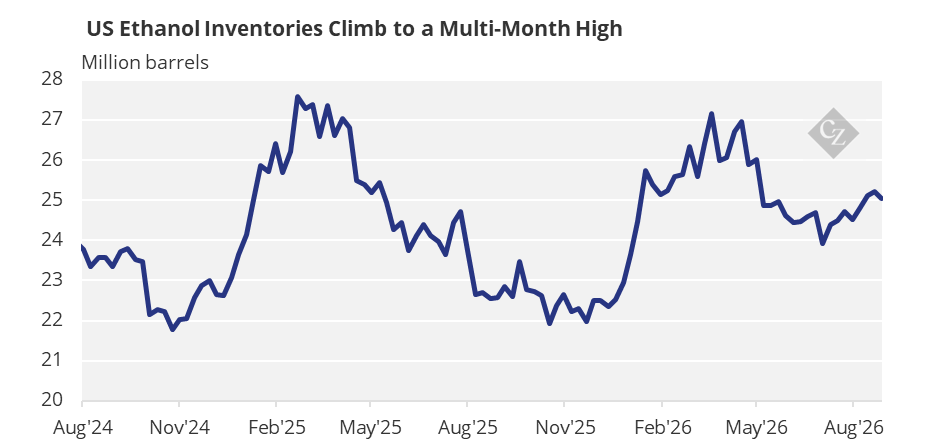
US ethanol stocks recently moved to a multi-month high. The US Energy Information Administration (EIA) said in late August that the domestic supply of 25.206 million barrels was the largest since early May, up 85,000 on the week and 2.657 million year-on-year, as increased production rates pushed domestic reserves higher.
Source: EIA
Ethanol production averaged 1.112 million barrels per day, rising 23,000 from the previous week and 42,000 from a year earlier, accounting for a significant share of domestic corn usage. The Iowa State University Center for Agricultural and Rural Development said the estimated operating margin for the average Iowa plant tightened slightly while remaining firmly in positive territory.
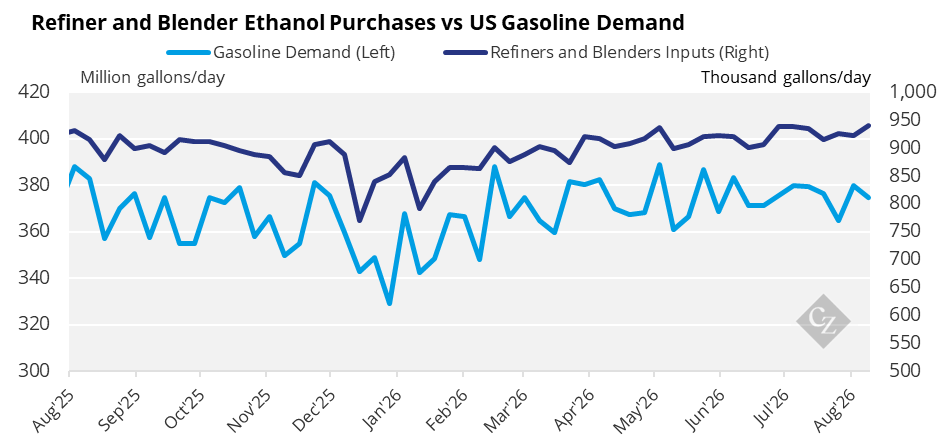
The RFA said net inputs of ethanol purchased by refiners and blenders strengthened in the latest reporting week, while gasoline demand remained near recent highs despite easing slightly from the previous week.
Source: RFA
California Clears a Key Regulatory Hurdle for E15
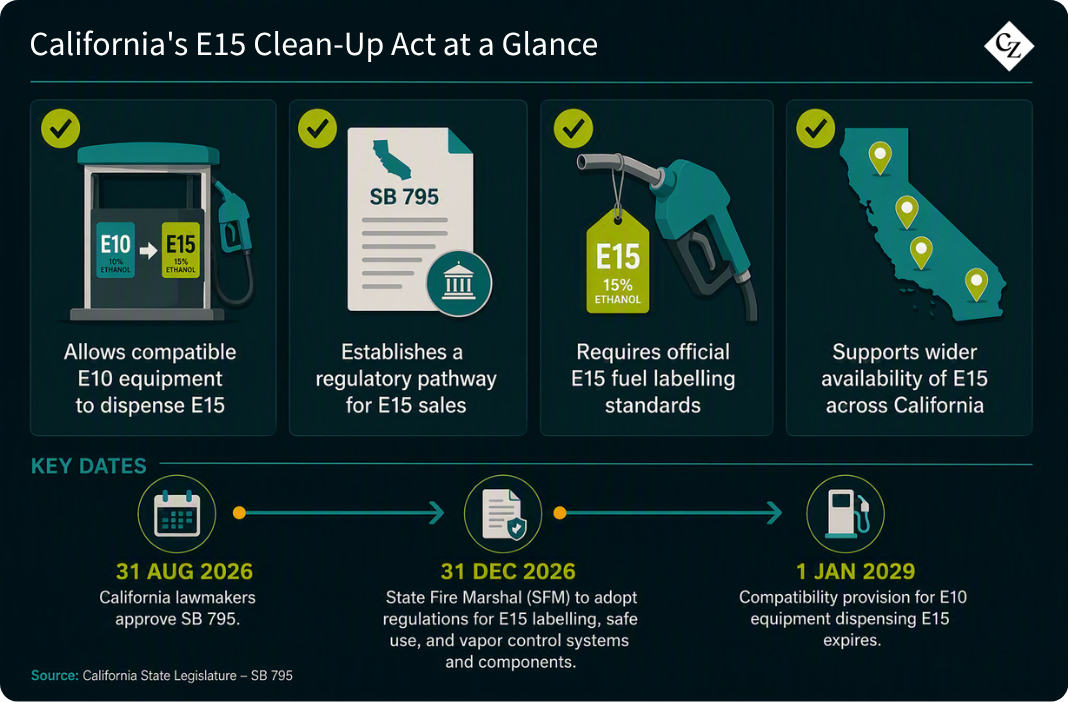
On August 31, California lawmakers approved the E15 Clean-Up Act, a bill directing the State Fire Marshal (SFM) to adopt regulations governing the labelling and safe use of E15 fuel blends, as well as vapor control systems and their components, by December 31. The legislation, SB 795, passed unanimously in both the California Senate and the California Assembly.
The bill also authorises vapor control systems and components currently dispensing E10 fuel to dispense E15 fuel, provided the manufacturer submits a statement of compatibility, until January 1, 2029. Fuel stations dispensing E15 must comply with labelling requirements established by the SFM.
“The passage of this bill means Californians will finally be able to enjoy savings at the pump with a lower-cost fuel blend that’s also better for the environment,” said RFA’s Cooper. “We thank principal authors Sens. Bob Archuletta and Suzette Martinez Valladares, and Assembly member David Alvarez, as well as the entire bipartisan California Problem Solvers Caucus, for their leadership and commitment to reducing gas prices for California families. We are also grateful to Gov. Gavin Newsom for his ongoing strong support of E15.”
Aemetis, a diversified renewable natural gas and biofuels company, praised the unanimous passage of California Senate Bill 795, which will allow the state’s fuel retailers to use existing vapor recovery equipment to dispense E15 based on manufacturer certifications. According to a UC Berkeley study, using a 15% ethanol blend would reduce the cost of blended gasoline to California consumers by USD 2.7 billion per year.
“As a leading California ethanol producer for the past 15 years, Aemetis has long advocated for the state to allow E15 in order to lower gasoline costs and provide consumers with greater choice,” said Eric McAfee, Chairman and CEO of Aemetis. “This regulatory fix is a major step toward opening California’s market to more American-made ethanol.”
USDA Projects Record Ethanol Export Values
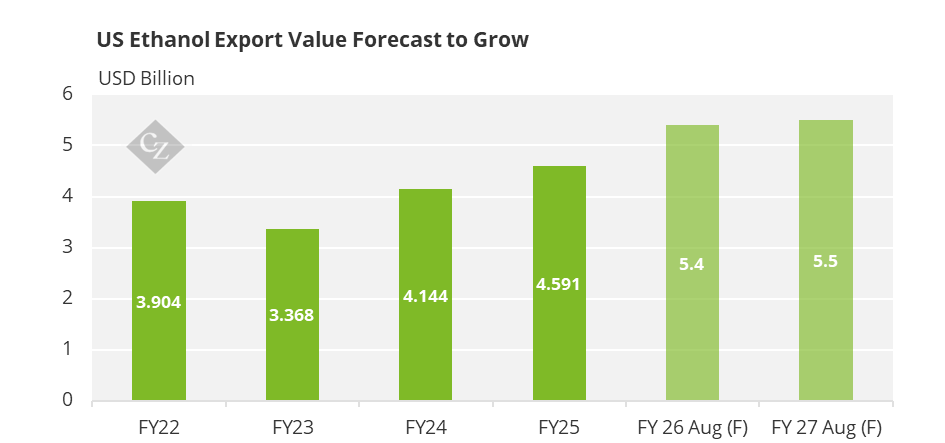
The USDA increased its forecast for fiscal year (FY) 2026 ethanol export values in its latest quarterly Outlook for US Agricultural Trade report, released on August 27. The agency also expects ethanol export values to continue growing in FY 2027. The USDA forecasts FY 2026 ethanol export values will reach USD 5.4 billion, up nearly 6% from the USD 5.1 billion forecast issued by the agency in its May quarterly outlook.
The value of FY 2027 exports is currently expected to increase to USD 5.5 billion, representing growth of approximately 2%. By comparison, the estimated value of FY 2025 ethanol exports reached USD 4.591 billion. The US federal fiscal year begins on October 1 and ends on September 30.
Source: USDA
For the first nine months of FY2026 (October 2025 to June 2026), the USDA estimates ethanol export values reached USD 4.07 billion, up more than 18% from USD 3.437 billion during the same period of FY2025.