Insight Focus
Ocean carriers are expanding and modernising their fleets rapidly. Major companies like COSCO, MSC, Evergreen, PIL and Hapag-Lloyd have placed large orders for LNG and dual-fuel vessels through 2029 to increase capacity and improve efficiency. These investments reflect fierce competition in global liner standings, with MSC leading, Evergreen climbing, and smaller players like Wan Hai aiming to move up the rankings.
Major ocean carriers continue to invest heavily in fleet expansion and modernisation, reflecting the growing demand for more efficient and sustainable shipping solutions. These investments are aimed not only at increasing transportation capacity, but also at enhancing operational efficiency, reducing emissions, and remaining competitive in a fiercely contested market.
Several top-tier container shipping companies were particularly active in the newbuilding market during the final weeks of 2025 and the first month of 2026, signalling that carriers are accelerating plans to upgrade fleets and secure future capacity amid rising global trade volumes.
Below is an overview of the most significant new vessel orders placed by major container carriers.
COSCO
In mid-January, COSCO Shipping Holdings placed orders for 18 container vessels at a total cost of approximately USD 2.7 billion, marking the Chinese shipping giant’s first move into LNG dual-fuel propulsion for large container ships.
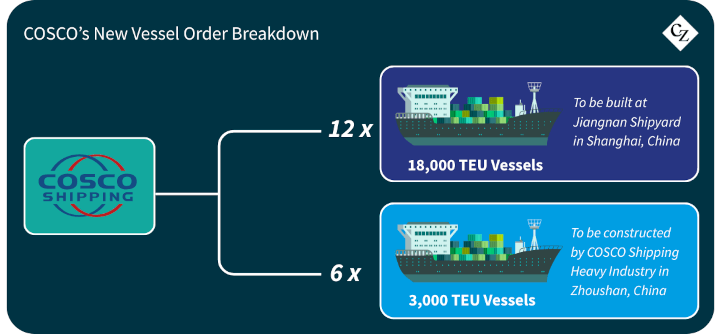
The larger, 18,000 TEU capacity vessels are scheduled for delivery between 2028 and 2029, while the smaller ships are expected to be delivered between June and December 2028.
MSC
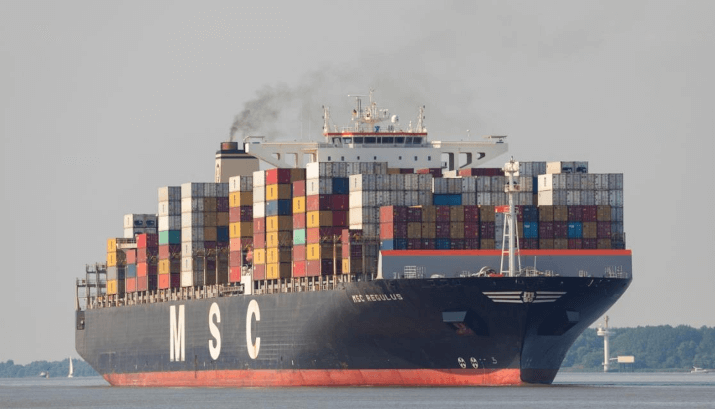
In January, MSC finalised an order for six 11,400 TEU container vessels from Zhoushan Changhong International Shipyard in China. The LNG dual-fuel newbuilds are scheduled for delivery in 2029, and the contract also includes options for four additional vessels.
Evergreen
In the same month, Evergreen signed contracts with two Chinese shipyards for 23 newbuilds with a combined capacity exceeding 90,000 TEUs. The order, worth up to USD 1.47 billion, includes:
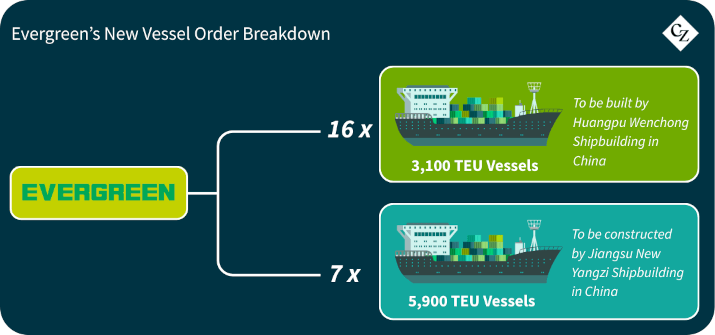
The delivery dates for Evergreen’s newbuild boxships are yet to be disclosed.
PIL
At the end of the first month of the year, Singapore-based Pacific International Lines (PIL) signed letters of intent with two shipyards for the construction of eight 13,000 TEU LNG dual-fuel container vessels.
If finalised, the orders will be evenly split between Hudong Zhonghua Shipbuilding in Shanghai and HD Hyundai Heavy Industries in Ulsan, South Korea, with each shipyard building four vessels.
Hapag-Lloyd
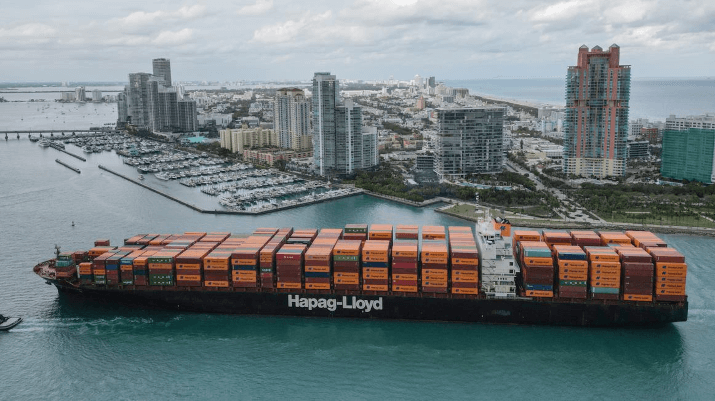
In mid-December 2025, German powerhouse Hapag-Lloyd announced the signing of a contract with Chinese shipyard CIMC Raffles for the construction of eight new 4,500 TEU container ships, which will be equipped with state-of-the-art dual-fuel methanol engines. The order, which surpassed USD 500 million, is expected to be delivered in 2028 and 2029.
Ups and Downs in the Global Liner Standings
These developments highlight continued investment by both major and smaller market players, pointing to a steady increase in vessel supply while also underscoring intense competition among container lines in terms of TEU capacity.
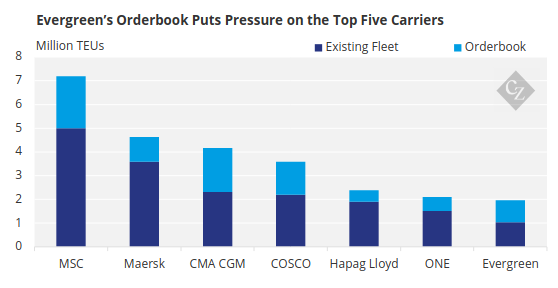
Based on the latest data, MSC remains by far the largest ocean carrier, followed by Maersk and CMA CGM, which is expected to move into second place once its current orderbook begins to be delivered. COSCO and Hapag-Lloyd round out the top five.
However, Hapag-Lloyd’s position could be challenged by Evergreen, which currently ranks seventh but is aggressively expanding its fleet. Supported by a strong orderbook, Evergreen is pushing to climb the global container shipping rankings and overtake both Ocean Network Express (ONE) and Hapag-Lloyd.
Source: Alphaliner
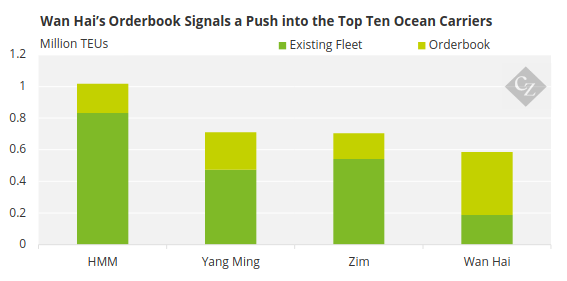
At the lower end of the top 10 liner operators, Wan Hai Lines is making a noteworthy push to break into the elite group. Its current orderbook could allow the carrier to surpass ZIM and potentially challenge Yang Ming’s position, while HMM’s ranking appears safe for now.
Source: Alphaliner