Insight Focus
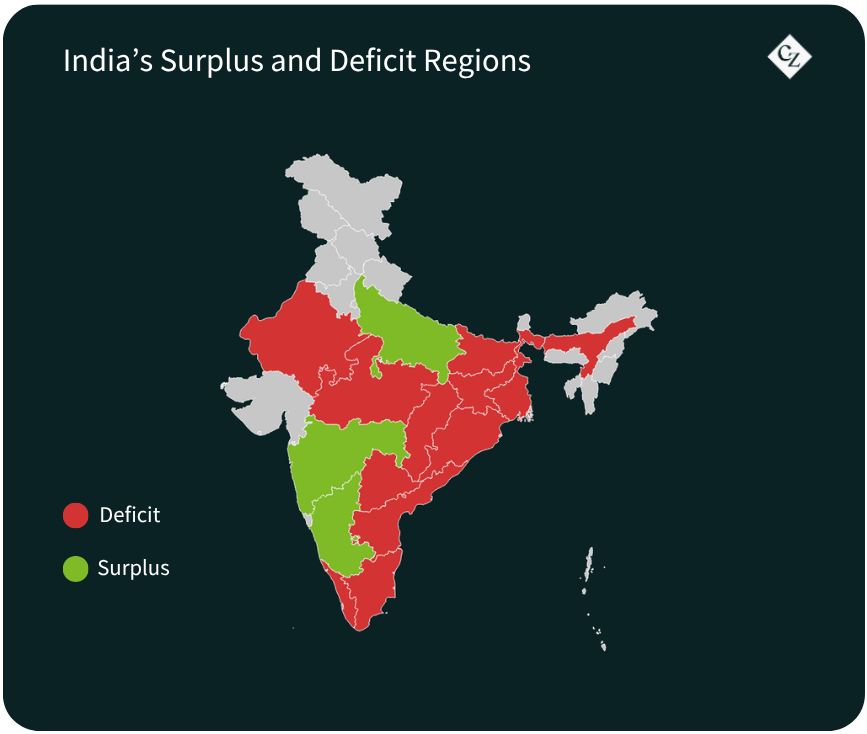
India is the world’s largest sugar consumer and second largest producer. The states of Uttar Pradesh, Maharashtra and Karnataka dominate production, but differences in climate, regulation and access to ports mean each region plays a distinct role in the industry.
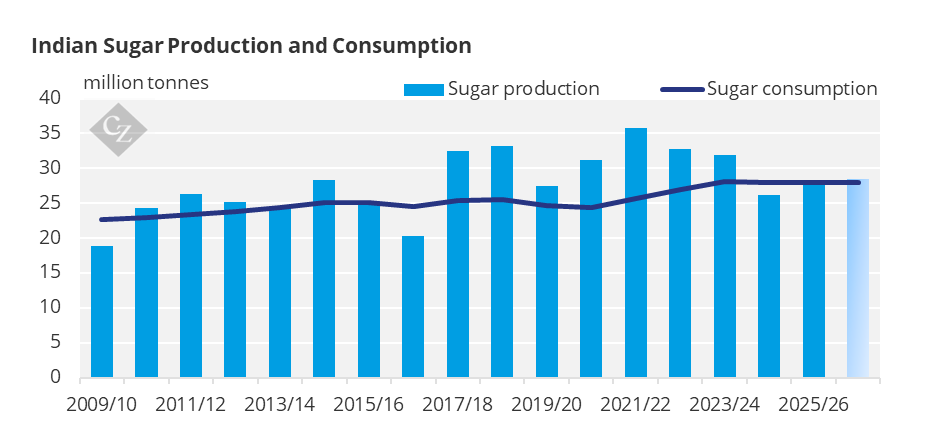
India is the world’s largest consumer of sugar and second largest producer. Production is usually close to consumption, but if it deviates too far it can lead to swings in India’s export availability or import requirements.
Sugar production is concentrated in three states: Uttar Pradesh in northern India and Maharashtra and Karnataka in the west and south. Together, they account for most of the country’s output, although differences in climate, regulation and access to ports mean each region plays a distinct role in the industry.
Not all sugarcane is processed into sugar. Some is retained as seed, fed to cattle, used to produce traditional sweeteners such as jaggery and khandsari or diverted into ethanol production. The amount of cane available to sugar mills can therefore change even when the overall cane crop remains relatively stable.
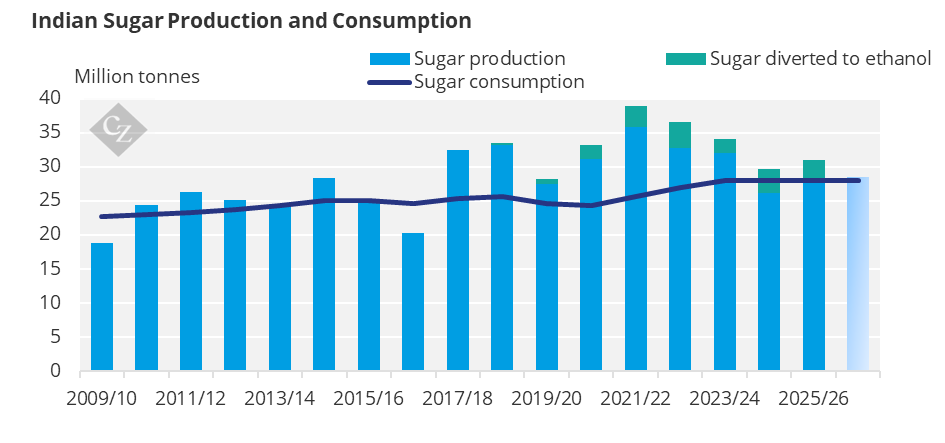
Indian sugar production can change significantly between seasons. This reflects changes in cane availability, weather conditions and the amount of cane diverted away from sugar production, including into ethanol.
Maharashtra
Maharashtra is one of India’s largest sugar-producing states. Since 2021/22, its cane area has averaged more than 1.4m hectares, but production can vary sharply from one season to the next because of changes in rainfall, water availability and the cane-growing cycle.
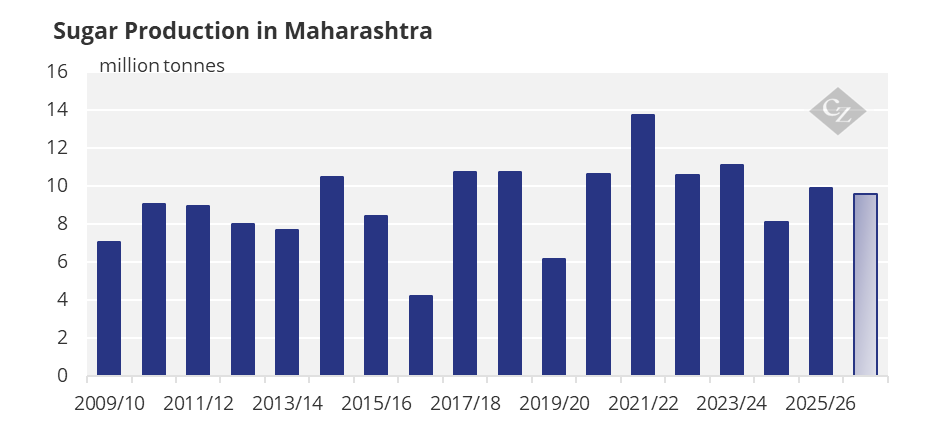
Cane is largely irrigated in Maharashtra, but rainfall levels can dictate how much water is available to farmers, who may then change their cane planting decisions based on whether there is sufficient water availability.
Sugar production fell from 11.1m tonnes in 2023/24 to 8.1m tonnes in 2024/25, before recovering to 9.9m tonnes in 2025/26. On rare occasions when water stress is acute, sugar production can fall below 6m tonnes.
Mills in Maharashtra tend to be smaller than those in northern India. However, many are located close to ports on India’s west coast. The state normally produces more sugar than it consumes, making it one of India’s main sources of exportable sugar.
Karnataka
Farmers in Karnataka typically plant more than 600k hectares of cane each year. Sugar output here is lower than Maharashtra’s and is similarly affected by rainfall, water availability and the cane-growing cycle.
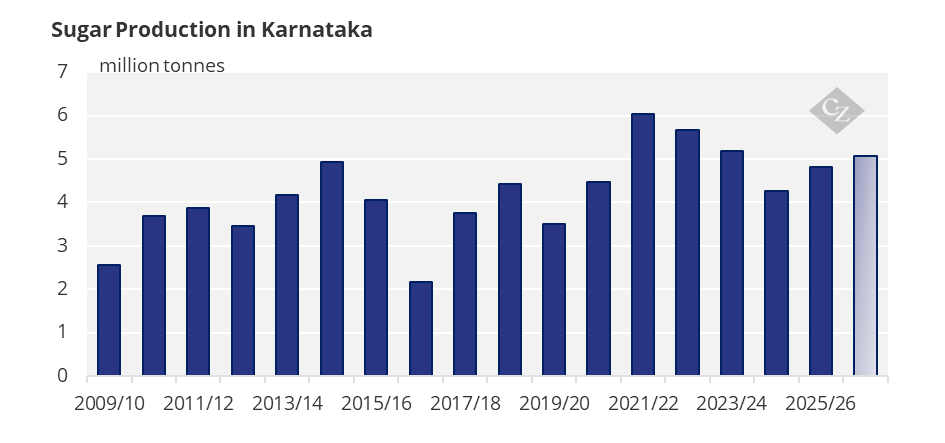
Production has been growing in the past 15 years, from around 3-4m tonnes a year to 4-5m tonnes per year.
Karnataka’s mills also tend to be smaller than those in northern India. Although fewer mills are located close to the west coast than in Maharashtra, Karnataka remains an important surplus-producing state and contributes to India’s export availability when production is strong.
Uttar Pradesh
Uttar Pradesh’s large cane area makes it one of India’s biggest sugar-producing states.
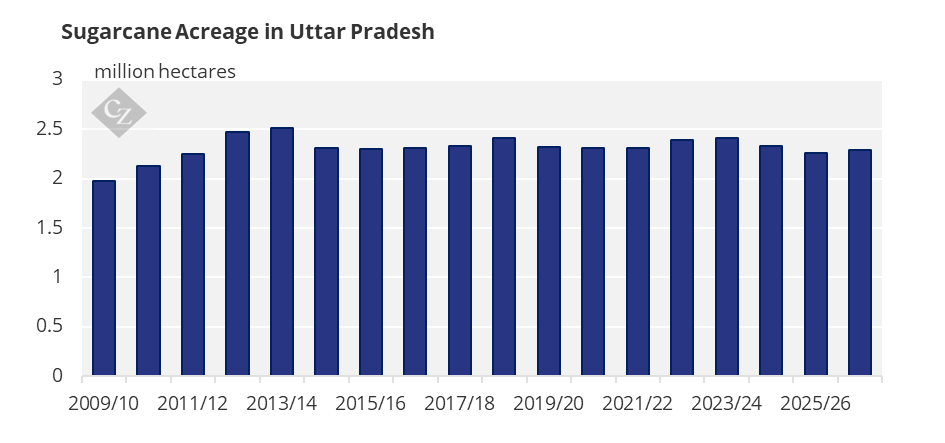
It has around 2.3 million hectares of cane, equivalent to close to half of the country’s total cane area.
The Indian sugar industry supports millions of farmers and other rural workers. Around a quarter of Indian cane farmers are located in Uttar Pradesh. Farms are generally small, while an individual mill can receive cane from tens of thousands of growers within its allocated area.
This structure makes it difficult to estimate the exact area planted with cane. It also makes cane pricing and farmer payments politically important.
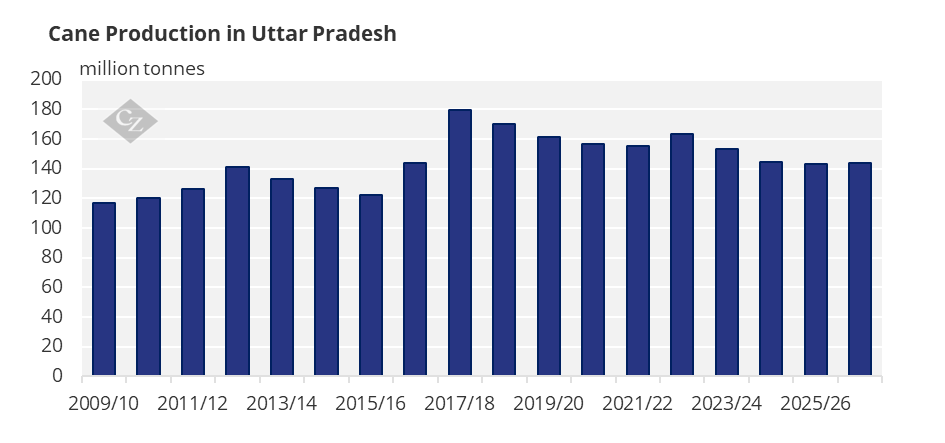
Uttar Pradesh’s cane production is more stable than production in Maharashtra and Karnataka. Water availability tends to be high owing to plentiful water courses flowing from the Himalayas into the Ganga basin. Irrigation is widespread, reducing the crop’s dependence on annual monsoon rainfall. The state’s alluvial soils also retain moisture well and are well suited to growing cane.
Sugar production rose substantially during the 2010s following the adoption of a higher-yielding cane variety, which increased both the weight of cane harvested per hectare and the amount of sugar recovered by mills.
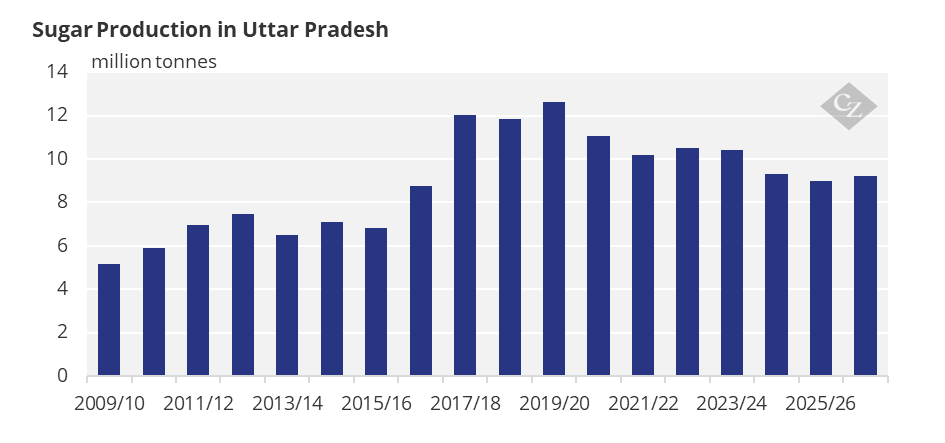
Output has since eased from its earlier highs, falling from 10.4 million tonnes in 2023/24 to 9.3m tonnes in 2024/25 and an estimated 9m tonnes in 2025/26. The high yielding cane variety introduced in the 2010s has gradually been phased out as its become susceptible to diseases.
Unlike Maharashtra and Karnataka, Uttar Pradesh is landlocked and more than 1,000km from major west coast ports. Its sugar is therefore more likely to supply domestic deficit regions, while exports are generally easier and less costly from Maharashtra and Karnataka. Nevertheless, raw sugar from UP mills was exported from Kandla and Mundra ports in 2021 to world market destinations.
Cane Prices Are Government-Regulated
The Indian government sets a Fair and Remunerative Price, or FRP, which acts as a minimum price for cane. The effective cane price paid in Maharashtra and Karnataka also reflects the sugar recovered from the cane.
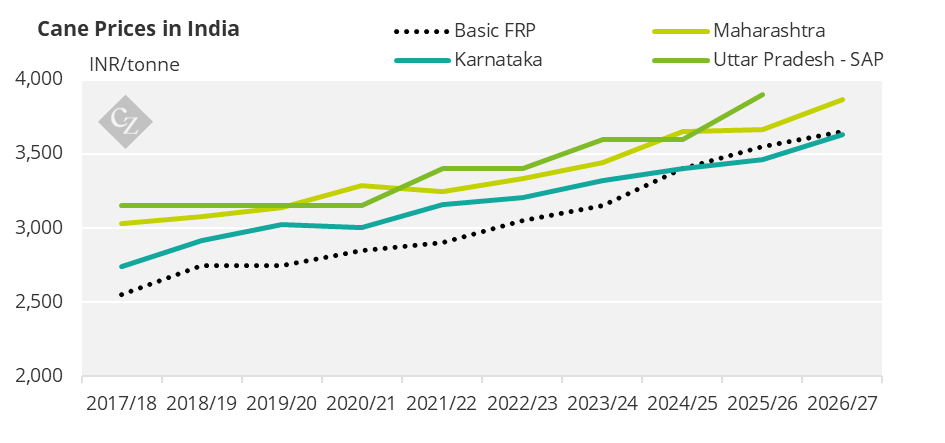
Uttar Pradesh operates differently. Its state government sets a State Advised Price, or SAP, which mills must pay to farmers. This has generally been higher than the national FRP.
These protected prices make cane attractive to farmers because they have an assured buyer in the local sugar mill, and a government-set price. However, when sugar prices are weak or production is high, mills can struggle to pay farmers on time. These delayed payments are known as cane arrears. If they become large enough, farmers can sometimes opt to plant other crops instead of sugar cane.
Other Sweetener Production
Sugar cane in India isn’t just processed at cane mills. Artisan producers also make jaggery (a traditional unrefined sweetener) from cane. Unlike sugar, jaggery is a cottage industry and is not subject to heavy government control. Jaggery producers pay a discount to the cane price paid by mills, but typically pay cash on receipt of cane.
Jaggery Production in Pictures
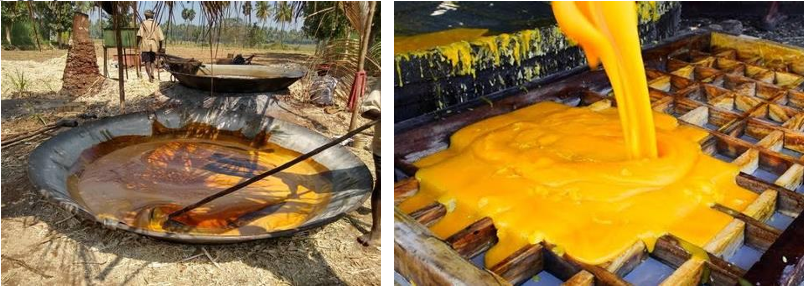
At times when mills are making slow cane payments to farmers, the faster payment offered by Jaggery manufacturers can be attractive. Typically, around 30-40% of UP’s cane is diverted away from cane mills, predominantly to produce jaggery
Sugar Consumption
Sugar mills are individually told how much sugar they need to sell into the domestic market each month by the Government. This sugar must be sold at a minimum ex-mill price of 31 INR/kg.
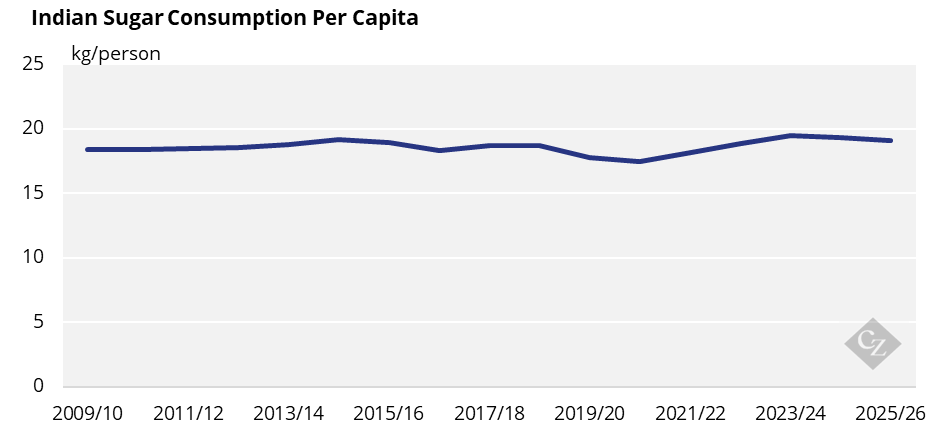
India consumes around 28-29 million tonnes of sugar each year, which is roughly 19kg per person per year. Per-capita consumption has remained relatively stable despite the country’s economic growth. This partly reflects India’s large rural population, the continued consumption of traditional sweeteners such as jaggery and the comparatively small share of the population in the urban middle class, where consumption of processed foods and drinks tends to be higher.
35% of the sugar consumed is tabletop and 65% is in processed products like confectionary, drinks and other foods. In general, processed food consumption is higher in more urbanised populations and, at 35%, urbanisation rates in India remain relatively low.
Virtually all tabletop consumption is of higher colour white sugar. Many processed foods require refined sugar, which only some of the mills are equipped to provide.
Traditional Indian sweets also play an indispensable role in Indian culture and customs, be they festivals, wedding ceremonies & other religious and social events. Some major festivals like Diwali are therefore lead to higher sugar sales when they occur.
Sugar Exports
India’s sugar exports vary significantly between seasons, depending on domestic production, consumption and government policy. Exports during the 2010s were generally modest and often required government support to be competitive on the world market.
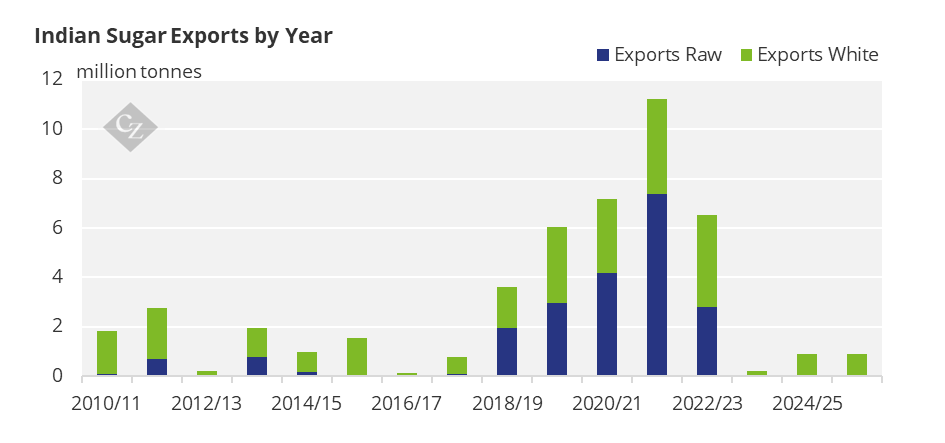
Exports increased sharply from 2018/19, reaching a record of more than 11m tonnes in 2021/22. Strong world sugar prices allowed Indian mills to export without subsidies, while several years of high domestic production created a large exportable surplus.
This surplus has since narrowed as sugar production has fallen and more sucrose has been diverted into ethanol. Exports dropped to around 6.5m tonnes in 2022/23 and almost stopped in 2023/24. They remained below 1m tonnes in both 2024/25 and 2025/26 as sugar production fell and the government prioritised domestic supply and ethanol production.
Sugar Imports
India normally produces enough sugar to meet domestic demand, so imports are relatively rare. However, when domestic production falls short, the country’s size means it can quickly become a major buyer and influence world sugar prices.
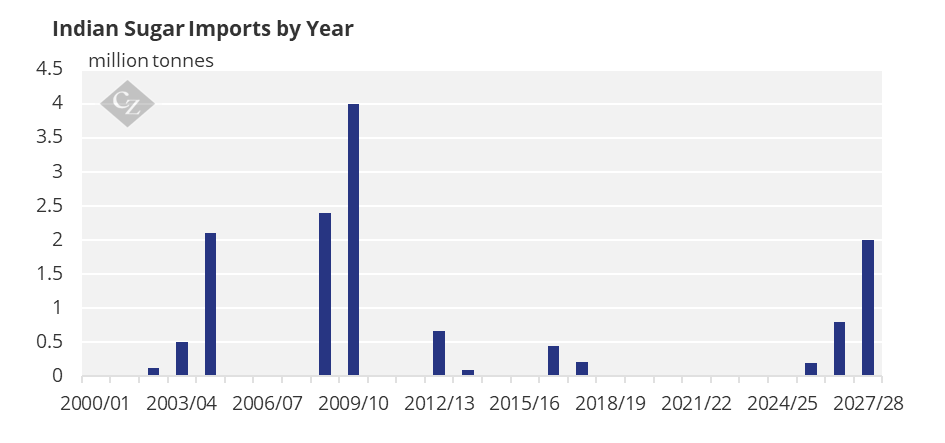
Imports were particularly high around 2008/09 and 2009/10, when Indian sugar production fell sharply. Reduced planting, and poor monsoon rainfall and high diversion to jaggery left domestic production well below consumption, forcing India to turn to the world market.
India subsequently returned to surplus and imported very little sugar for more than a decade. However, domestic stocks have tightened again following weaker production and continued sucrose diversion into ethanol. India therefore returned to the import market in 2025/26, with imports expected to increase further in 2026/27 and 2027/28.
The government generally prefers raw sugar imports because they can be processed by Indian refineries and cane mills. However, white sugar may be imported when additional supply is needed quickly because it can move directly into the domestic market. Whether imports are workable ultimately depends on the relationship between world sugar prices, freight, import duties and domestic prices.