Insight Focus
Cash trade remains quiet as US sugar harvest advances unevenly. US sugar beet and sugar cane crop ratings weakened across key producing states, while beet harvest reached 12% complete in the top four producing states. Growers delayed harvest in some areas to boost yields despite frost risks, as the corn sweetener market monitored proposed HFCS legislation.
This update is from Sosland Publishing’s Sweetener Report. For more information and subscription details, CLICK HERE.
Activity in the cash sugar market was limited this week, with sellers largely staying on the sidelines and most users already covered. Prices were unchanged but remained nominal.
US Sugar Crop Ratings Decline as Harvest Progress Remains Uneven
Crop condition ratings were mostly lower compared with a week earlier. In its weekly Crop Progress report, the USDA said good-to-excellent ratings for the US sugar beet crop as of September 20 were 88% in Minnesota (87% a week earlier, 83% a year earlier), 73% in North Dakota (82%, 84%), 83% in Idaho (85%, 93%), 72% in Colorado (82%, 57%), and 65% (all good) in Wyoming (65% all good, 81% all good).
The good-to-excellent rating for the Louisiana sugar cane crop tumbled to 53% as of September 20, down from 63% a week earlier and well below 80% a year earlier.
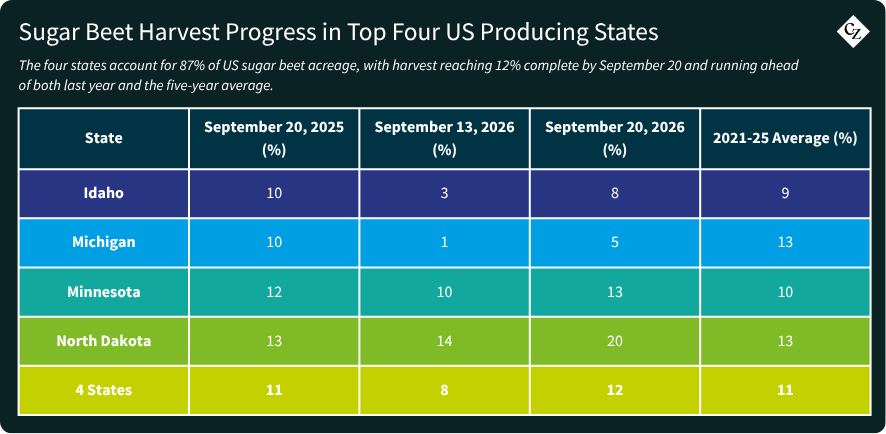
Harvest of the sugar beet crop continued to progress at an uneven pace. By September 20, the USDA said an aggregate 12% of the US crop in the four major reporting states (Idaho, Michigan, Minnesota, and North Dakota) had been lifted, up from 8% the prior week and ahead of both the 11% pace from a year earlier and the 2021-25 average for the week.
However, only Minnesota and North Dakota completion rates (13% and 20%, respectively) topped prior years’ levels. North Dakota’s harvest pace was almost double the five-year average of 13% for the week. Both Minnesota and North Dakota are part of the Red River Valley region, which accounts for approximately 50% of domestic sugar beet production.
Progress in the other two states was behind both the year-earlier and average pace. By September 20, harvest completion in Idaho was 8% (10% a year earlier, 9% as the five-year average) and 5% in Michigan (10%, 13%).
Harvest Delays Reflect Yield Focus Amid Frost Risk
For the other reporting states, the USDA said harvest in Wyoming had not yet begun as of September 20, which was well behind the 20% pace from a year earlier and the five-year average of 15% for the week. By the same date, about 7% of the sugar beet crop in Colorado had been lifted, ahead of the 3% pace from the previous year; five-year average harvest data was not available from the USDA.
Aside from the Red River Valley area, growers likely were delaying harvest to capture additional late-season moisture that might boost yields. With sugar beet acreage sharply reduced this growing season, processors were eager to maximise production, but they also ran the risk of exposing the crop to an early frost.
The domestic corn sweetener market was active, with negotiations for 2027 annual contracts underway.
The market watched for any Congressional action on the recently introduced Removing Excess Additives and Limiting Sugar Act, which calls for the Federal Food, Drug, and Cosmetic Act to classify any food containing high-fructose corn syrup as unlawful for interstate commerce.