Insight Focus
We have mixed feelings about Thailand’s 2025/26 cane season. While most regions are showing strong crop potential, the spread of White Cane Leaf Disease (WCLD) in the Upper Northeast is a growing concern.
White Cane Leaf Disease Spreads in Northeast
A large area of cane in the Upper Northeast of Thailand is showing symptoms of White Cane Leaf Disease (WCLD), which can be observed from cane leaves turning pale or white. The disease impacts plant health by stunting growth, suppressing tillering and reducing agricultural yield.

We have heard about this in past years, but it has become more concerning this year due to the widespread nature of the disease across the region. The large-scale spread across highland, sandy-soil areas—conditions ideal for WCLD—has made it one of the most pressing issues for cane farmers in the region.

Cane Area Grows Despite Neglect
Although some cane areas have been lost due to infected crops that farmers have already uprooted, we think cane areas will increase by 4.9% year-on-year. However, this figure excludes “neglected cane” fields—mostly ratoon cane—that have not been maintained due to farmer uncertainty and delayed government support payments. Farmers in these areas are clearly in a holding pattern, waiting to see how the disease develops before committing to further investment in weed control or fertilizer applications.

Interestingly, fields previously uprooted due to WCLD are not being converted to cassava as in past years. Instead, many farmers are leaving the fields fallow, signalling their intention to replant cane in the upcoming October planting window for the 2025/26 crop cycle.
Central, North, East Cane Crops Hold Strong
On the other hand, cane in the Central region is performing well, given the sufficient irrigation and water supply.

Notably, no signs of WCLD have been detected here, due to the region’s more clay-dominant soil composition and lower elevation.

We have heard that the North and the East are also optimistic, with cane fields developing as expected. The Lower Northeast, while showing some WCLD infections, is still expected to produce a relatively good crop this year.
Weather Supports Cautious Optimism
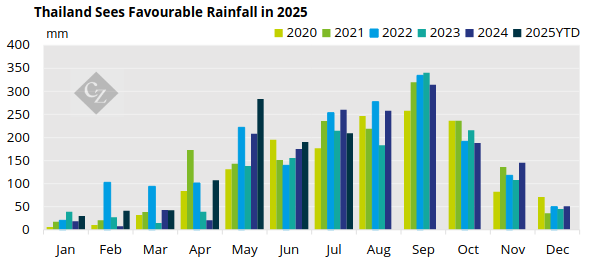
So far this year, rainfall has been favourable. Unlike the previous two seasons, Thailand has not experienced significant drought, helping ratoon cane recover well from last year’s stresses. However, it’s not all smooth sailing—excessive or poorly timed rainfall could still pose a threat. Prolonged waterlogging (more than two weeks) in low-lying areas, for example, could reduce yields if drainage isn’t properly managed.
Balancing Resilience and Risk This Season
The 2025/26 season is clouded by the unpredictability of contributing factors. While we expect good performance in the Central, East, and North, the WCLD outbreak in the Northeast is a reminder that disease management and timely support remain critical.
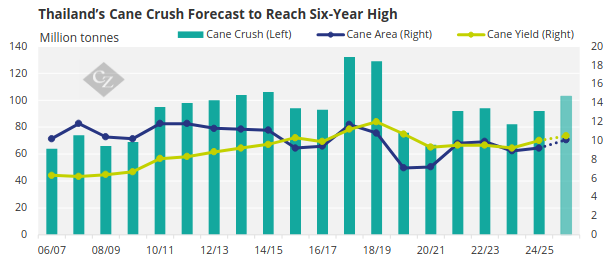
We think Thailand will crush 102.7 million tonnes next season, the highest in the past six years. However, we still need to see how rainfall patterns unfold and how severe the damage will be in the Northeast—these factors will shape the true trajectory of Thailand’s cane crop this year.
The planting season for 2026/27 is coming up in October. We are concerned about the risks—if WCLD is unmanaged, it could become a larger issue for the future.