
Insight Focus
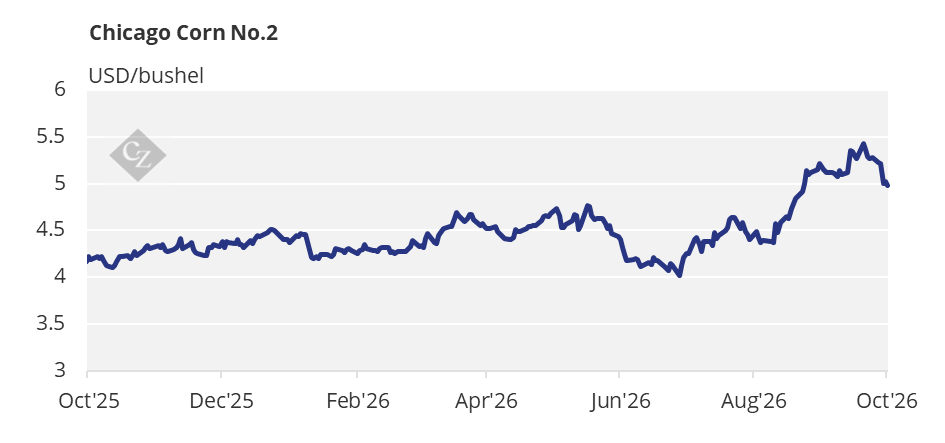
Corn falls on higher stocks, while Black Sea exports remain stalled. The focus this week is the October WASDE and whether we see further yield cuts, something we no longer expect. If yields remain unchanged, higher old crop stocks should leave the market more comfortable, making prices above USD 5/bushel difficult to justify and supporting lower new crop price forecasts.
Corn plummets on higher-than-expected old crop stocks. No progress in Black Sea export flows.
We have the October WASDE this Friday, where the USDA will publish the new carryout number for the old crop based on the stocks report released last week, which will imply lower demand, whether domestic or export. The question mark is whether they will reduce the yield of the new crop.
The September WASDE was widely expected to land somewhere between the 180.7 bushels/acre (bpa) yield from the August WASDE and the roughly 173 bpa from the Pro Farmer tour. The September WASDE came in the middle at 178.5 bpa, in what appeared to be a moderate approach. Now, with higher stocks, the USDA has more room to reduce yields without causing a price crisis.
However, rainfall has been decent, and we think the Pro Farmer yield estimate of roughly 173 bpa is too low, so we do not expect any major changes to the September WASDE yield estimate. What we could see are harvest delays, with recent rains slowing harvesting progress in many regions, which should be supportive.
The focus this week is the October WASDE and whether we will see a further reduction in yields, something we no longer expect. Once we have confirmation of no changes to the new crop, higher old crop stocks leave the market more comfortable, to the point where a market above USD 5/bushel is not justified, and we will reduce our new crop price forecast.
There are no changes to our estimate for the 2026/27 average price of corn in Chicago of USD 5.5/bushel with a downside bias to around USD 5/bushel. The average price since September 1 is running at USD 5.2/bushel.
Corn Drops on Higher-Than-Expected US Stocks
Corn in Chicago opened lower last Monday and plummeted on Wednesday following the publication of the quarterly stocks report, but it was still able to defend the USD 5/bushel level. Thursday and Friday not only saw consolidation of the losses but also further downside, although limited, with the market ultimately closing the week below USD 5/bushel.
European corn was also pulled lower by Chicago but suffered much smaller losses, below 1%, while Chicago fell more than 5% during the week.
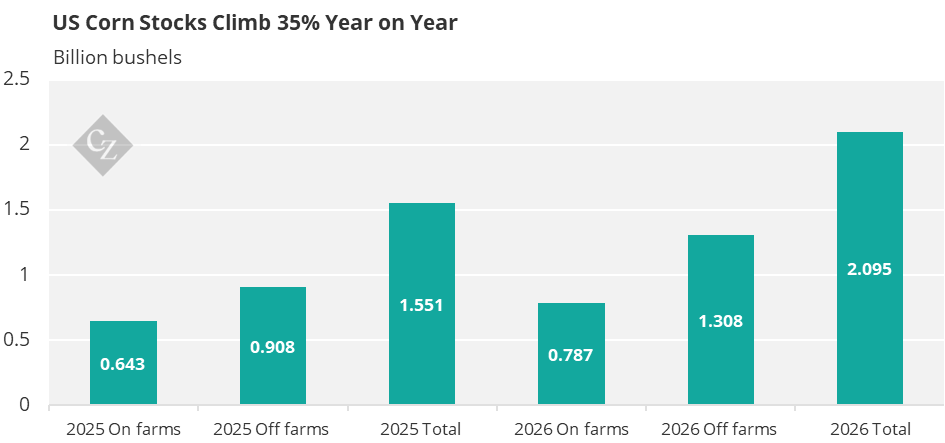
Last Wednesday, the USDA released its quarterly stocks report, showing stocks as of September 1, which represent the carryout of the old crop. Corn stocks came in at 2.1 billion bushels versus 1.92 billion bushels expected and 1.55 billion bushels last year. This was up 35% year on year. This means the October WASDE will show this stock number instead of the 1.92 billion bushels used in the September WASDE, and it will become the carry-in for the new crop, increasing 2026/27 carryout to 1.74 billion bushels versus the 1.57 billion bushels we had previously, assuming no other changes are made. This new level of ending stocks puts the new crop stocks-to-use ratio at 10.8% versus the 9.7% we had before.
Source: USDA
The September MARS bulletin reduced EU corn yields to 6.5 tonne/ha from 6.6 tonne/ha in its August report. This is down 9% year on year and 8% below the five-year average. This downward revision was not a surprise. The European Commission also projected EU corn production at 48.3 million tonnes, 3% lower than its August estimate.
US corn is 18% harvested versus 17% last year and the five-year average of 18%. Crop conditions are rated 57% good to excellent, unchanged week on week and versus 66% last year. French corn is 67% harvested versus 22% last year and the five-year average of 20%, while crop conditions are rated 22% good to excellent, down one point week on week and versus 62% last year. Corn harvesting in Ukraine is 3% complete. Safrinha corn harvesting in Brazil is 99.5% complete versus 99.6% last year and the five-year average of 99.7%, while summer corn planting has reached 29.1% versus 26.7% last year and the five-year average of 24.5%.
Russian Export Outlook Weakens as Black Sea Talks Stall
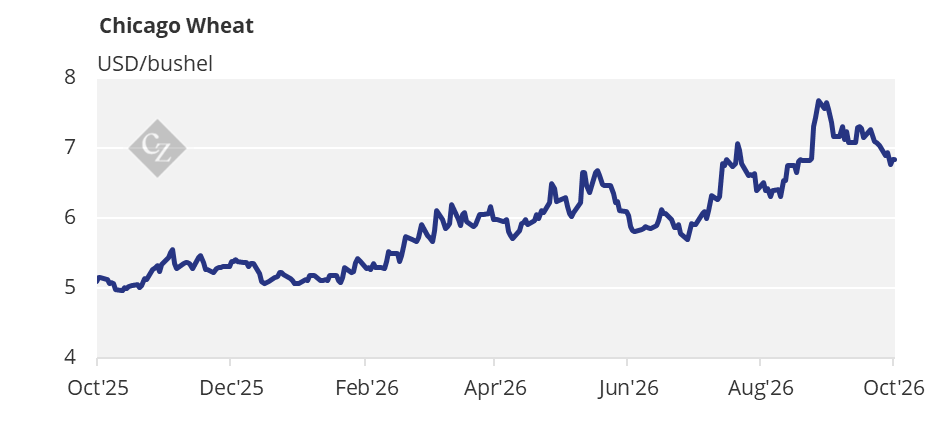
Wheat was also pulled lower by corn and, although Chicago wheat closed lower, Euronext posted only limited weekly losses as export flows out of the Black Sea continue without a solution.
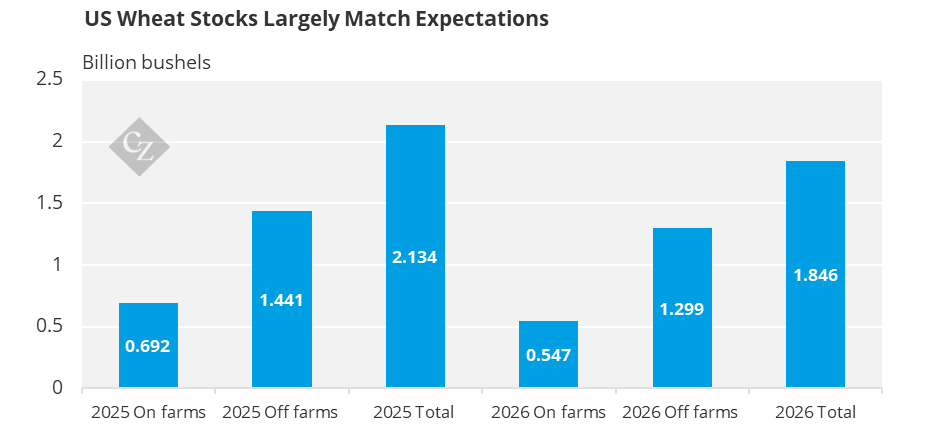
The USDA quarterly stocks report for wheat came in at 1.84 billion bushels versus 1.85 billion bushels expected and 2.1 billion bushels last year, making the report neutral for the market.
Source: USDA
Once the quarterly stocks report was out of the way, the focus turned back to Black Sea exports. Both Ukraine and Russia continued attacking each other and failed to agree on a grain export corridor, despite efforts by several nations to broker an agreement. In fact, SovEcon reduced its 2026/27 Russian wheat export forecast to 36.7 million tonnes, down 4.7 million tonnes year on year.
US spring wheat harvest is virtually complete. US winter wheat planting is 27% complete versus 32% last year and the five-year average of 34%. Winter wheat planting in Ukraine is 31.4% complete versus 30.1% last year.
On the weather front, the US is expected to see warm temperatures and some rainfall, although not as much as during the previous two weeks. Brazil is expected to remain rainy this week, as is Argentina. Rain is finally expected in France and the rest of northwestern Europe, while the Black Sea region is expected to remain mostly dry.