Insight Focus
Chicago grains fell while Euronext gained amid geopolitical pressures. Fundamentally, we don’t think lower prices are justified, particularly for corn, unless vessel navigation from Russia and Ukraine is restored and larger crops reach the market. Overall, we see more upside than downside risk for Chicago corn.
This update is from Nixal Commodities. For more information, CLICK HERE.
It was a negative week in Chicago but a positive one on Euronext, with currency movements and geopolitics having a greater influence than underlying fundamentals.
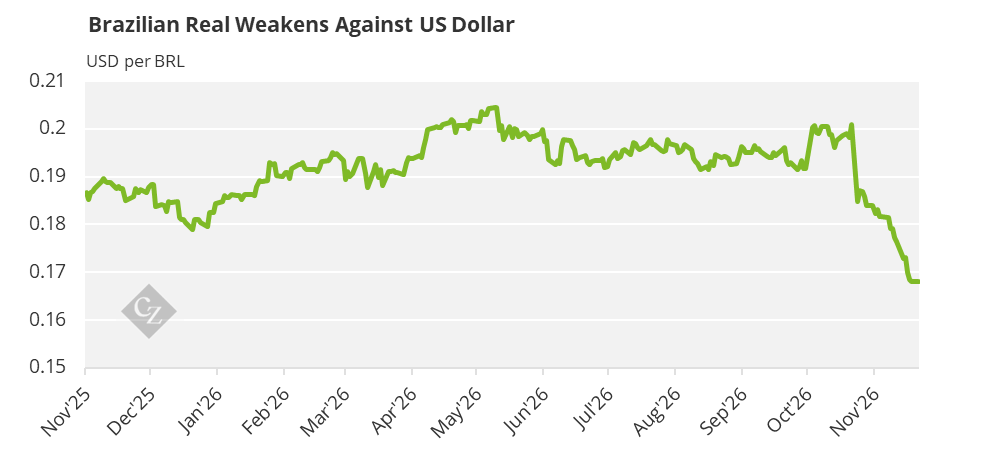
Sentiment last week was somewhat bearish on the back of the strength of the dollar, the weakness of the BRL making Brazilian exports more competitive, and the US-Russia-China discussions around a possible end to the war in Ukraine. This ultimately did not materialise, but it did impact market sentiment.
But fundamentally, we don’t think lower prices are justified, especially for corn. Only if vessel navigation out of Russia and Ukraine is restored, freeing up the large crops, would this provide a significant bearish element. We would expect more upside than downside risk for corn in Chicago.
There are no changes to our estimate for the 2026/27 price of corn in Chicago to average USD 4.75/bushel. The average price since September 1 is running at USD 4.8/bushel.
Geopolitics and Currency Pressure Chicago Corn Prices
Corn in Chicago traded sideways early last week, but sold off last Wednesday, dragged lower by wheat after Ukraine announced a plan to protect vessels in the Black Sea, but also due to the rally in the dollar. Thursday traded slightly positive, but Friday was a negative day again, with corn ultimately closing the week lower.
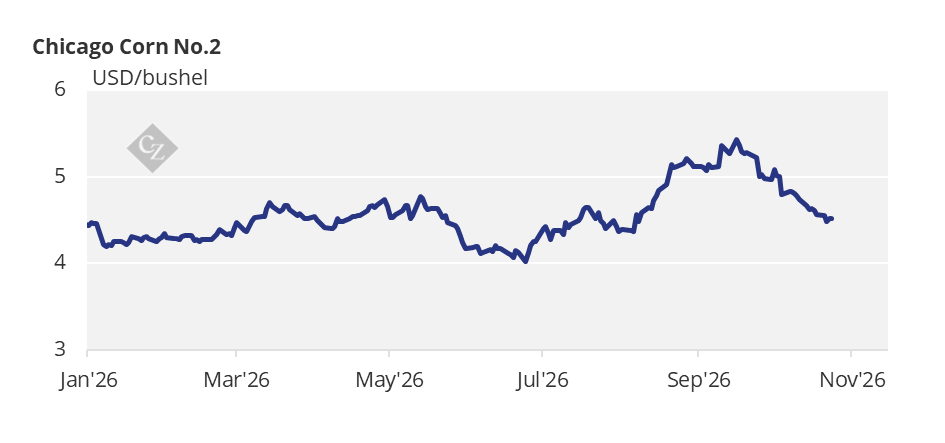
Ukraine announced a plan to protect vessels in the Black Sea, which triggered the sell-off in wheat last Wednesday and dragged corn lower. But on Thursday, Putin rejected any possibility of peace or a ceasefire in Ukraine, and the market rallied back, especially on Euronext, which also benefited from the weaker euro and posted a positive week for both corn and wheat.
It was a week more influenced by geopolitics and currency, with Trump meeting Russia and China to discuss the war in Ukraine and the trade relationship between the US and China. No progress was made on either front.
In Europe, the French Agriculture Ministry published its latest crop forecast and, with corn fully harvested, projected corn production at 7.3 million tonnes, down 47.5% from last year’s production of 13.9 million tonnes.
US corn is 88% harvested, slightly behind 90% last year and the five-year average of 92%, and condition is no longer reported. Corn harvesting in Ukraine is 56.2% complete, trailing Russia at 71.6%. Brazil’s summer corn crop planting reached 57.2%, ahead of 49.5% last year and the five-year average of 54.1%.
Chicago Wheat Falls Despite Black Sea Tensions
Despite the positive week for Euronext wheat, Chicago posted significant losses, despite fresh attacks on vessels in the Black Sea and Putin rejecting any possibility of peace in Ukraine.
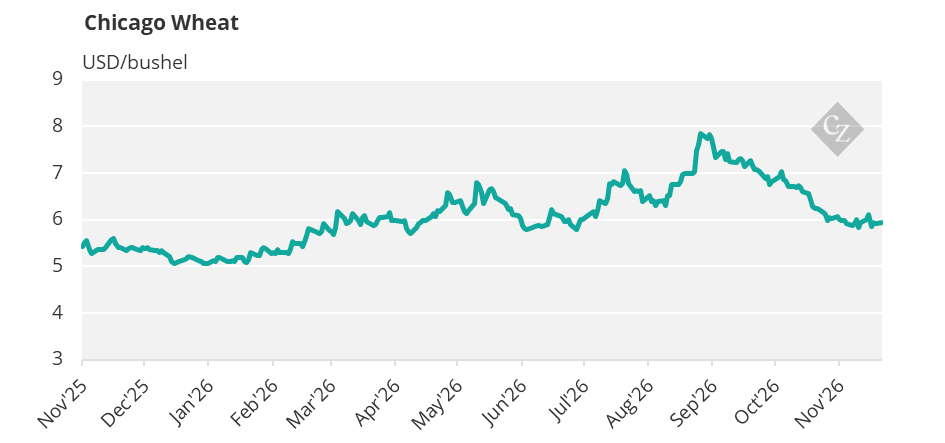
The French Agriculture Ministry published its estimate of wheat production at 31.5 million tonnes, down 5.7% year on year and 3.6% below the five-year average.
US winter wheat is 92% planted, slightly ahead of 91% last year but trailing the five-year average of 94%, while condition is 53% good or excellent, up four points week-on-week. Winter wheat planting in Ukraine is 91.7% complete, behind 97.7% last year. Winter wheat planting in France is 98% complete, ahead of 95% last year and well above the five-year average of 89%, while the condition is 94% good or excellent, down one point week-on-week and below 98% last year. Winter wheat planting in Russia is 92.7% complete. Wheat harvesting in Brazil is 88.8% complete, well ahead of 73.6% last year and above the five-year average of 83.5%.
Brazil is expected to be rainy again, with rainfall also forecast in Argentina. In the Northern Hemisphere, rain and cold weather are expected in northwestern Europe, as well as in the Black Sea region. US weather in the wheat and corn areas is expected to be dry with mild temperatures.