Insight Focus
Global container freight markets have been coming down. As post-peak demand softened, congestion eased, and effective capacity increased. The transpacific weakened most clearly, while Asia-Europe pricing remained firmer but faced growing downward pressure from returning Suez services and additional vessel capacity.
Transpacific Rates Begin to Soften
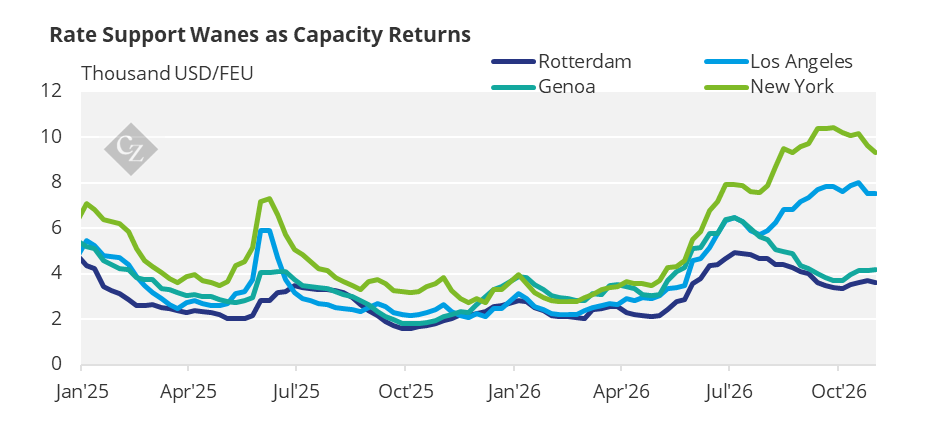
Global container freight rates eased into early November as the transpacific peak season lost momentum. Drewry’s World Container Index fell 3% to USD 4,429/FEU on October 29, followed by a further 1% decline to USD 4,389/FEU on November 5. Despite the recent correction, the index remained 124% above the previous year.
The largest reductions occurred on routes from Asia to the US. Shanghai to Los Angeles fell 6% in late October to USD 7,514/FEU, while Shanghai to New York declined 5% to USD 9,631/FEU. By November 5, the New York rate had fallen another 3% to USD 9,303/FEU, although Los Angeles held broadly stable at USD 7,539/FEU.
Source: Drewry
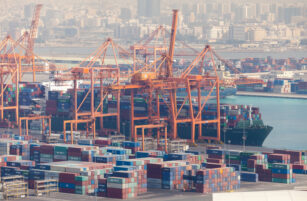
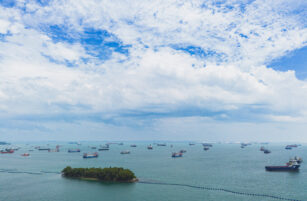
Demand eased following China’s Golden Week holiday, while weather-related congestion at major Chinese ports began to improve. Average vessel waiting times at Shanghai fell to approximately 35 hours in early November. Carriers also announced fewer blank sailings, increasing the effective capacity available to cargo owners and adding to downward pressure on spot rates.
Asia-Europe Pricing Remains Firmer
Asia-Europe rates proved more resilient than transpacific prices. Freightos reported that rates increased by approximately 10% to North Europe and 23% to the Mediterranean over the month to November 3. Prices reached about USD 3,595/FEU to North Europe and USD 4,375/FEU to the Mediterranean.
This strength partly reflected congestion at North European ports, lingering vessel backlogs in Asia, elevated fuel costs and a one-day port workers’ strike affecting several European locations. Carriers also sought to strengthen their position ahead of annual contract negotiations by announcing November rate increases of between USD 1,000 and USD 1,500 per container.
However, underlying momentum was beginning to weaken. On November 5, Drewry assessed Shanghai to Rotterdam at USD 3,615/FEU, down 2% week on week, while Shanghai to Genoa was unchanged at USD 4,166/FEU. Forwarders questioned whether demand was strong enough to support additional mid-November increases, particularly as more vessel capacity returned to the market.
Suez Return Releases Capacity
The gradual return of container services to the Suez Canal was one of the month’s most important supply-side developments. Container-ship transits through the canal exceeded 50% of pre-disruption levels in October, while weekly traffic reached its highest point of 2026 by the end of the month.
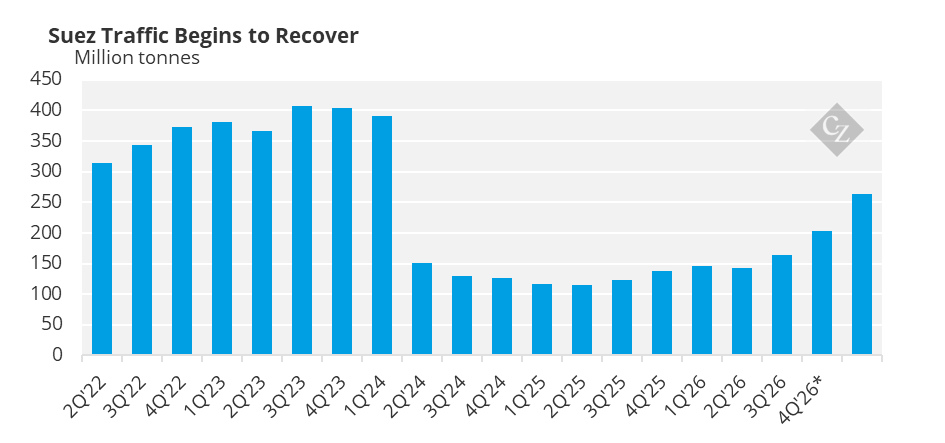
*based on October figures of 88 million tonnes – all vessels
Source: Suez Canal Authority
Evergreen resumed Suez transits in early November, while Yang Ming was expected to follow in December. Two further Asia-Mediterranean services were also preparing to return to the canal. Shorter voyages reduce round-trip times and release vessels and containers more quickly, effectively increasing capacity even without additional ships entering the fleet.
This created a softer outlook for Asia-Europe freight rates. However, the capacity benefit remained vulnerable to security conditions. Some Gulf-bound container traffic continued to be rerouted, while elevated bunker costs and the possibility of renewed attacks maintained a risk premium in both freight pricing and insurance.
Regional Differentials Remain Wide
The gap between major headhaul routes remained considerable. In early November, Asia to the US East Coast was trading near USD 9,900/FEU, according to Freightos, compared with approximately USD 8,300/FEU to the US West Coast, USD 4,375/FEU to the Mediterranean and USD 3,595/FEU to North Europe. Longer sailing distances, canal exposure, inland congestion and equipment imbalances all contributed to the differential.
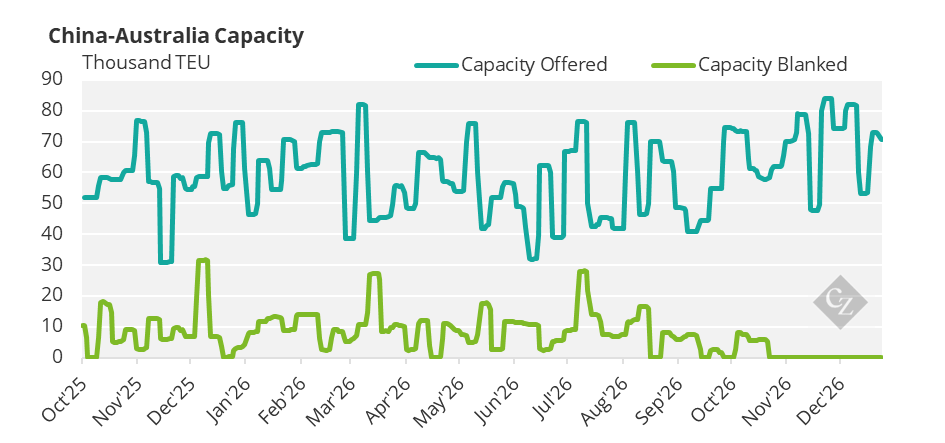
China to Australia prices followed the broader downward trend. The market rate fell 6% over four weeks to USD 2,676/TEU from November 1. Nevertheless, the rate remained 104% above the previous year. Carriers offered around 324,343 TEU of capacity across November, with 19,919 TEU, or 6.1%, removed through blank sailings.
Source: NaviaFreight
Equipment availability on the route improved from tight to broadly balanced as Chinese ports recovered from October congestion. However, space remained constrained on some departures, particularly during the early-November Australian and New Zealand peak-season period.
Arbitrage Opportunities Favour Flexible Shippers
The clearest procurement opportunity was on the transpacific, where easing demand and improving effective capacity created greater scope to renegotiate November spot bookings. Carrier attempts to implement increases of USD 2,000-3,000 per container had not appeared in early-November market data, suggesting that cargo owners could resist increases unless linked to guaranteed space or improved schedule reliability.
Asia-Europe shippers faced a more balanced decision. Congestion and contract-season positioning supported rates, but the return to Suez shortened voyages and increased available capacity. Buyers with flexible departure dates could avoid committing at announced November increases and compare spot offers with short-duration contracts.
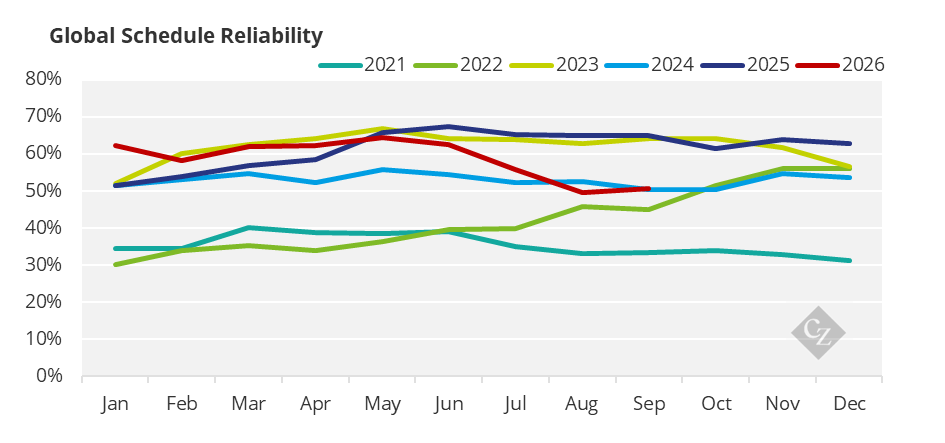
Backhaul rates remained substantially below headhaul prices, creating opportunities for exporters able to use repositioning capacity. Nevertheless, price alone was an incomplete guide. Global schedule reliability was only 50.6% in September, while delayed vessels arrived an average of 6.65 days late. Cargo owners therefore needed to assess delivered cost, transit time and reliability together rather than simply selecting the lowest quoted rate.
Source: Sea-Intelligence
Capacity Grows Faster Than Demand
The underlying balance was gradually shifting in favour of shippers. Post-peak demand was easing, port congestion was improving, blank sailings were declining on some routes, and more vessels were returning to shorter Suez routings. These developments increased effective capacity and limited the likelihood of sustained rate increases.
Risks nevertheless remained elevated. Fifty-six blank sailings were scheduled across the main east-west trades between November 2 and December 7, while vessel bunching, weather disruption in East Asia and continuing Middle East uncertainty reduced the amount of capacity available on reliable schedules.
The overall market was therefore becoming cheaper but not necessarily more predictable. Container rates were likely to remain under pressure on the transpacific, while Asia-Europe pricing would depend on whether carriers could manage capacity tightly enough to offset the return of Suez services and seasonally softer demand.