
Insight Focus
Global soybean supply is forecast to expand, while demand signals diverge. In the May WASDE, the USDA projected stronger output, exports and biofuel-driven consumption in 2026/27, led by growth in Brazil, the US and Argentina. However, weaker China demand signals and no new US buying commitments add uncertainty to the outlook.
Global Soybean Supply Rises as Demand Expands
The USDA’s initial soybean supply & demand projections for 2026/27 feature new increases in soybean output in the top producing countries, growth in the use of soybean oil for biofuel in the US, and further growth in Chinese consumption and imports.
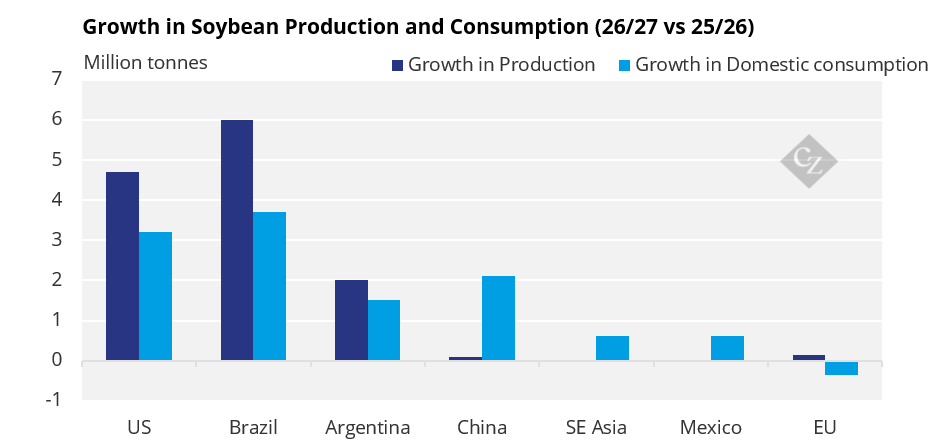
US soybean output for 2026/27 is projected at 4.435 billion bushels, or 120.7 million tonnes. Growth in US production of 4.7 million tonnes is mainly due to expanded area based on Spring surveys. Brazil’s soybean output is projected to grow by 6 million tonnes to set another record at 186 million tonnes. Argentina’s output is projected to grow by 2 million tonnes to reach 50 million tonnes in 2026/27.
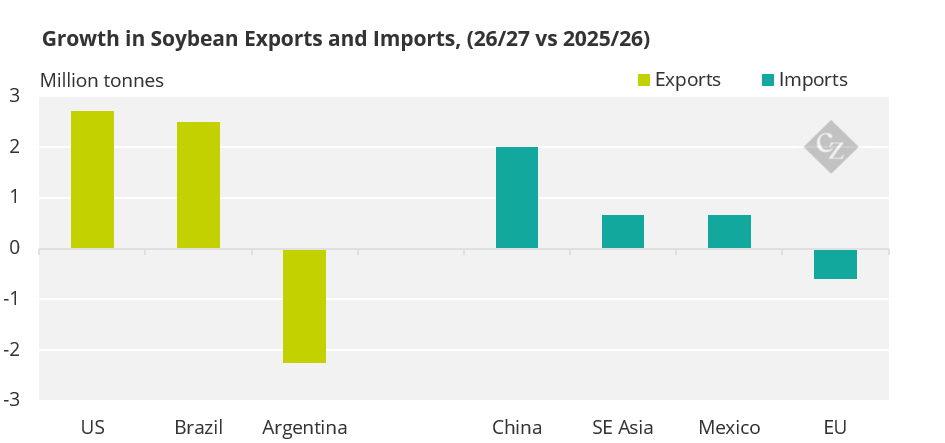
Major producing countries are also expected to increase their consumption of soybeans in 2026/27. USDA projects that growth in production will exceed growth in consumption in the US, Brazil, and Argentina. Consequently, exports from these countries will grow to meet rising consumption in China, Southeast Asia, and Mexico. A small decline in consumption is projected for the EU.
Source: USDA
The USDA projects that US and Brazilian soybean exports will each rise by more than 2 million tonnes. US exports are projected to rebound from their low 2025/26 level to 44.36 million tonnes in 2026/27. Brazil’s exports are projected to grow to 117.5 million tonnes. Argentina’s exports are expected to fall from the relatively high volume seen in 2025/26—when export taxes were temporarily lifted—to a lower volume of 6 million tonnes in 2026/27. China is projected to have the largest increase in global import demand, with a 2-mmt increase to 114 million tonnes. Exports to Southeast Asia will rise moderately to 11.56 million tonnes, exports to the EU will fall slightly to 13.2 million tonnes, and exports to Mexico will rise to 6.75 million tonnes.
Source: USDA
A 10% increase in US soybean oil consumption is driven by growing biofuel use. The projections show a 1.4-mmt increase in US soybean oil consumption—the largest of any country—and a 0.39 million tonne reduction in US soybean oil exports. A smaller increase in Brazil’s consumption is projected, while Brazil and Argentina will both increase soybean oil exports. China’s soybean oil consumption is projected to grow by 0.3 million tonnes.
The projections indicate that Brazil and the US will both increase their use and exports of soybean meal. China, Southeast Asia, and Mexico will increase their soybean meal consumption.
Rising Costs and El Niño Threaten Brazil’s Soybean Growth
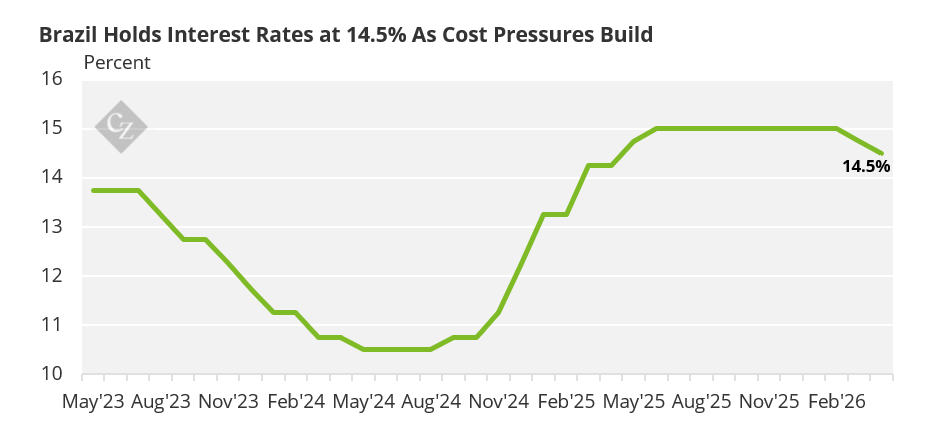
Most market observers agree that Brazil’s soybean output is likely to grow again in 2026/27, but growth may be slower than in past years due to several factors. One restraining factor is declining net returns for Brazilian farms. Producer prices in Brazil are down this year due to the record-large crop. Appreciation of the Brazilian currency means that competitive dollar prices in the export market translate into lower prices in the local currency. With a benchmark interest rate of 14.5%, high interest rates in Brazil raise the cost of credit for capital-intensive farms. Brazil’s reliance on imported fertiliser and farm chemicals means that farms have been heavily affected by this year’s shipping disruptions in the Hormuz Strait and price hikes for inputs.
Source: Trading Economics
Predictions of an intense El Niño are another factor that could disrupt production during 2026/27, especially in Brazil. The latest European Centre for Medium-Range Weather Forecasts projection has upgraded sea surface temperature anomalies in the Central Pacific by the end of 2026 to one of the most extreme events on record since the 19th century. This year’s El Niño is expected to impact Brazil during its soybean planting and growing season. El Niño events often cause heavy rains and flooding risks in southern Brazil, and droughts in the North and Northeast. A strong El Niño in 2015/16 contributed to a 9.5% decline in Brazil’s grain output.
Conflicting Forecasts Cloud China’s Soybean Demand
China’s agriculture ministry issued a CASDE soybean balance sheet that clashes with USDA’s projection of growth in Chinese consumption and imports. The May CASDE projected a 7.4 million tonne decline in China’s crush and a 7.8 million tonne decline in its soybean imports to 95.5 million tonne for 2026/27. CASDE attributed the decline to a reduction in sow numbers, which will reduce hog production during 2026/27. It was released the same day as the ministry’s announcement of a lower target for the nation’s sow inventory (equivalent to a 5% reduction in the herd).
However, CASDE’s past practice of predicting low values for imports undermines confidence in the forecasts. This year, CASDE had projected similar declines for 2025/26 until values were revised sharply upward in the May report, and the forecast of plunging imports was pushed a year into the future.
China’s purchase commitments for US soybeans of 25 million tonnes annually during 2026–28 also received more attention. With a new US soybean marketing year beginning in three months, China has not purchased any soybeans from the 2026/27 US crop.
US soybean futures prices climbed ahead of the Beijing summit in anticipation of a new pledge, but nothing new was announced for soybeans. Instead, the White House announced a new Chinese commitment to buy USD 17 billion in non-soybean agricultural products. US Treasury Secretary Bessent told news media that soybeans “are all taken care of” by last October’s commitment.
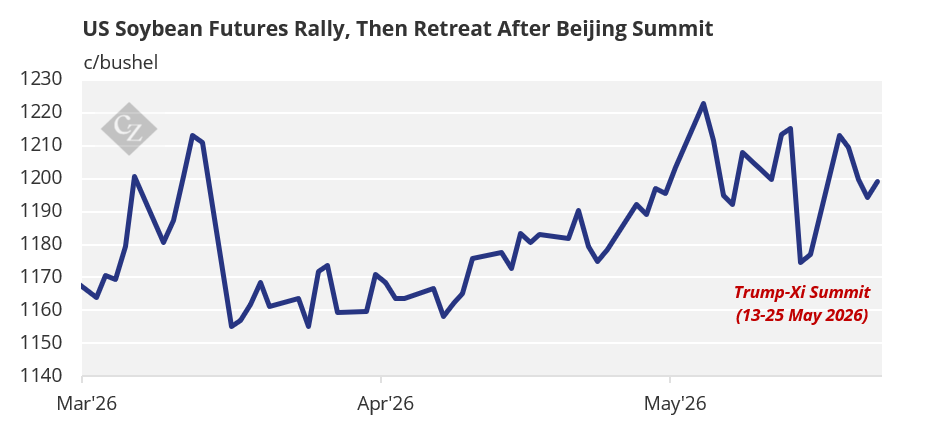
A post-summit readout on agricultural trade by China’s commerce ministry did not mention any purchase commitment. State-run Futures Daily followed up on the ministry’s readout by giving a pessimistic outlook for US soybean purchases. The article cited large volumes of South American soybeans arriving at Chinese ports during May, increases in crush volumes, and declining prices for soybean meal.
One Chinese futures trader quoted by Futures Daily judged large purchases of US soybeans before the end of the year to be unlikely, in view of premiums of USD 1/bushel for US over Brazilian soybeans arriving in China. The trader noted a tighter US soybean market, reflected by WASDE’s projection of increased US crush for 2026/27 driven by biofuel demand and reduced ending stocks.