Insight Focus
China’s soybean demand growth is showing signs of slowing. Forecasts differ over the outlook, while changing diets, a pork glut and rising soybean oil exports point to growing pressure on consumption. US and Brazilian soybean industries are already taking steps to reduce their reliance on China.
US and Brazil Remain Reliant on Chinese Soybean Demand
Big soybean crops in Brazil and the US this year will again rely heavily on exports to China.
For the first 11 weeks of the 2026/27 market year, 59% of US soybean exports were bound for China. The largest alternative markets were Mexico (8%) and the EU (7%). Brazil’s exports for January-October 2026 relied even more heavily on China, with a 70% share. Brazil’s largest alternative market was the EU, with 8%.
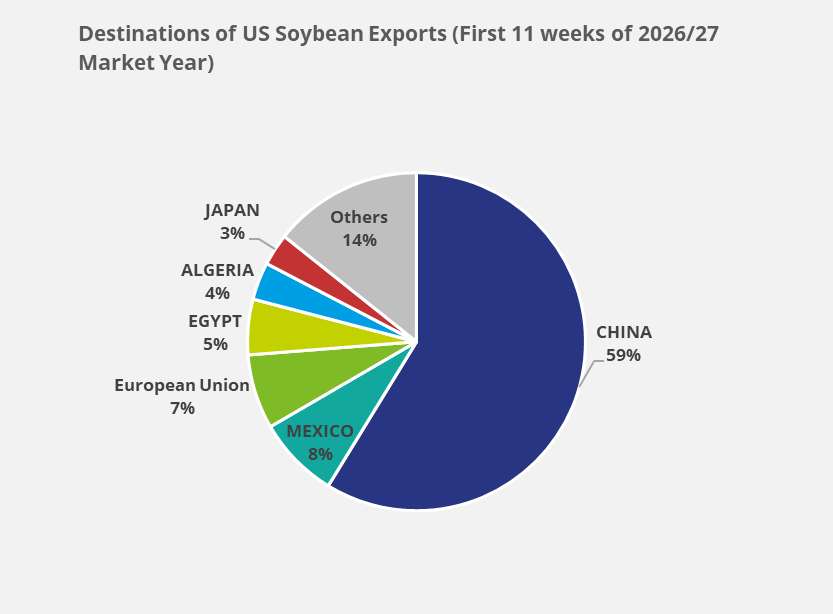
Source: USDA export inspections
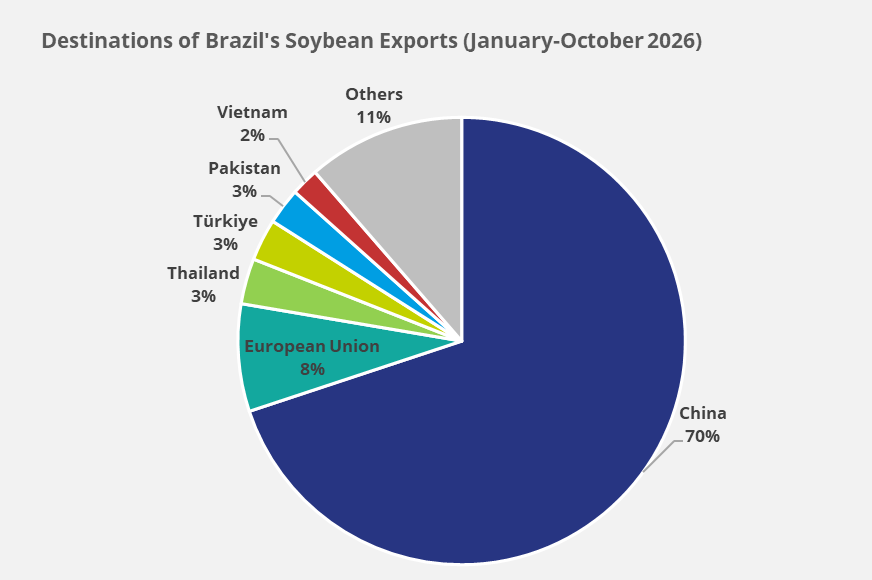
Source: Comex
China’s growing demand has been the big story in the global soybean industry for three decades. It’s natural to ask how sustainable China’s growth is and whether it will continue to absorb increased output from the Americas. There is consensus that China’s growth has slowed from earlier decades, but it has not yet peaked.
Outlooks Diverge on China’s Soybean Demand Growth
Differing views are evident from a comparison of the USDA’s WASDE forecast with a forecast of China’s soybean S&D in a monthly “CASDE” report issued by China’s agriculture ministry. November’s WASDE projects 2-million-tonne increases in China’s soybean crush and imports in 2026/27, slower than growth posted in past years but still positive. China’s CASDE report is much more pessimistic, projecting a 7.1-million-tonne decrease in crush and a 16.1-million-tonne decrease in imports for 2026/27.
Pessimistic Chinese forecasts for soybean consumption reflect several indicators of decelerating demand, as well as the Chinese government’s ambitions to reduce a stubbornly high reliance on imported soybeans. China’s declining and ageing population is one clear indicator of decelerating growth. Slowing economic growth and a sharp contraction in the food service industry affect consumption of soybean oil and animal protein produced with soybean meal.
Chinese officials are encouraging reduced consumption of oil and soybean meal by issuing dietary guidelines and a five-year plan calling for less oil in cooking and moderate meat intake, ostensibly to bolster healthy diets but also to cut back on soybean imports.
At the same time, dietary change in China is profoundly affected by the boom in online purchases of ready-made foods, takeaway meal delivery and new tastes in food acquired through increased travel. Abundant supplies of soybean oil are quietly displacing rapeseed oil and palm oil in cooking and food processing. A Chinese TV exposé this year revealed that an internet influencer was selling premium cooking oil purportedly made from walnuts that was actually soybean oil.
China’s Share of Global Soybean Demand Has Stabilised
Historical data in USDA’s PS&D shows that China’s consumption of soybeans has slowed over the years but still accounts for just under a third of the global market. China’s share of global soybean consumption doubled from 16% in 2000/01 to 31% in 2016/17. Over the most recent decade, China’s share stabilised at 30% to 32%. USDA’s 2026/27 estimates suggest that China’s share will hold steady at just under 31% during the current market year.
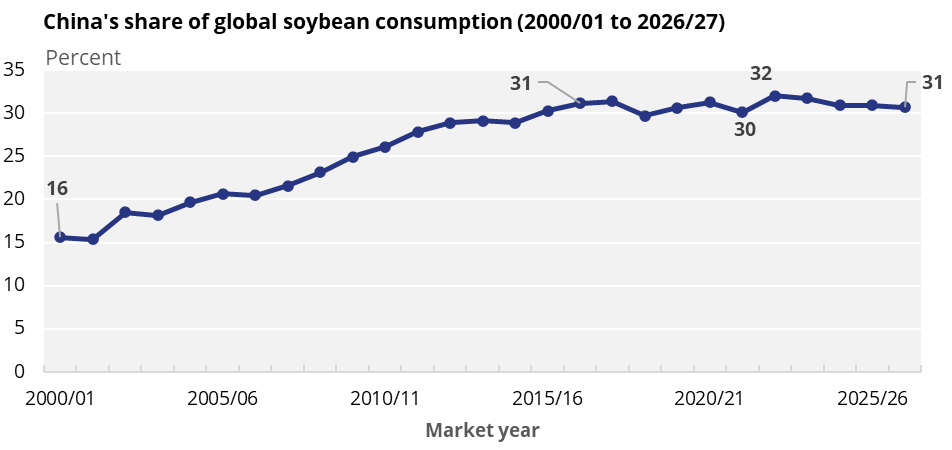
Calculations based on USDA PS&D database. 2026/27 is based on USDA’s forecast as of November 2026.
China still accounts for the biggest share of growth in soybean consumption. According to USDA data, China’s consumption of soybeans grew by 30.4 million tonnes between 2016/17 and 2025/26, more than any other country.
Other big chunks of global consumption growth were in the top exporting countries: Brazil’s consumption grew by 23.7 million tonnes and US consumption grew by 19.9 million tonnes between 2016/17 and 2025/26. Another 23.5 million tonnes of growth was spread across a group of 13 other countries, such as India, Russia, Mexico, Egypt, Thailand, Algeria and Turkey, that recorded consumption gains of 1-3 million tonnes each between 2016/17 and 2025/26.
Meanwhile, there was little growth in soybean consumption in two other traditionally big soybean players: Argentina (top exporter of soybean meal and oil) and the European Union (the top importer before China came on the scene).
China Emerges as a Net Soybean Oil Exporter
One sign of a changing market is China’s transition to a net exporter of soybean oil. China’s imports of soybean oil fell sharply in 2020. Then, in 2025, China’s exports of soybean oil rose to over 560,000 tonnes, exceeding imports. Soybean oil exports rose even higher during the first 10 months of 2026, while imports dropped even lower. This transition reflects supplies outpacing Chinese demand for oil, but it also reflects the growing use of soybean oil for biodiesel in oilseed-exporting countries. India is the chief market for China’s soybean oil exports.
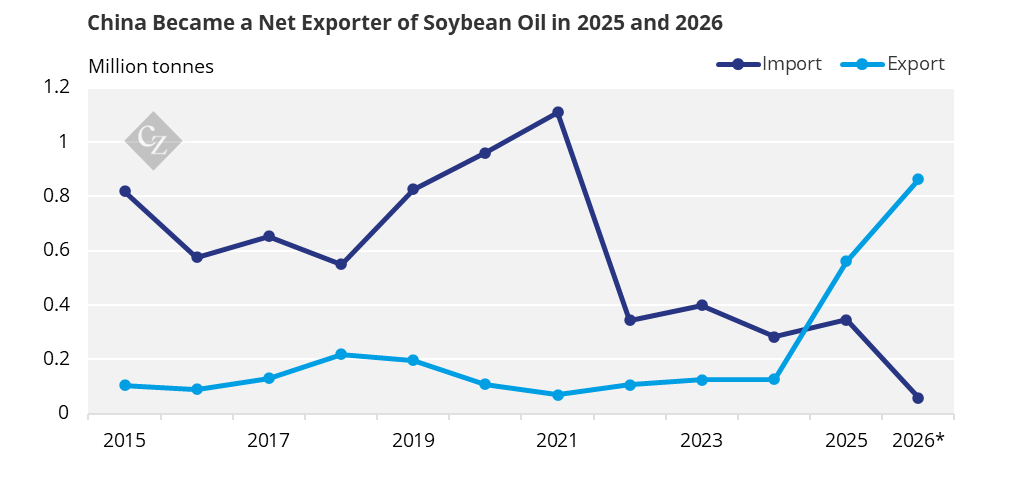
*2026 data for January-October. China customs administration data.
China’s Pork Glut Weighs on Soybean Meal Demand
China’s demand for soybean meal, mainly for swine and poultry feed, remained surprisingly resilient at the same time as there were signs of a saturated market for livestock products.
China’s pork production grew rapidly after hitting a low point in 2020 during the African swine fever epidemic. Per-capita output grew from 29.1 kg per person to 41.1 kg per person between 2020 and 2023. Output grew by 1.2 kg to 42.3 kg per person by 2025. An official survey measuring household food purchases showed parallel growth in pork consumption during 2020-23, but consumption declined by 2.9 kg by 2025. The divergence between production and consumption indicated by these statistics is consistent with signs of a pork glut in recent years.
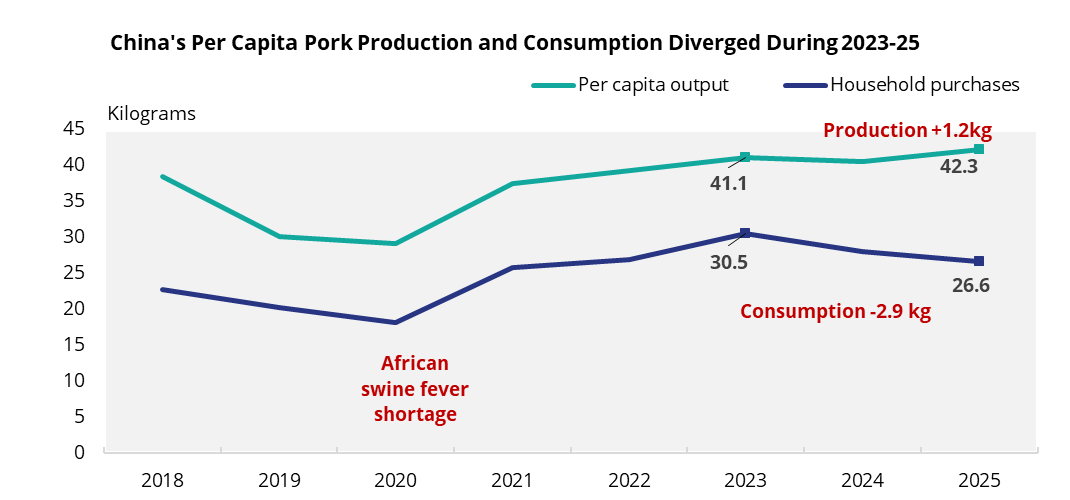
Source: China National Bureau of Statistics
In early 2025, Chinese government officials began urging pork producers to cut back production to avoid a glut. But pork output nevertheless grew 3% year-on-year during the first three quarters of 2026 despite the lowest hog prices seen in decades. Poultry production grew more than 9% as China boosted its exports of chicken meat. China’s Feed Industry Association reported that production of commercial animal feed for January-September 2026 was up 2.8% year-on-year, and soybean meal comprised about 13% of raw materials.
By October-November, financial losses for livestock producers began to crimp demand for soybean meal and other feed ingredients. Official data showed a decline in the swine industry’s inventory of sows at the end of September, while hog prices fell to their lowest level in years during November. Feed mills became more conservative in purchasing ingredients, and crushing margins deteriorated. An industry survey reported that inventories of soybean meal at crushing plants rose to 1.4 million tonnes in November, 30% higher than a year earlier. The same survey showed that 9.5 million tonnes of soybeans were expected to arrive at Chinese ports in November and 9.6 million tonnes in December. According to one news media report, Chinese customs inspectors had slowed clearance of imported soybeans to help crushers work through the backlog of soybeans.
Exporters Look Beyond China as Demand Growth Slows
It’s unclear whether China’s current slowdown is cyclical or the beginning of a plateau in China’s consumption of soybeans. The WASDE has accurately projected moderate increases in China’s crush and imports in each of the last three years when China’s CASDE was projecting declines. But a turning point is much harder to forecast.
It is clear, though, that soybean industries in exporting countries are already taking steps to reduce their reliance on the Chinese market. Industry data in the US and Brazil have shown strong growth in domestic crush, driven to a large degree by the use of soybean oil for biodiesel fuel. US soybean industry officials have also been actively promoting soybeans and meal in the dozen or so countries where consumption is growing.