Insight Focus
Chinese importers paid a premium for Brazilian sorghum this year. Prices averaged USD 244.7/tonne between January and October, with nearly all exports destined for China. In 2027, prices are expected to moderate as US exports regain competitiveness, Chinese import demand declines and new suppliers enter the market.
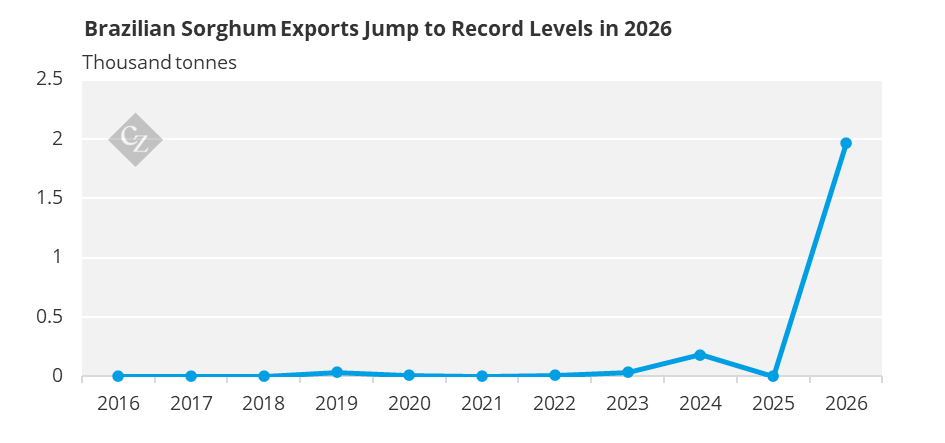
Following the surge in sorghum exports seen this year, Brazilian producers are beginning to wonder how the market might behave in 2027. Not only have exports grown significantly, reaching nearly 2 million tonnes between January and October, compared to 2,200 tonnes for the entirety of 2025, but prices have also risen.
*Between January and October.
Source: Comex
China accounted for 96.5% of shipments this year, according to Comex, and paid a premium. On average, Brazilian sorghum was exported at USD 244.7/tonne, with shipments gaining momentum from August. Last year, with China not yet in the picture, the price hovered around USD 211.5/tonne.
The signing of a phytosanitary agreement between China and Brazil for the trade of sorghum in November 2024, followed by the first shipment authorizations to Chinese ports, formalized in late 2025, transformed the landscape for Brazilian exports.
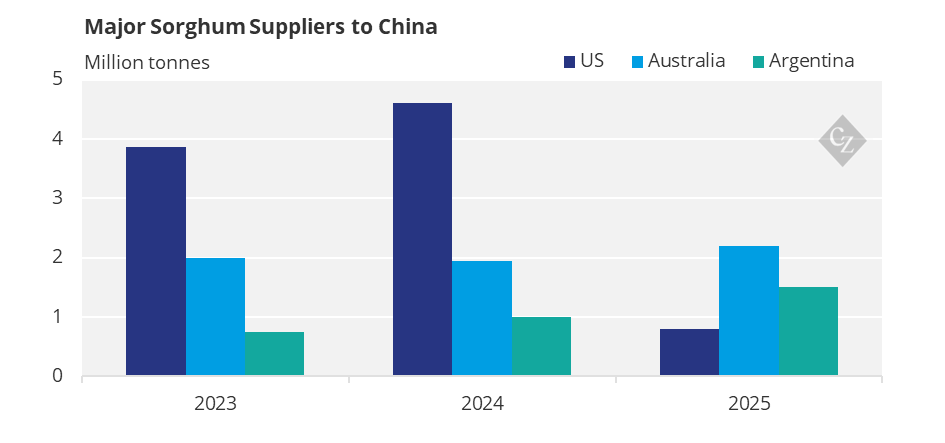
The timing could not have been better. The escalation of the trade war between the US and China last year led to the introduction of a 12% tariff on American agricultural products. This measure has impacted trade flows destined for Chinese ports. Before tensions intensified, the US dominated sorghum exports to China, leaving little room for other sources of supply.
Source: USDA
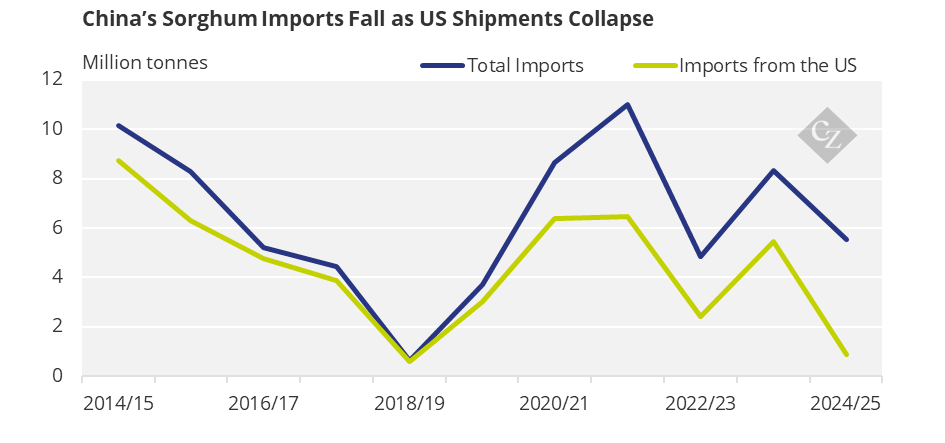
The US has historically been the primary supplier of sorghum to China, accounting for approximately 70% of China’s total imports. In the 2024/25 season, amid an intensifying trade war, Chinese imports of the US product fell to about 866,000 tonnes, down from approximately 5.5 million tonnes in 2023/24, an 84% decline, according to the USDA.
With tighter supplies arriving from the US, China turned to other sources. This shift has benefited Brazilian exports and influenced prices.
US-China Trade Truce Could Reshape Sorghum Flows
With the trade truce signed between the US and China on September 25, American sorghum is once again subject to the standard 3% tariff in China. As a result, the US-grown grain is expected to regain its competitiveness, narrowing the trade advantage that Brazil has recently secured.
The entry of new players is also likely to influence this landscape. A notable example is Mexico, which is emerging as a significant source of sorghum for China. Under an agreement reached between the Chinese trading firm Sichuan Yourong Group and Gessa Agroservicios, Mexico is expected to ship up to 1.2 million tonnes of the grain to Chinese ports this year.
Price prospects, however, will also depend on the outcomes of upcoming harvests in countries such as the US, Australia and Argentina, all strategic suppliers of sorghum to China, as well as the global supply-demand balance for the grain.
Source: UN Comtrade
The outlook points to lower production for the US harvest, according to the USDA. Drought conditions and high temperatures in major producing states, such as Nebraska and Kansas, have been affecting crops and causing losses.
The US is expected to produce approximately 7.4 million tonnes of sorghum in the 2026/27 crop year, a 33.4% decline compared to the previous season, according to the USDA. Exports, meanwhile, are expected to fall by about 22%, reaching approximately 4 million tonnes.
Australia also anticipates a smaller harvest due to the impacts of El Niño. Higher temperatures and dry weather have hindered the early development of crops in key sorghum-producing regions, such as Queensland and New South Wales.
The Australian Bureau of Agricultural and Resource Economics and Sciences estimates a 26% drop in production for the upcoming harvest, with the country expected to produce approximately 1.9 million tonnes of sorghum.
Argentina, meanwhile, is projected to see higher production in 2026/27, ranging between 3 million and 3.2 million tonnes, representing an increase of up to 33% compared to the 2025/26 season. According to the USDA, exports are also expected to rise, reaching between 1.5 million and 1.7 million tonnes in 2027, up from approximately 1.3 million tonnes forecast for 2026.
In Brazil, production is also expected to grow, reaching 8 million tonnes, a 9.5% increase over the 2025/26 cycle, according to Conab.
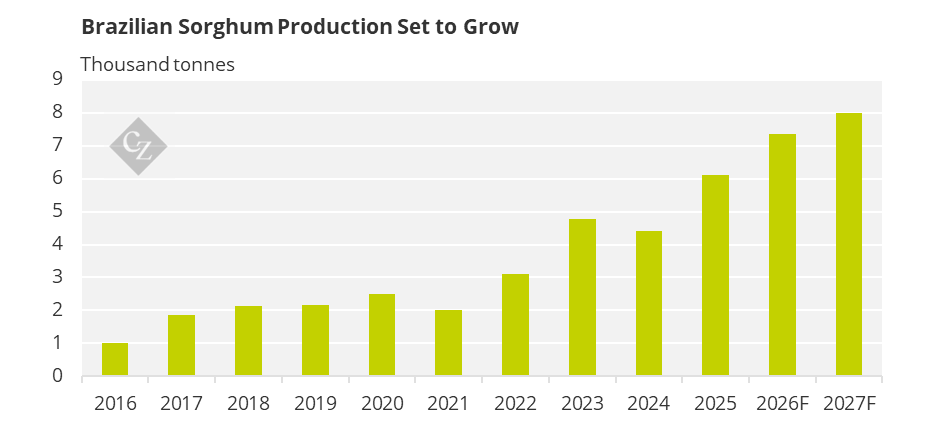
Source: Conab
With an increase in supply, Latin America is poised to grow in significance as a producer and supplier of sorghum to China by 2027, helping to offset potential crop shortfalls in the US and Australia.
Higher Corn Supply Could Weigh on China’s Sorghum Demand
Another key factor in this equation is corn. Widely used in animal feed, the grain is a fundamental component in the mix of raw materials required to feed China’s livestock. “Sorghum often serves as a substitute for corn,” says Daniele Siqueira, head of market intelligence at the consultancy AgRural.
According to the USDA, corn production in China is expected to rise from approximately 301 million tonnes in the 2025/26 crop year to 306 million tonnes in 2026/27. Consequently, the grain balance in the Chinese market should be in a somewhat more comfortable position next season.
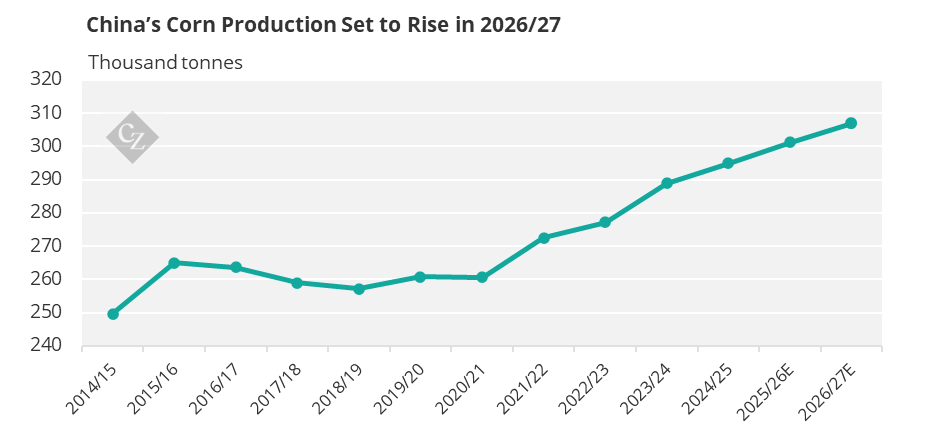
Source: USDA
Uncertainties regarding the global sorghum supply for the upcoming harvest, combined with greater availability of other feed grains, such as corn, in the Chinese market, are expected to lead China to reduce its sorghum imports in 2027, according to USDA projections.
“These moves by the Chinese government are specifically aimed at balancing supply and demand, preventing prices from rising too sharply,” says Siqueira.
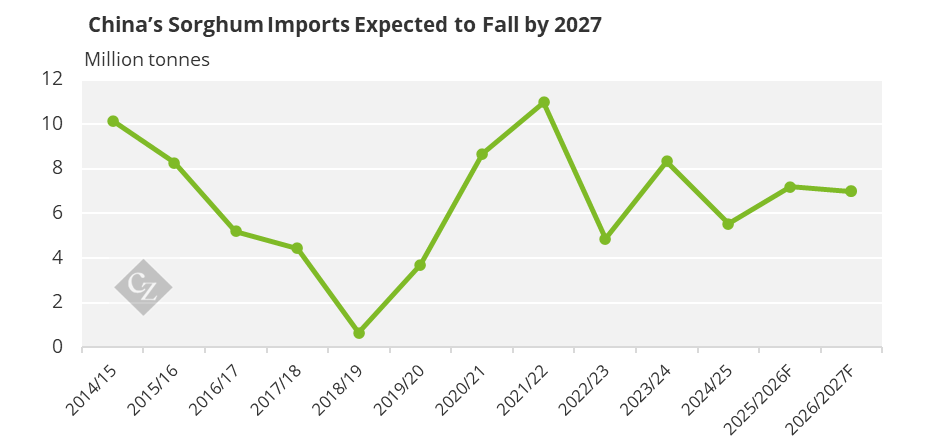
Source: USDA
In this scenario, Brazil is set to consolidate its position as a strategic partner for China, although premiums are likely to settle at lower levels than those observed this year.