Insight Focus
Soybean prices held near recent highs despite trade policy uncertainty. Expectations for new Chinese soybean purchase commitments faded following the Trump-Xi summit, while biodiesel demand and Chinese buying supported the market. US exports started the 2026/27 marketing year strongly, while quality concerns emerged in the Midwest and Brazil’s next crop expanded.
No New Soybean Commitments Emerge from Trump-Xi Summit
Chicago soybean futures fluctuated between USD 12.80 and USD 13.25/bushel during September and early October 2026. The price peaked at USD 13.28 on September 21, during the week leading up to the Trump-Xi summit in Washington. A week later, it fell to USD 12.88 after a post-summit fact sheet offered no new measures to boost US-China soybean trade. Soybean prices recovered to the USD 13/bushel level in the first week of October. Futures remain well above last year’s levels, when prices were stuck between USD 10 and USD 10.50/bushel and China was not buying US soybeans.
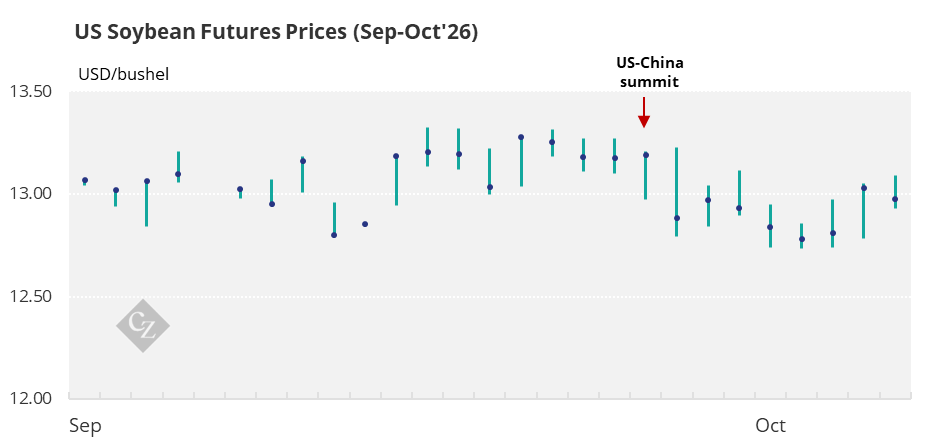
Source: CBOT
With biodiesel use of soybean oil increasing this year and China returning as a buyer of US soybeans, competition for beans intensified before the new crop entered market channels in large volumes. As old-crop stocks dwindled and export shipments ramped up, some Midwestern crushing plants offered prices as much as USD 1/bushel above futures to ensure adequate supplies for their operations.
Many market participants had anticipated new soybean purchase commitments from China during leader Xi Jinping’s visit to Washington on September 24-25, but no specifics were announced. A fact sheet released by the White House noted progress on establishing a US-China Board of Trade, encompassing lists of products with trade totalling USD 30 billion compiled by each country and under consideration for tariff reductions.
The Chinese list of more than 1,600 items included coal, medical devices and nearly all agricultural products, but excluded soybeans. Negotiations are set to resume at the next summit in November. A US-China agricultural working group established at the May summit is also expected to meet before the end of 2026, although no date has been set.
US Soybean Exports Start Marketing Year Strongly
For US soybean trade, the result is that the 25-million-tonne annual purchase commitment made last year remains in place. It will likely be fulfilled almost entirely by state-owned firms, as the additional 10% tariff on US products makes soybean purchases too expensive for most private Chinese companies. Chinese stockpiling authorities auctioned imported soybeans from reserves to make room for new US purchases, but total sales reached only a little more than 2 million tonnes over two months of weekly auctions.
During the first month of the 2026/27 marketing year, US soybean exports were running ahead of the previous year’s pace. Accumulated exports during the first five weeks were about 1 million tonnes above the year-earlier level. Exports were also ahead of the 2024/25 marketing year, when sales got off to a slow start. China accounted for 55% of accumulated exports during the first five weeks of 2026/27, followed by the EU at 23%. Other destinations accounting for 4% to 7% each included Egypt, Algeria, Mexico, Japan and Bangladesh. Outstanding US soybean export sales totalled 18.85 million tonnes as of October 1, 2026.
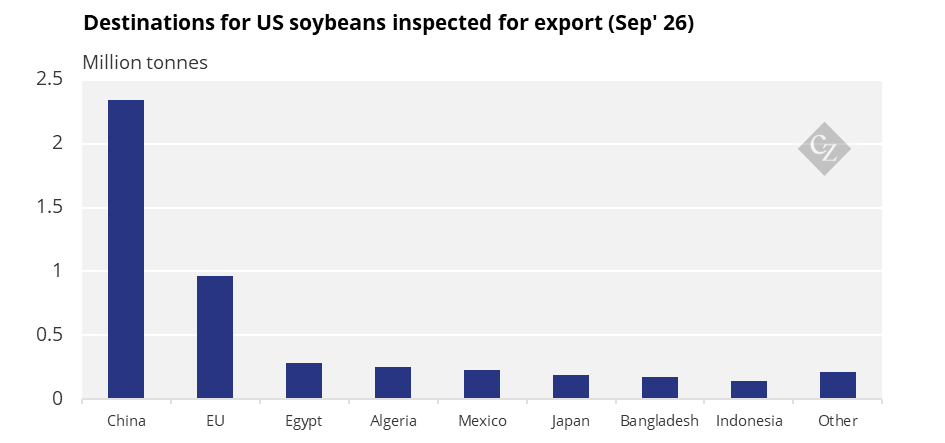
USDA accumulated exports, September 1 through October 1, 2026
Source: USDA
Quality Risks Surface as Brazil Begins Planting
Heavy rains delayed soybean harvests across many areas of the US Midwest during September and raised concerns about new-crop quality. Swollen and split pods can make beans more vulnerable to fungus and mold, cause seeds to sprout in the pod, and result in purple discoloration. These issues may lead to quality downgrades in the marketing chain. Chinese customs inspectors, in particular, have shown a high propensity to reject soybean shipments from both the US and Brazil and suspend exporters over quality concerns.
Brazilian farmers have been planting their new soybean crop, although progress has also been slowed by rain, with 7.3% of planting complete by early October. Brazil’s ANEC projected planted area at 49.2 million hectares, while CONAB estimated the 2026/27 soybean crop at 181.6 million tonnes, up 1.4% from the previous year. ANEC later updated its estimate to 182.7 million tonnes.
Brazilian Soybean Export Prices Continue to Climb
Brazil’s soybean exports declined seasonally to 7.4 million tonnes in September, less than half the 16.8 million tonnes exported at the April peak. September exports were slightly ahead of the year-earlier total.
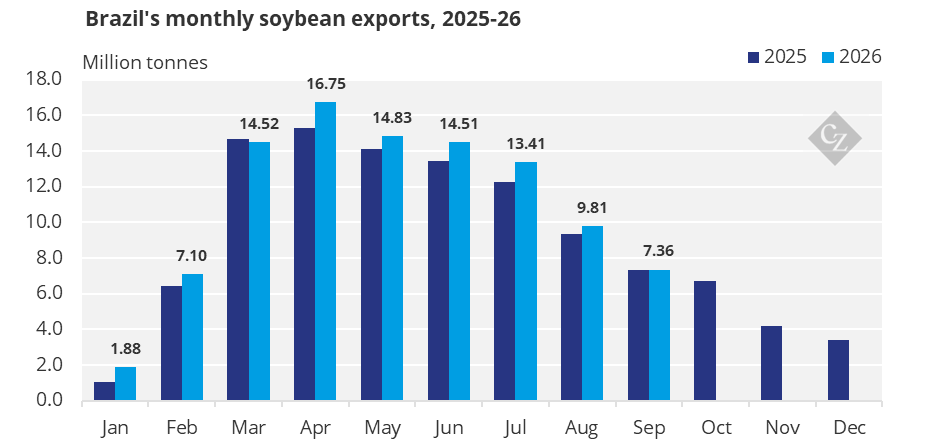
Source: Comex
Shipments to China totalled 5.3 million tonnes, down 1.7 million tonnes from a year earlier. Exports to destinations outside China increased year over year but totaled only 2 million tonnes, led by 523,000 tonne to the EU, around 260,000 tonnes each to Thailand and Pakistan, and 200,000 tonnes to Iran. Brazil’s soybean meal exports also remained robust, reaching 2.45 million tones in September, up 380,000 tonnes from a year earlier.
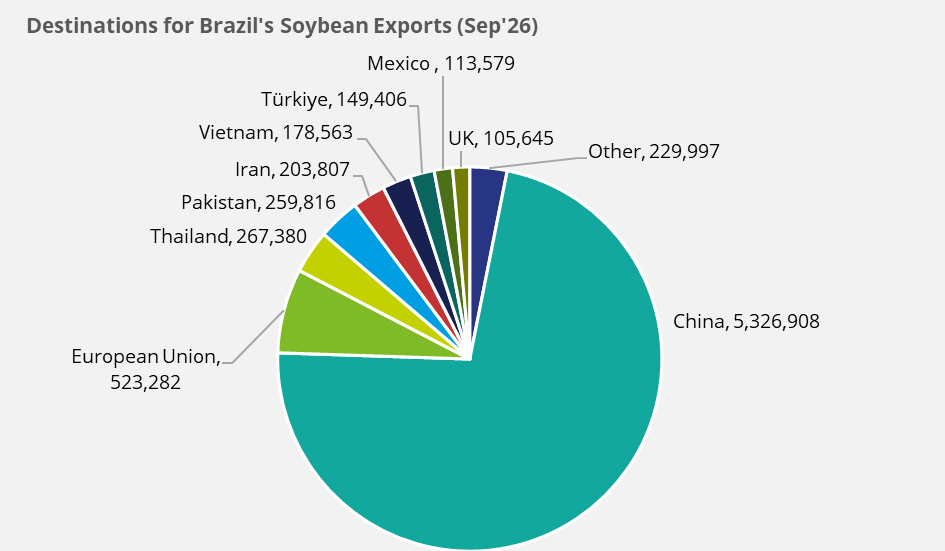
Source: Comex
Brazilian soybean export prices have risen every month since March. The average export unit value reached USD 472/tonne in September, up 16% from the seasonal low of USD 406 in March and 12% higher than a year earlier. Quotations at the Paranaguá port reported by CEPEA exceeded USD 500/tonne during September, pointing to potentially higher export prices in the months ahead.
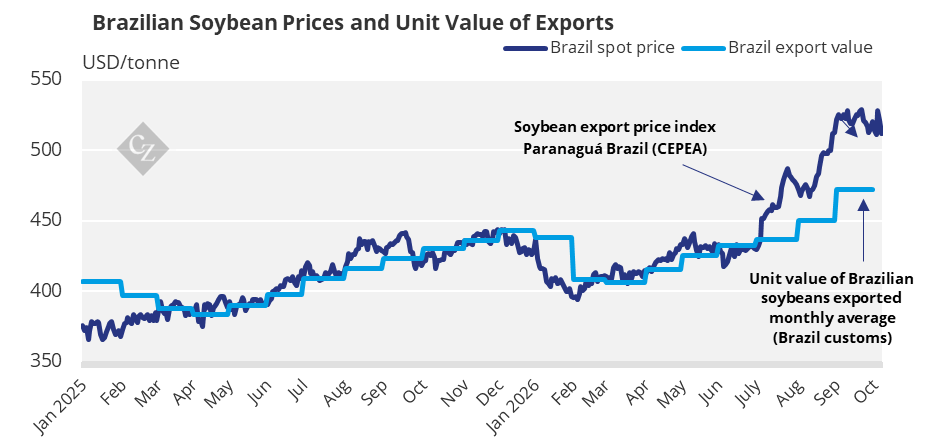
Source: CONAB
Brazil’s currency appreciated 4% against the US dollar following the October 4 presidential election, in which challenger Flavio Bolsonaro won 47% of the vote compared with incumbent Lula da Silva’s 45.16%. The Brazilian real reached its highest level in 17 months as market participants anticipated tighter fiscal policy if Bolsonaro ultimately wins the October 25 runoff. In the days following the appreciation, domestic soybean prices in reais declined. A stronger currency would tend to reduce the price competitiveness of Brazilian soybeans in global markets, although it could also lower the cost of imported farm chemicals and fuel.