Insight Focus
Corn holds steady as harvest pressure offsets European crop losses. Wheat fell on growing hopes for a Black Sea export corridor, while the Trump-Xi meeting failed to deliver fresh market support. With US harvesting running ahead of last year and French production losses largely priced in, attention remains focused on export negotiations and harvest progress.
This update is from Nixal Commodities. For more information, CLICK HERE.
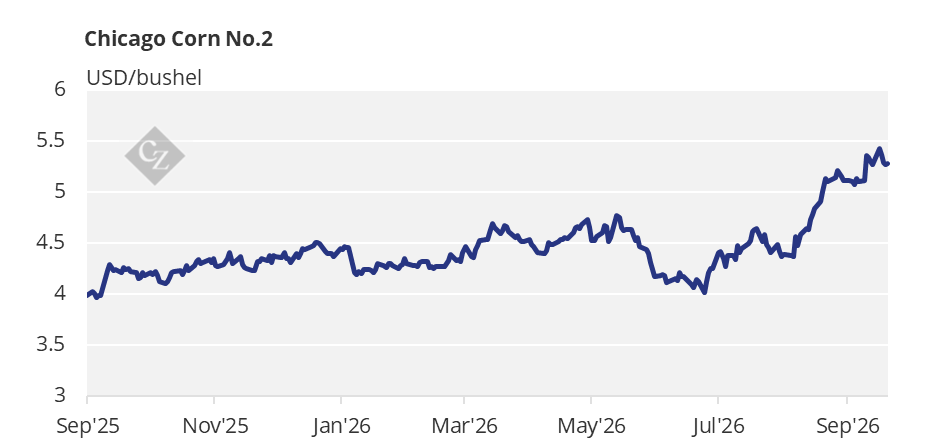
Corn was unchanged in Chicago but higher in Europe following poor French harvest data. Wheat fell on the prospect of an export corridor out of the Black Sea. The Trump-Xi meeting disappointed.
Harvesting and commercial hedging pressure will ramp up in the coming weeks, adding to selling pressure in corn futures. Despite the good progress in corn harvesting, recent and forecast rainfall across parts of the Corn Belt will probably result in some delays and a slower harvesting pace in this week’s and next week’s crop progress reports.
We continue to see price action dominated by the possibility of a resumption of exports out of the Black Sea, particularly for wheat prices. On the corn side, the focus remains on the pace of the US harvest. We could see some slowdown due to rainfall, but as harvesting remains ahead of both last year and the five-year average, we do not expect this to have a material impact on prices. Additional data from France is also expected, but we believe the production losses are already fully priced in. We continue to expect Chicago corn to trade in the USD 5.0-5.5/bushel range.
There are no changes to our estimate for the 2026/27 average price of corn in Chicago of USD 5.5/bushel. The average price since September 1 is running at USD 5.23/bushel.
French Crop Losses Deepen as US Harvest Advances
Corn in Chicago opened very strong last week, with a 3% rally on Monday due to new attacks in the Black Sea and hopes of more US exports ahead of the US-China meeting. However, the market turned lower on Tuesday due to profit-taking and good progress in the US harvest pace, and remained under pressure on Wednesday due to a lack of supportive news before trading sideways through the end of the week. Friday then saw a sell-off, with the market reaching the week’s low after the Trump-Xi meeting yielded no concrete results, although it recovered later and ultimately closed the week unchanged.
Coceral in Europe reduced its corn production forecast to 48.6 million tonnes, down from 52.7 million tonnes in its July forecast. This compares with 56.5 million tonnes produced last year. The biggest reduction was in France, where production is expected to fall to 7.56 million tonnes from 13.87 million tonnes last year, a decline of 45.5% year on year.
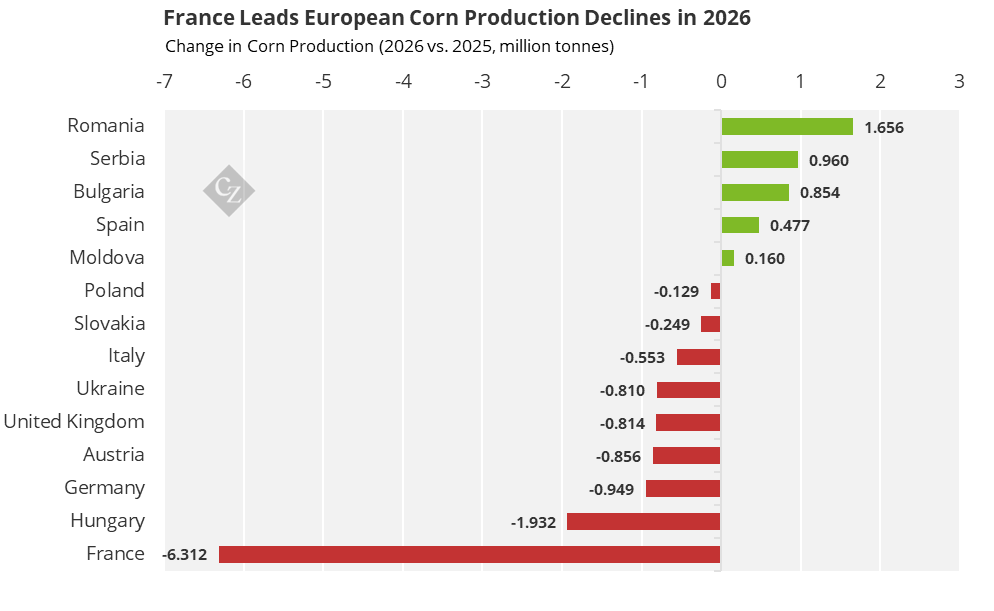
Source: Coceral
BAGE in Argentina projected corn production at 66 million tonnes in the 2026/27 crop, up 3.1% from the previous crop of 64 million tonnes, which was an all-time high.
US corn is 13% harvested, versus 10% last year and the five-year average of 11%. Crop condition is rated 57% good or excellent, unchanged week on week and down from 66% last year. French corn is 45% harvested, versus 13% last year and the five-year average of 11%, while crop condition is 23% good or excellent, unchanged week on week and down from 62% last year. Corn harvesting in Ukraine is 1% complete and 4.6% complete in Russia.
Safrinha corn harvesting in Brazil is 98.7% complete, versus 99.6% last year and the five-year average of 98.8%, while summer corn planting has reached 21.4%, versus 20.8% last year and the five-year average of 19.2%. Argentina corn planting is 17.1% complete, while the old crop is 99.2% harvested.
Black Sea Corridor Talks Pressure Wheat Prices
Wheat opened strongly last Monday as renewed Ukrainian attacks on Russia complicated prospects for a solution regarding the grain export corridor. However, diplomatic efforts put pressure on prices from Tuesday onwards, with Marco Rubio stating that both sides had expressed interest in a limited ceasefire covering grain and energy infrastructure.
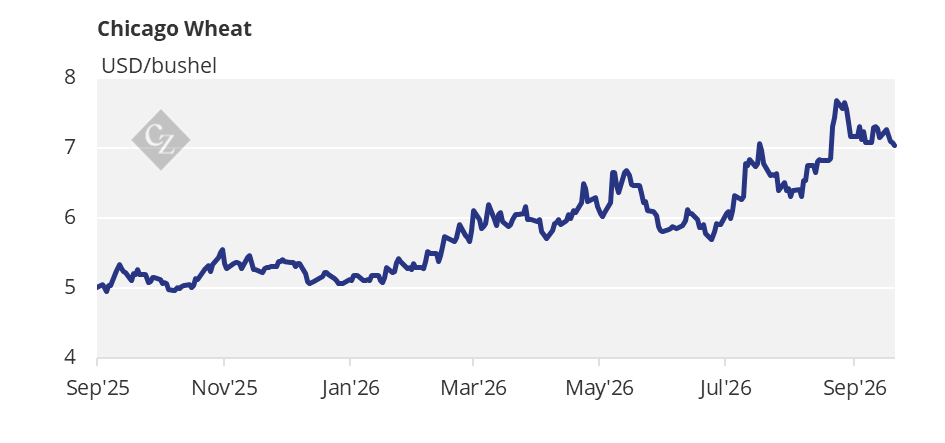
Turkey announced at the UN General Assembly in New York that it was increasing diplomatic efforts to restore the grain export corridor. Zelensky also said last Friday that several countries, not only Turkey, were involved in the negotiations. At the time of writing, however, no agreement had been announced, while Russian wheat exports in September are expected to be nearly 60% lower year on year.
Coceral in Europe lowered its forecast for 2026 wheat production in the EU+UK to 137.5 million tonnes, down from 140.8 million tonnes projected in July. This compares with 148.7 million tonnes last year, a decline of 7.5% year on year.
BAGE in Argentina projected wheat production in 2026/27 at 23.4 million tonnes, which would represent a sharp 15.8% year-on-year decline.
US spring wheat is 96% harvested, versus 96% last year and the five-year average of 96%. US winter wheat is 17% planted, versus 19% last year and the five-year average of 21%. Winter wheat planting in Ukraine is 14.6% complete, versus 14.1% last year. Wheat harvesting in Russia is 93.9% complete. Wheat harvesting in Brazil is 21.6% complete, versus 23.2% last year and the five-year average of 23.3%.
On the weather front, Brazil is expected to turn rainy again and to close September with above-average rainfall. Rains are also expected to return to Argentina. US corn areas are expected to be rainy in the west, delaying harvest progress, while the eastern Corn Belt is expected to remain dry. Northwestern Europe is expected to remain warmer than average, with rainfall also below average, while the Black Sea region is expected to be warm and rainy.