Insight Focus
US soybean demand remains strong despite growing global supplies. Record crushing activity and Chinese buying have helped support US soybean prices. Meanwhile, Brazil is planting another large crop, while uncertainty over Chinese import demand continues to shape the global outlook.
US Soybean Prices Supported by Strong Crush, Export Demand
The US soybean harvest was 12% complete as of September 20. During the first month of the 2026/27 marketing year, Chicago soybean futures fluctuated within a range of USD 13/bushel to 13.40/bushel, higher than any prices seen during the 2025/26 marketing year and about USD 3/bushel above year-earlier levels.
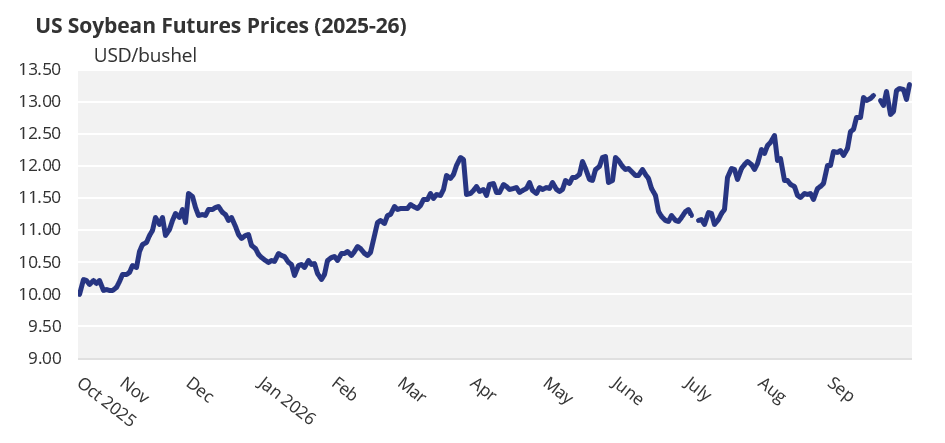
Source: CBOT
The USDA rates the US crop at 58% good or excellent, equal to the five-year average. The September WASDE raised its estimate of 2026/27 soybean production to 123.4 million tonnes, up 7.4 million tonnes from 2025/26. On the demand side, 2026/27 crush is estimated at 75.66 million tonnes, up 3.4 million tonnes from 2025/26. Exports for 2026/27 are estimated at 45.86 million tonnes, up 4.5 million tonnes from 2025/26.
NOPA reported a record crush volume of 205 million bushels in August 2026, up 8.2% from a year earlier. This continues a string of record monthly crush volumes that are expected to remain strong in 2026/27. Monthly crush volumes are expected to ramp up seasonally following the upcoming harvest. This month’s announcement of plans to build a large soybean crushing facility in Wisconsin symbolised the trend of rising domestic crush.
The facility is expected to have an 80-million-bushel capacity when completed in 2028. China accounted for nearly half of the 1.6 million tonnes of cumulative exports during the first 17 days of the 2026/27 market year. The early-September export pace this year is only slightly ahead of last year’s, despite China’s return to the US market, but it is nevertheless the fastest early-September pace of the past six years.
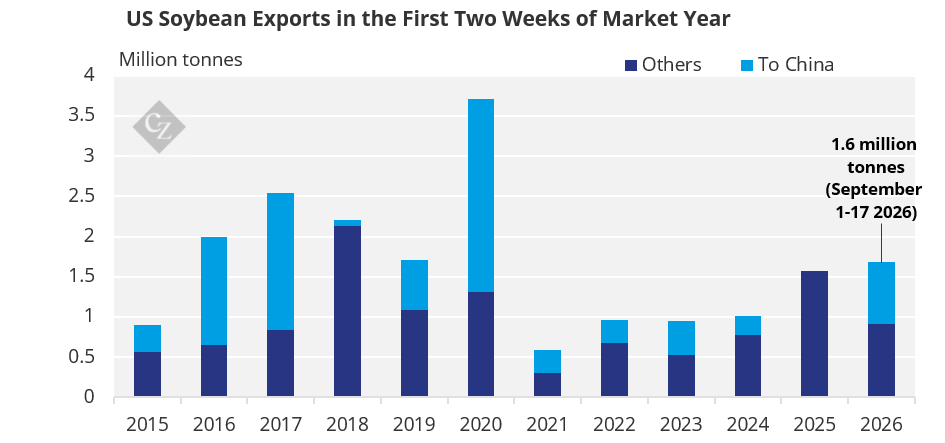
Source: USDA Export Inspections Data
The peak export months of October to December are critical for crop demand, and exports to China are expected to continue at a robust pace during those months in 2026. Announced sales of US soybeans to Chinese buyers for 2026/27 exceed 10 million tonnes. Recent sales were reportedly made to Chinese state-owned firms for shipment in December and January, months when Brazilian supplies are tight.
Soybean Market Watches for Progress On US–China Trade
The September 24 meeting between Chinese leader Xi Jinping and President Trump in Washington was highly anticipated by agricultural market watchers, even though most reporting ahead of the meeting focused on topics such as AI, semiconductors, rare earths, Taiwan and conflicts in the Persian Gulf and Black Sea. News reports noted that China was making progress on its commitment to buy 25 million tonnes of US soybeans during 2026/27, but had made limited progress in purchasing USD 17 billion of non-soybean agricultural goods, prorated to an unspecified degree in 2026
A soybean market rally in mid-October 2025 anticipated the Chinese soybean purchase commitment made at the Busan, South Korea, summit. Another rally in the weeks ahead of an expected March 2026 summit fizzled out when the summit was postponed.
A further surge in prices ahead of the May 14 summit in Beijing was reversed after no new soybean measures emerged from that meeting. US Treasury Secretary Bessent explained that the purchase commitment made at the October 2025 Busan summit had “taken care of” soybeans.
The Washington summit was cited as a contributor to high prices in September 2026, but the most likely impact would come from a relaxation of China’s 10% tariff on US goods, which could expand purchases of US soybeans by private-sector buyers in China. However, there has been no signal that this is on the table.
Brazil Eyes Larger Soybean Crop as China Demand Remains Strong
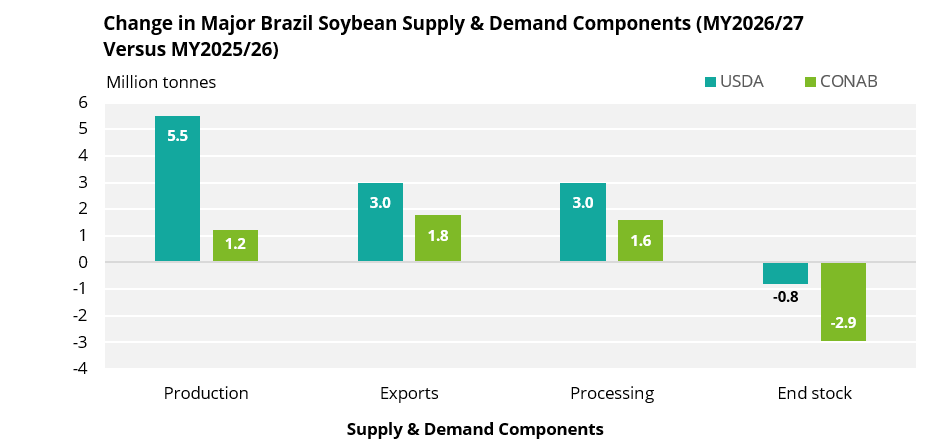
Brazil began planting its new soybean crop in September. Initial estimates released in CONAB’s 2026/27 outlook show a 600,000-hectare increase in area to 49.3 million hectares, which CONAB noted was the slowest percentage growth in 20 years. CONAB projects soybean output at 181.64 million tonnes in 2026/27, a 1.2-million-tonne increase from 2025/26. CONAB’s estimate is more conservative than the USDA’s estimate of a 5.5-million-tonne increase in output to 186 million tonnes.
The USDA projects faster growth in Brazilian exports and crush, while CONAB projects a larger decline in ending stocks for Brazilian soybeans in 2026/27. CONAB also projects small increases in Brazil’s production, exports, and domestic use of soymeal in 2026/27. Exports of soybean oil are projected to decline, while domestic use is expected to increase by 1 million tonnes.
Brazil remained the dominant source of Chinese soybean imports in August. China imported 12.1 million tonnes of soybeans in August 2026, of which 10.6 million tonnes came from Brazil. Imports from the US fell to just 200,500 tonnes in August, the lowest level since January. Other suppliers to China during August included Argentina (887,400 tonnes), Uruguay (291,800 tonnes), Canada (21,000 tonnes), and small volumes from Ukraine, Ethiopia, and Benin. During the first eight months of 2026, China imported 55.1 million tonnes of soybeans from Brazil, 10.6 million tonnes from the US, and 5.1 million tonnes from Argentina.
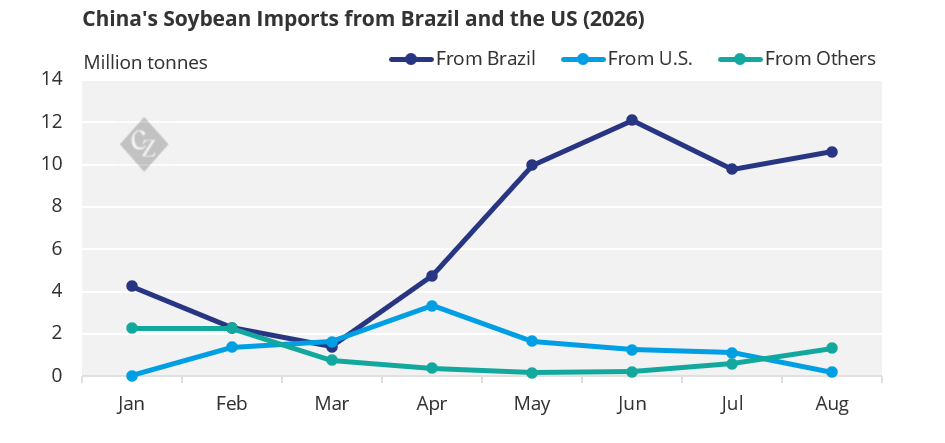
Source: China Customs
For MY2026/27, the USDA’s WASDE projects that China’s soybean imports will increase by 2 million tonnes to reach 115 million tonnes. In contrast, China’s Ministry of Agriculture and Rural Affairs, in its September CASDE report, projected a 7.5-million-tonne decrease in China’s imports to just 94 million tonnes in 2026/27.
The Chinese Ministry has projected declines in soybean imports each year since officials launched a campaign to reduce reliance on imported soybeans. Those forecasts have subsequently had to be revised upward later in the marketing year.
Last year, the USDA projected a 4-million-tonne increase in China’s soybean imports for 2025/26, while CASDE projected a 13.5-million-tonne decrease. Actual China Customs data for the first 11 months of the 2025/26 marketing year show a 3-million-tonne year-on-year increase, slightly below the increase projected by the USDA but significantly stronger than the decline projected by CASDE.