Insight Focus
Brazil could benefit if Panama Canal restrictions raise shipping costs for US exports to Asia. Thanks to restrictions due to El Nino, higher transport costs would make US soybeans less competitive, likely weakening prices at the US Gulf while boosting premiums for alternative suppliers. But the weather phenomenon also means grains farmers must contend with higher risk and costs, compressing margins.
Brazil Well Positioned to Capture Diverted Demand
If new restrictions at the Panama Canal increase the cost of the US Gulf to Asia freight route, US soybeans could lose competitiveness. This adjustment would likely be reflected in physical price differentials, characterised by a weaker basis at the US Gulf and firmer premiums at origins capable of supplying Asian demand.
Already, routes from Shanghai to the US East Coast have surged, according to Drewry.
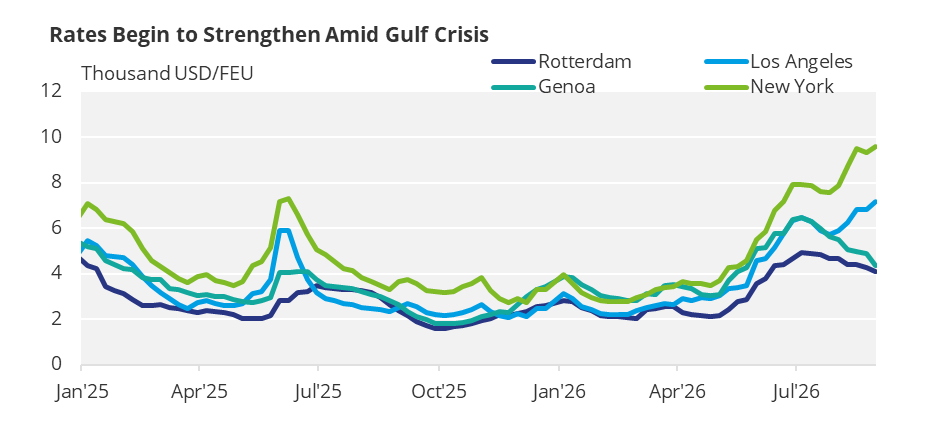
Source: Drewry
Key Brazilian shipping routes connecting Santos, Paranaguá, and the Northern Arc to China do not rely on the Panama Canal. This works in Brazil’s favour when US costs rise, although increased demand for South American cargoes can also keep vessels fully utilised and put upward pressure on Atlantic freight rates.
A restriction in Panama would most directly affect shipments from the US Gulf and could shift some Asian demand toward South America. Brazil is well positioned to capture a share of this flow, provided it has the necessary production and delivery capacity.
For soybeans, available supply will determine how much of this market movement reaches Chicago. With high production levels, the impact may remain concentrated in premiums and CIF prices. A significant production loss in the US or South America would add logistical risk to reduced physical availability.
Corn is more sensitive to competition among origins because freight costs account for a larger share of the final price. A more expensive North American route could favour suppliers in Brazil, Argentina, or the Black Sea region. Second-crop corn production, together with growth in domestic consumption for animal feed and ethanol, will determine how much of this demand Brazil can absorb.
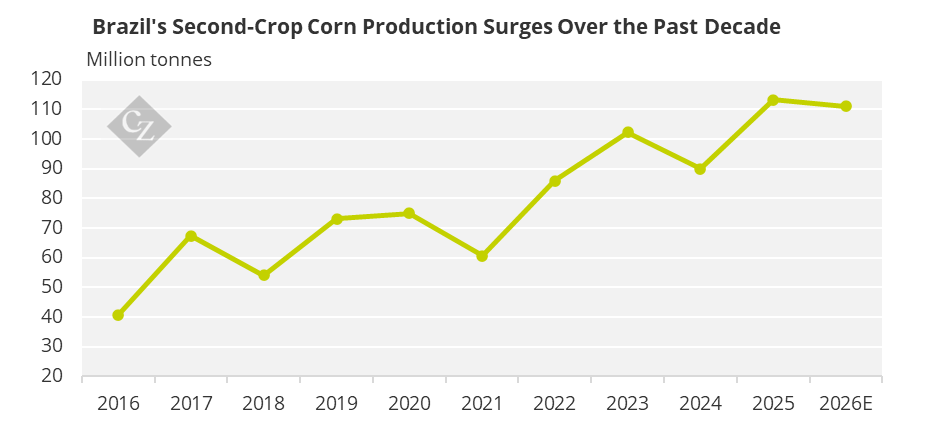
Source: Conab
Panama Canal on Alert Amid Renewed Drought Risks
Operations at the Panama Canal depend on water volumes in Gatun and Alhajuela Lakes, which are used to operate the locks, and water levels have already declined due to the lack of rainfall caused by El Niño.
In August, lower-than-expected rainfall prompted the Panama Canal Authority to announce new measures. The maximum draft at the Neopanamax locks is set to be limited to 48 feet starting in September and 47.5 feet starting in October.
These restrictions are precautionary and do not indicate an immediate risk of disruption. Nevertheless, the timing of their introduction is notable. At this time of year, reservoirs should be accumulating water for the dry season. Rainfall levels over the coming months will determine whether additional measures will be required in 2027.
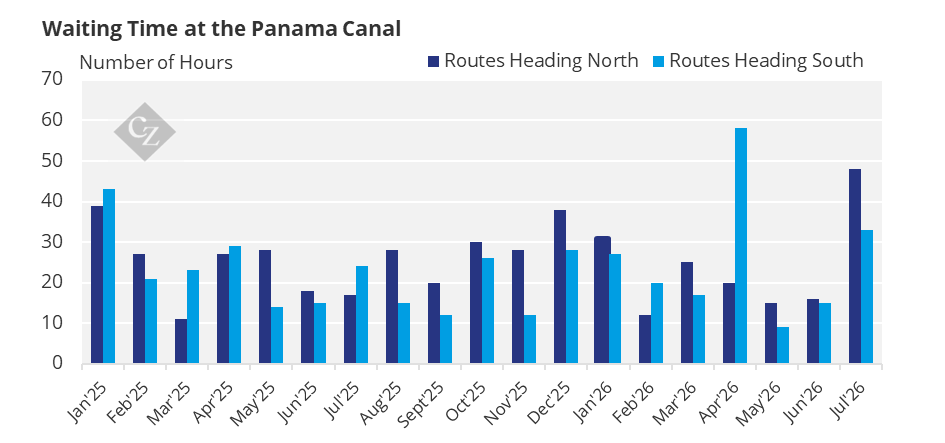
Source: Panama Canal Authority
The 2023/24 drought highlighted the scale of the challenge. Ships faced queues, reduced cargo loads, or sought alternative routes. Grain shipments from the US Gulf to Asia were diverted via the Suez Canal, adding more than 5,000 nautical miles to the voyage and extending travel times by approximately two weeks
The volume of grain transported through Panama fell from 35.8 million tonnes in fiscal year 2023 to 13.3 million tonnes in 2024. In 2025, it recovered to 24.7 million tonnes but remained approximately 31% below pre-drought levels, according to the Canal Authority’s Annual Report.
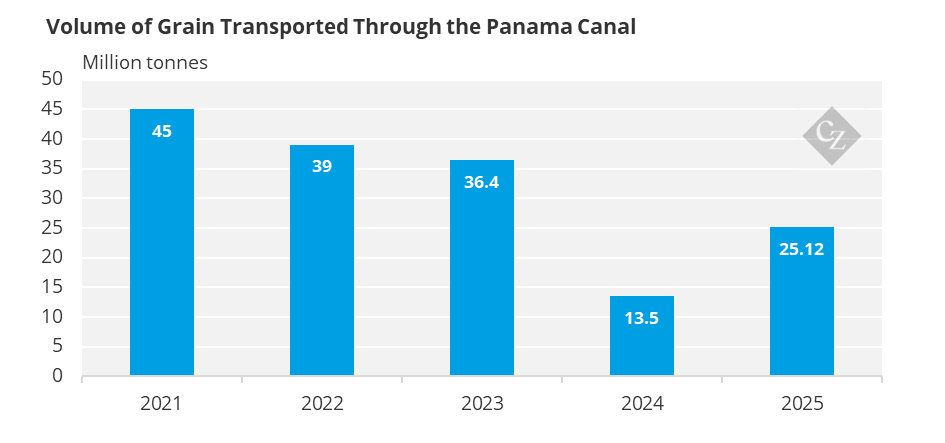
Source: Panama Canal Authority
Higher premiums at Brazilian ports may signal stronger international demand, but they can also point to tighter supply. Producers benefit only when price gains exceed productivity losses and higher costs for fertilisers, diesel, storage, financing and transport.
Brazil’s advantage will be strongest if pressure on competing routes comes alongside a good harvest and smooth port operations. If US disruption coincides with production losses or congestion in Brazil, switching between origins will be harder, increasing the impact on exchange-traded prices.
El Nino Risk Intensifies
The rapid intensification of El Niño during the second half of the year increases the risk to global agricultural production. In its latest update, released on September 10, the National Oceanic and Atmospheric Administration (NOAA) raised the probability of the weather phenomenon becoming very strong, starting in September in the Southern Hemisphere, from 93% to 97%. There is a 75% chance that El Niño will be the most intense since 1950 during the October-December period this year.
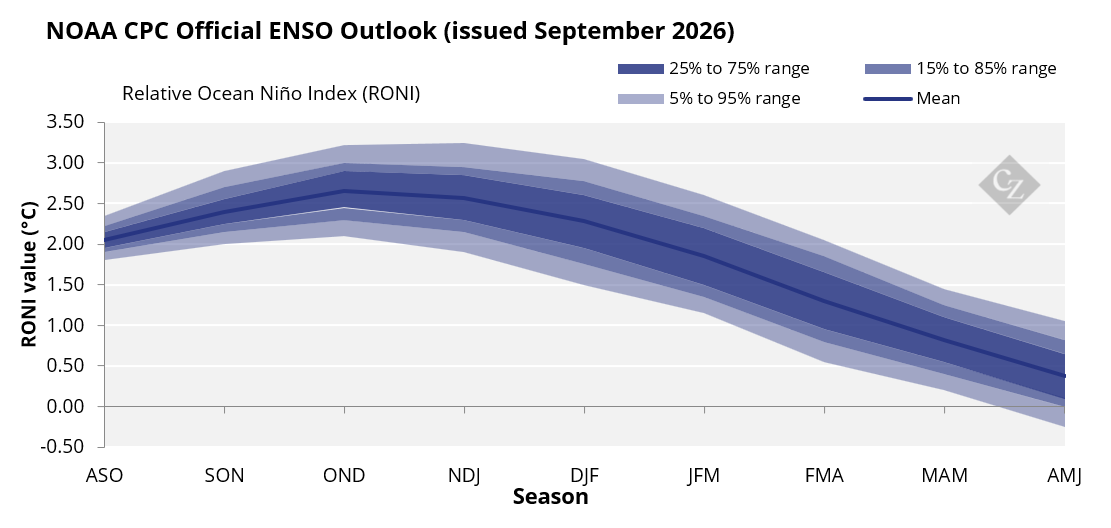
Source: NOAA
However, the impact of El Niño on agriculture will depend on several factors, including temperature conditions in the Atlantic and Indian Oceans, as well as the stage of crop development when climate changes and rainfall reach the producing regions.
In practice, the risk is less about widespread crop failure and more about a series of regional issues capable of reducing supply. Price reactions will depend on the state of supply-demand balances when the weather effects materialise. The initial trend is likely to be a more visible adjustment in physical markets, reflected in premiums, freight rates and differentials between origins.
With comfortable inventory levels, the impact tends to remain concentrated in the directly affected regions. However, lower inventories, or simultaneous shocks in key source regions, increase the risk of pressure spreading to the commodity exchanges.
Risks Mount for Global Grain Production
In the US, the 2026 soybean and corn crops will be well advanced by the time El Niño is expected to peak. Markets will watch for any late-cycle disruption, but focus is likely to move to winter wheat, soil moisture and planting conditions for 2027.
The current US soybean balance sheet offers some protection. In September, the USDA projected record production of 4.53 billion bushels (123.42 million tonnes) for the 2026/27 season and ending stocks of 310 million bushels (8.43 million tonnes). In the previous season, the country produced 4.262 billion bushels (115.99 million tonnes).
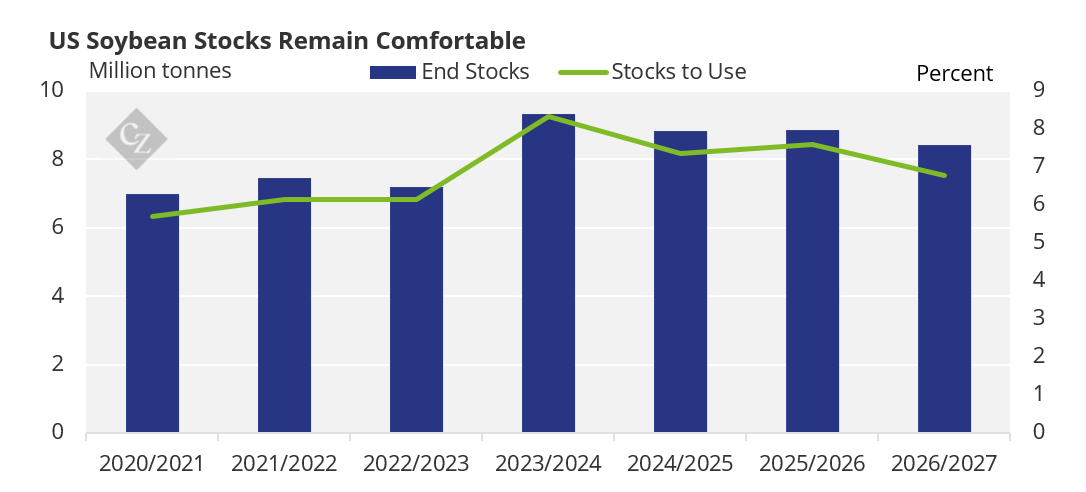
Source: USDA
Crush demand remains strong, but available supplies reduce the need for an immediate market reaction in Chicago to localised issues.
In South America, risks arise with the planting of the 2026/27 crop. In northern Brazil and the Matopiba region (comprising Maranhão, Tocantins, Piauí and Bahia), a “super El Niño” tends to cause more severe dry spells. In the Centre-West, a moderate reduction in rainfall is forecast, although northern Mato Grosso could also be affected by drought.
For soybeans, planting delays may occur in the Centre-West, which accounts for nearly half of Brazil’s production, due to shifts in rainfall patterns. Delays are expected to be more pronounced in Matopiba, which accounts for approximately 14% of the soybean crop.
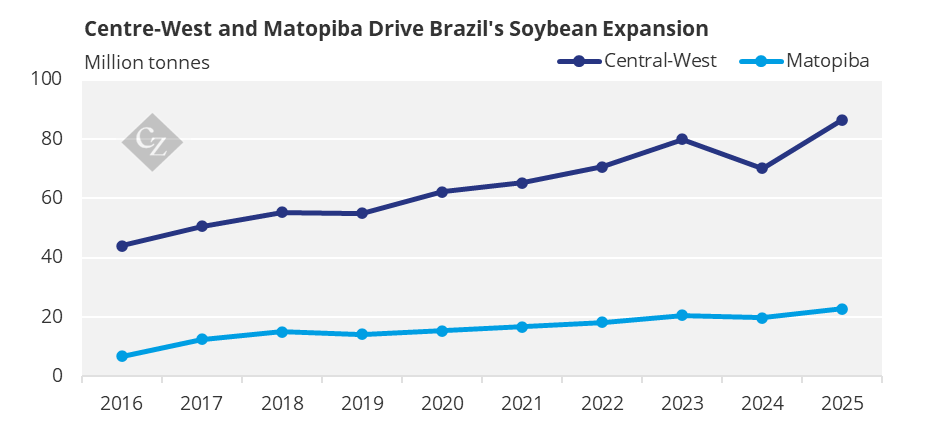
Source: Conab
The greatest risk lies with Safrinha (second-crop) corn, which is planted after the soybean harvest. It is worth noting that soybeans are a flexible crop: if they receive adequate water and sunlight during the growing phase, they can make up for an initial delay and still achieve a full harvest.
The problem is that delays in the soybean crop can push corn planting into May and June. During this period, the crop risks facing the dry spells typical of winter, as well as frost, both of which reduce productivity. Consequently, a decent soybean harvest may be accompanied by lower corn production.
In southern Brazil, as well as parts of Argentina, Paraguay, and Uruguay, El Niño typically causes excessive rainfall. Due to this regional variation, excess moisture can delay planting and harvesting in the South. Furthermore, it increases the risk of disease outbreaks, such as Asian soybean rust, which harms productivity.
There is also the risk of intense storms and gale-force winds caused by El Niño, directly impacting crops in states such as Rio Grande do Sul and Paraná. In extreme cases, heavy rainfall and strong winds can cause corn stalks to lodge (topple over).
Since Brazil and Argentina play a decisive role in soybean and corn exports, as well as a range of other key agricultural commodities, this combination of regional risks tends to have a significant impact on the market.
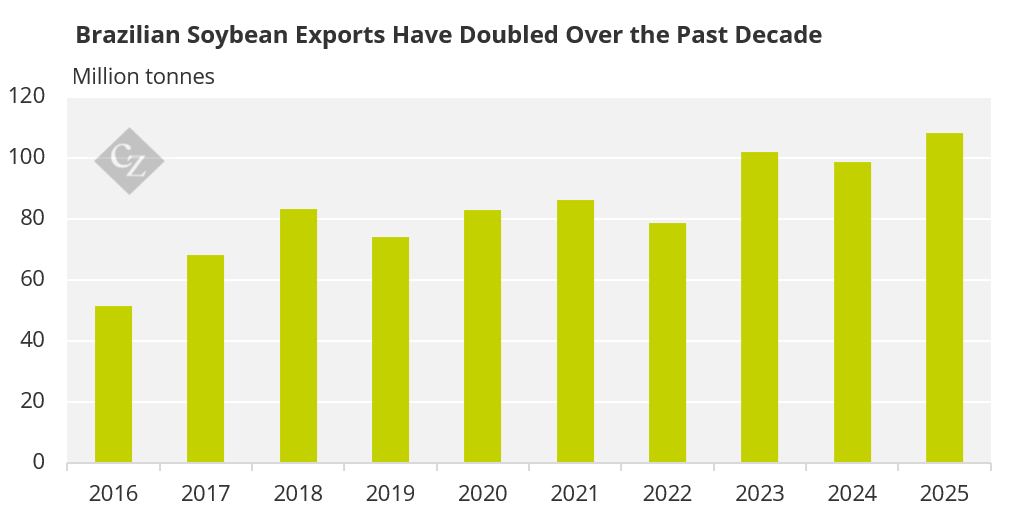
Source: Comex
Rising Energy Costs Add Pressure to Farm Margins
There is another important point to consider. Higher temperatures, one of the effects of El Niño, increase demand for electricity for cooling. Droughts reduce hydroelectric generation and increase the dispatch of thermal power plants fuelled by gas, coal or oil derivatives. Excessive rainfall, in turn, creates additional costs by disrupting railways, terminals and transmission networks.
In Latin America, where hydroelectric power plays a significant role in many electrical systems, a lack of rainfall typically leads to increased consumption of LNG, diesel and fuel oil.
It is also worth noting that since the conflict in Iran began in February, this equation has included an additional factor: the crisis in the Strait of Hormuz. International agencies such as UNCTAD have recorded rising energy and transport costs, while the IEA has lowered its forecast for global oil demand in the second half of the year.
In the agricultural sector, rising energy costs translate into higher prices for diesel, freight and fertilisers, which are produced from natural gas. Countries that rely on imports are naturally more exposed to these risks.
Brazil imports approximately 85% of the fertilisers it uses. According to the USDA, the price of fertilizers delivered to the country has risen by about 33% since March this year, impacting production costs.
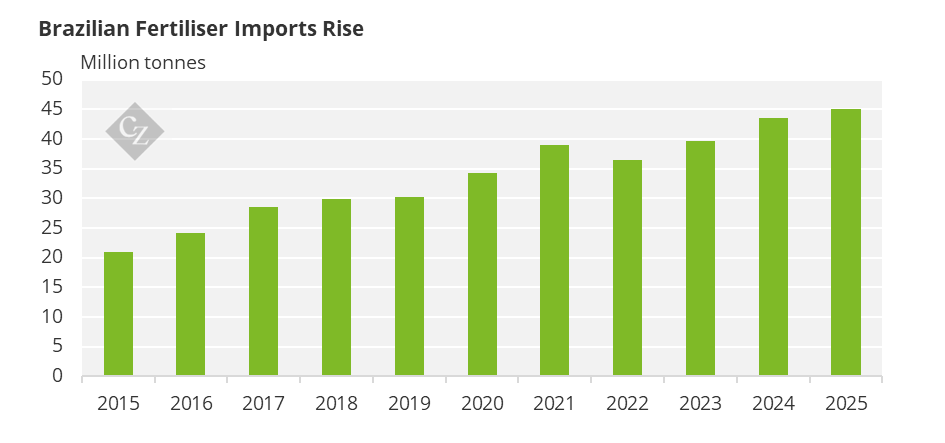
Source: Comex
Analysing El Niño solely through its potential impact on commodity prices is therefore insufficient. A rise in the price of soybeans, corn, sugar or cotton does not guarantee higher margins if it is accompanied by lower productivity and an increase in costs.