Insight Focus
Grain markets consolidate as expected WASDE tempers bullish sentiment. The September WASDE lowered US corn yield in line with trade expectations, prompting little market reaction and a round of profit-taking across grains. While another yield reduction cannot be ruled out as harvest progresses, tighter US and European balance sheets continue to support a Chicago corn market in the USD 5-5.50/bushel range.
This update is from Nixal Commodities. For more information, CLICK HERE.
All grains corrected on profit-taking, while the September WASDE reduced US corn yield largely in line with market expectations.
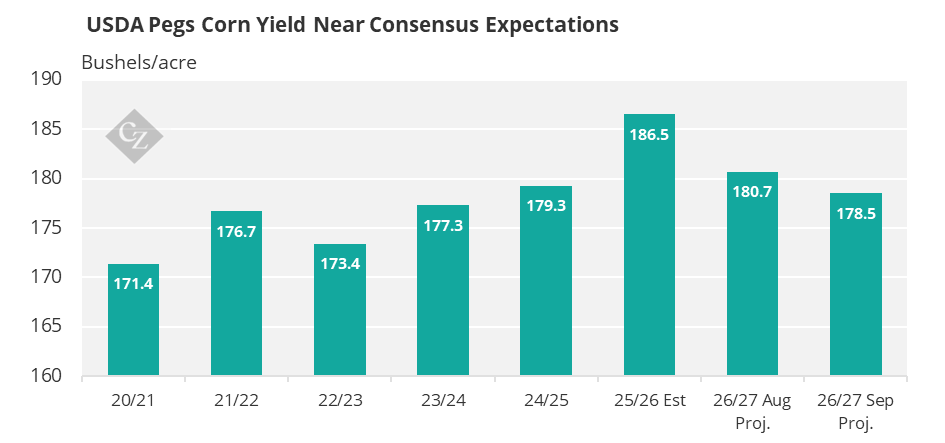
The highlight of the week was the September WASDE, which lowered US corn yield to 178.5 bushels/acre, almost exactly matching the average trade estimate. Was this deliberate to avoid a USD 7/bushel market if yields had been estimated at around 173 bushels/acre, or was it a genuine assessment? We can only wait for the next couple of months until harvesting is complete, but we would not rule out another reduction.
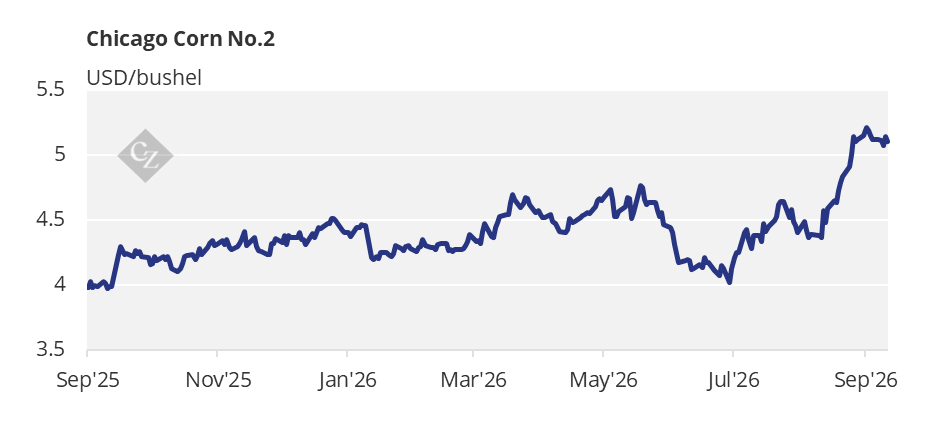
Because the report largely met expectations, the market showed little reaction, with Friday even closing lower. We would expect some consolidation from here, although the new supply and demand picture still justifies a market of USD 5-5.50/bushel given the tightening stock situation in both the US and Europe.
The 2025/26 (September/August) average Chicago corn price finished at USD 4.39/bushel, right at our estimate of USD 4.4/bushel, which we adjusted a few weeks ago from the USD 4.5 to 4.6/bushel range. Our first and preliminary estimate for the 2026/27 average Chicago corn price remains USD 5.5/bushel, as anticipated last week. The average price since September 1 is running at USD 5.14/bushel.
Corn Consolidates as WASDE Yield Cut Meets Expectations
Corn in Chicago opened negative last Tuesday (Monday was a holiday), following the downside of the previous week on rains expected in the US Corn Belt and continued profit-taking. It then traded sideways through the end of the week, even after the publication of the September WASDE last Friday, which was a non-event.
The September WASDE seemed very consensus-driven, as the most important figure was US corn yield and the question was not whether it was going to be lower, but by how much. It came in at 178.5 bushels/acre, right at the average of different polls, which was 178.6 bushels/acre, so basically what the market was expecting. This compares with 180.7 bushels/acre in the August WASDE and 173.4 bushels/acre in the Pro Farmer Tour estimate three weeks ago that triggered the rally in Chicago corn.
Source: USDA
The WASDE lowered old-crop ending stocks by 23 million bushels, all coming from higher exports. That lower carry-in for 2026/27 adds to the production loss of 213 million bushels due to the lower yield, and, somewhat expectedly, they offset part of the lower production with a 150-million-bushel reduction in feed and residual demand. New-crop ending stocks are now 86 million bushels lower at 1.567 billion bushels, and the stock-to-use ratio is now 9.7% versus 10.1% previously.
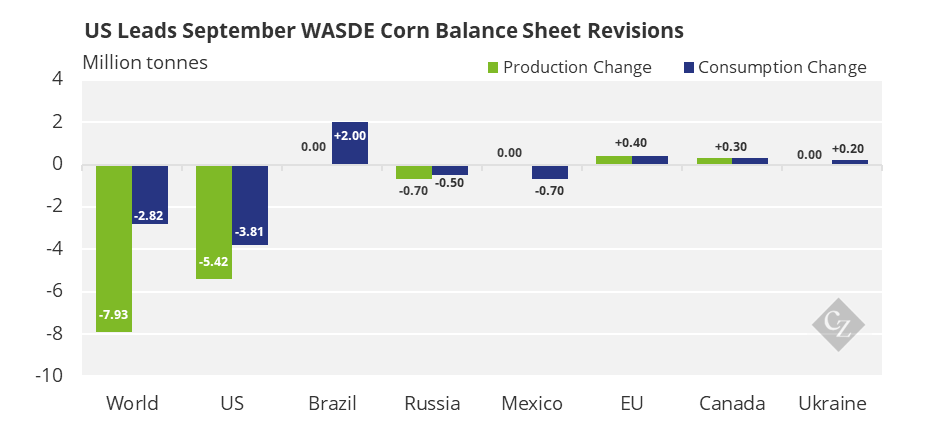
World stocks were reduced by 2.6 million tonnes, with the biggest reduction in production coming from the US (-5.4 million tonnes) and only immaterial changes in other regions. However, they also reduced consumption by almost 3 million tonnes, including in the US. The world balance sheet was essentially neutral in all regions except the US.
Source: USDA
BCR in Argentina increased its corn production forecast to 67.5 million tonnes, up from 66 million tonnes previously and versus 63 million tonnes in the September WASDE.
US corn is 5% harvested, up from 4% a year ago and ahead of the five-year average of 3%. Crop condition stands at 56% good or excellent, down one percentage point week on week and well below last year’s 68%. French corn is 9% harvested, up from 2% at the same point last year, while crop condition is 26% good or excellent, down one point from the previous week and far below last year’s 62%.
Corn harvesting in Ukraine is 1% complete. Safrinha corn harvesting in Brazil is 96.6% complete, slightly below last year’s 98.3% but marginally ahead of the five-year average of 96.5%, while summer corn planting has reached 11%, up from 9.6% a year ago and well ahead of the five-year average of 6.1%. Corn harvesting in Argentina is 96.95% complete, while planting of the new 2026/27 crop has begun and is 5.5% complete.
Geopolitical Risks Offset by Larger Global Wheat Supplies
On the wheat side, despite a negative opening last week on some profit-taking, the escalation of hostilities between Russia and Ukraine (with negotiations over a grain export corridor out of the Black Sea derailed) turned the market around on Tuesday as flows through the Black Sea continued to be disrupted. However, profit-taking emerged again, and wheat also closed the week lower, with the September WASDE proving to be a non-event.
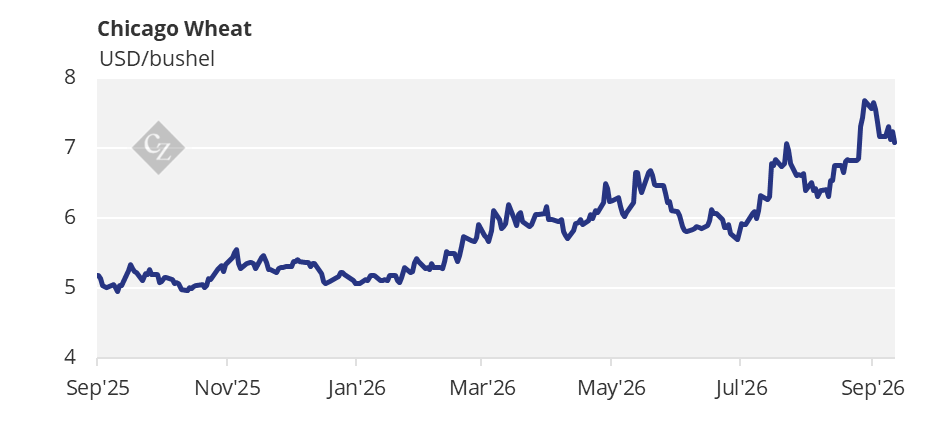
The September WASDE made no changes to its US wheat forecast, apart from raising its farm price estimate to USD 6.40/bushel from USD 6.20/bushel, while all supply and demand figures remained unchanged.
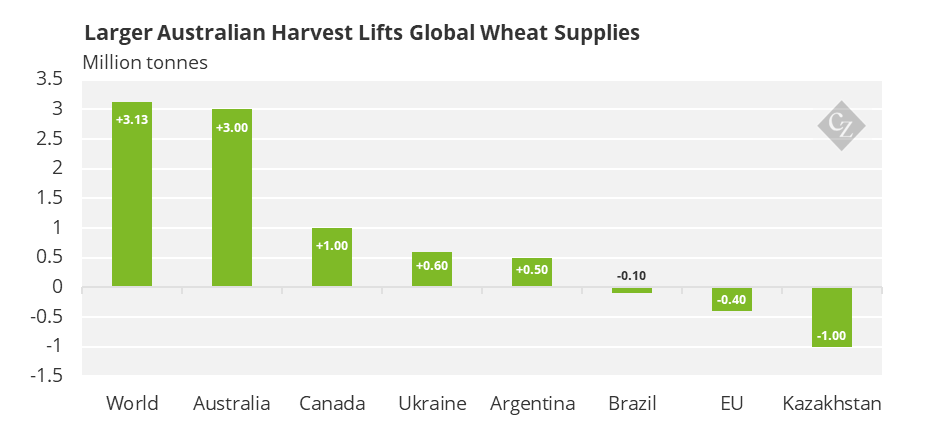
World wheat stocks were increased by 3 million tonnes, entirely due to a 3 million tonne increase in Australian production, with only immaterial changes elsewhere.
Source: USDA
US spring wheat is 86% harvested, versus 83% last year and the five-year average of 83%. US winter wheat is 2% planted, versus 4% last year and the five-year average of 5%. Wheat harvesting in Ukraine is 98% complete. Wheat harvesting in Russia is 84.9% complete. Wheat harvesting in Brazil is 11.5% complete, versus 11.1% last year and the five-year average of 12.4%.
On the weather front, cold and rainy weather is expected in the US Corn Belt. Brazil is expected to be rainy and cold again, as is Argentina. Europe is expected to be warm and dry in the southwest, while the north should see some rain. The Black Sea region is also expected to remain mostly dry, with limited rainfall.