Insight Focus
China’s soybean market has tightened in early 2026. Delayed US shipments, shrinking Brazilian old-crop supplies and lower imports are drawing down inventories, slowing crush rates and prompting government reserve auctions. Prices are likely to stay firm and volatile in Q1 before easing in Q2 as Brazilian new-crop exports and delayed US cargoes arrive.
Delayed Imports Tighten China’s Soybean Market
During the first half of 2026 the soybean market could see a dip in trade volume and a tight market in China as Brazil’s old-crop soybean supplies shrink. Newly purchased US beans will arrive in China about the same time new crop Brazilian beans in Q2.
China’s soybean market—the world’s biggest—is experiencing tight supplies in the first months of 2026. Brazil’s monthly soybean shipments shrank to 3.4 million tonnes in December 2025, with just 2.6 million tonnes bound for China. The newly purchased US beans may take two months to be transported and clear customs in China.
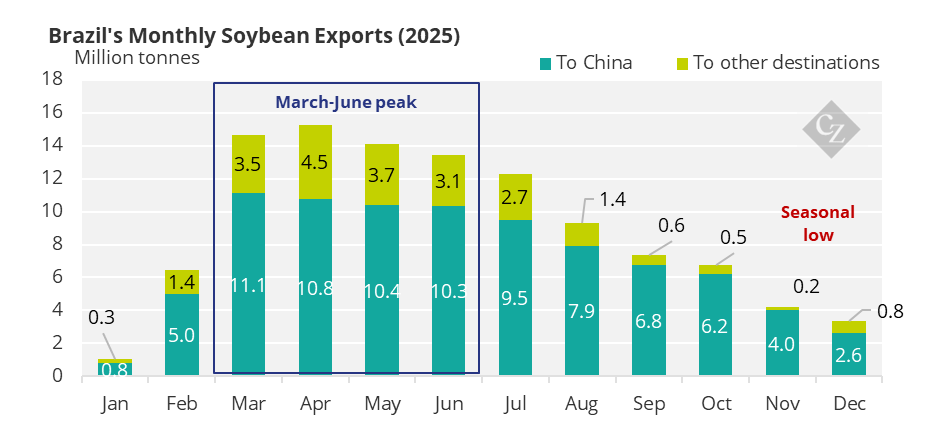
Source: Brazilian Customs Data
One Chinese market report forecast that China’s soybean imports would be under 4.6 million tonnes in January. That would be a little more than half of China’s monthly crush. It has also been rumoured that Chinese customs inspectors are lengthening the time required for customs clearance to 25 days, delaying the availability of imported cargoes.
US soybeans shipped during December may not clear customs in China until February. Most of the US beans were purchased by China’s Government reserve management company and may go directly into Chinese warehouses when they arrive. Private crushers still face an additional 12% tariff on US soybeans that makes purchases unprofitable for them.
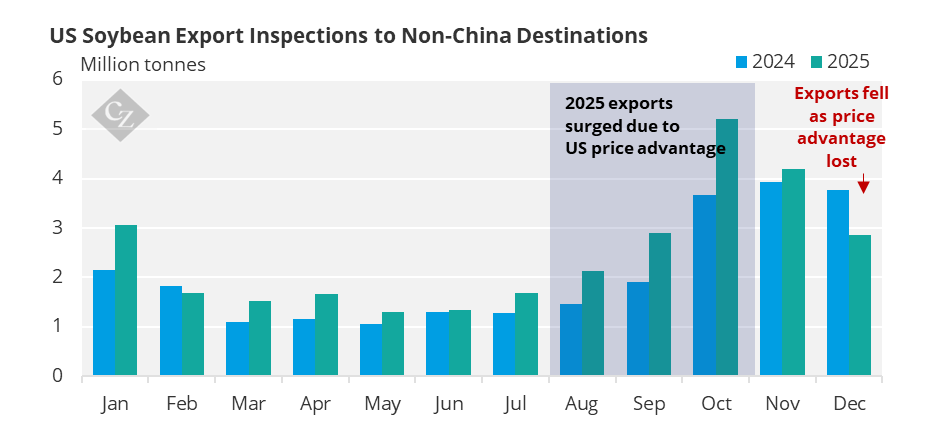
Moreover, news of Chinese purchases drove up US FOB prices, undermining US price competitiveness. The surge in US exports to non-China destinations seen in the autumn months was reversed in December as inspections of beans bound for non-China destinations dropped.
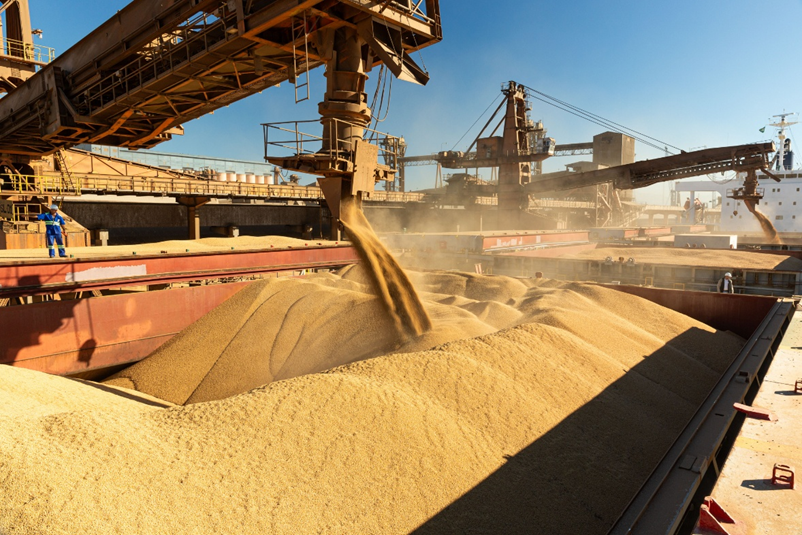
China’s monthly soybean crush pace of about 10 to 11 million tonnes set during the Summer and Fall months slowed marginally to 8 to 9 million tonnes as import volumes shrank. If China reaches its commitment to buy 12 million tonnes of US beans, that will equal a little more than one month of consumption in China.
As imports slowed, high inventories of imported soybeans, meal and oil began to shrink. According to one report, private stocks of imported soybeans peaked at 7.8 million tonnes but fell to 6.88 million in the first week of January. Some crushers planned to idle their plants early in advance of the February Lunar New Year holiday.
During December, Chinese authorities held three auctions of imported soybeans from Government reserves to make room for newly purchased US soybeans and to supplement tightening supplies. The December auctions sold 900,000 tonnes of the 1.55 million offered. Auctions were scheduled to restart January 13, 2026, with a sale of over 1.1 million tonnes.
Supply Relief Expected Later in 2026
Larger Brazilian exports will resume in 2026 after another large Brazilian soybean crop is harvested. Brazil’s CONAB estimates production at 177 million tonnes. In January’s WASDE report, the USDA raised its estimate to 178 million tonnes. Other analysts projected amounts larger than last year’s 171.5 million.
With a larger crop, the USDA forecasts that Brazil’s exports will grow and US exports will shrink in the 2025/26 market year. Argentina’s permanent reduction of export taxes could lead to an increase in exports.
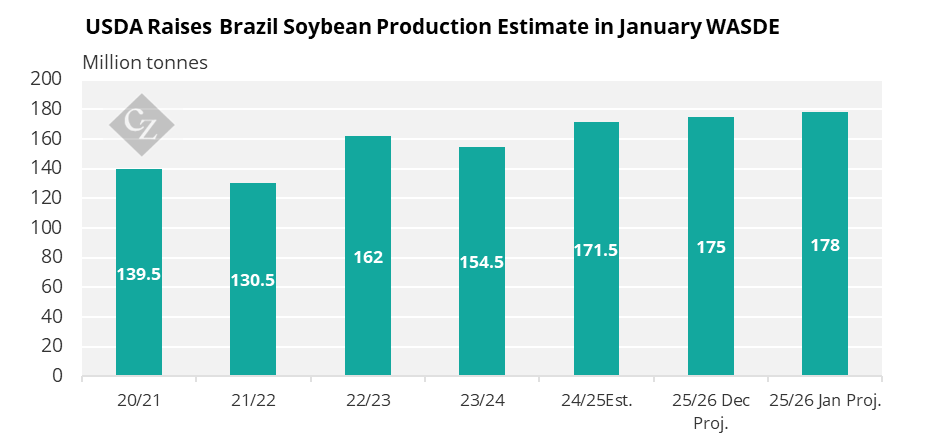
Source: USDA
This year China will likely have a concentrated arrival of soybeans during March-May from Brazil at the same time as the arrival of US beans purchased during November–January. The impact on market supplies in China will be diminished if the US beans go directly into Chinese State reserves. Nevertheless, cash prices will likely be under upward pressure and possibly volatile during Q1, followed by soft prices during Q2.
Private sector Chinese buyers may load up on Brazilian beans again in 2026 if the extra 12% Chinese tariff on US beans remains in effect. Non-China buyers may also return to Brazil in 2026 since the US price discount that drove them to US purchases in 2025 has now dissipated. This demand could give Brazilian prices some support despite increased supplies coming out of South America this year.
2025 Trade Flows Set the Stage
With 108 million tonnes of soybeans exported in calendar year 2025, Brazil continued to expand global soybean supplies. The soybean market continues to revolve around Brazil-China-US drama, while buyers elsewhere look for opportunities.
Brazil’s record exports were instrumental in facilitating China’s ability to maintain high tariffs on US soybeans after the trade war heated up during 2025. Exports bound for China totalled 85.4 million tonnes, accounting for 79% of Brazil’s soybean exports. Brazil’s exports to China rose 12.9 million tonnes during 2025, while its exports to non-China destinations fell 3.5 million tonnes.
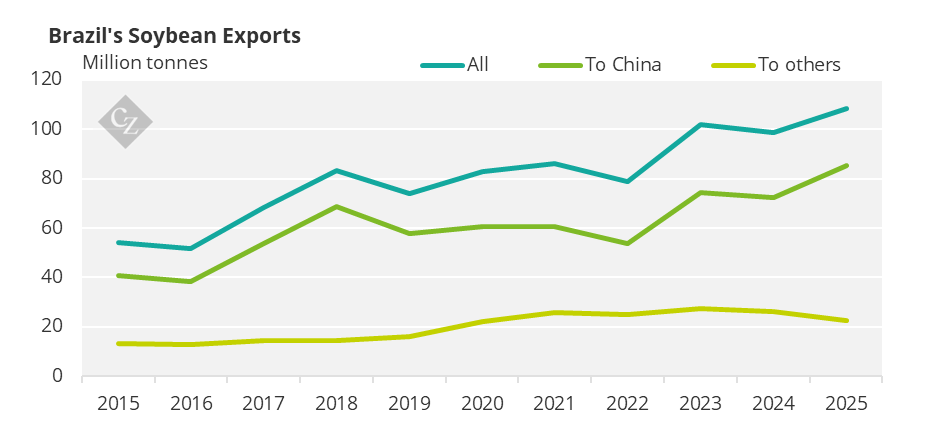
Source: Brazilian Customs Data
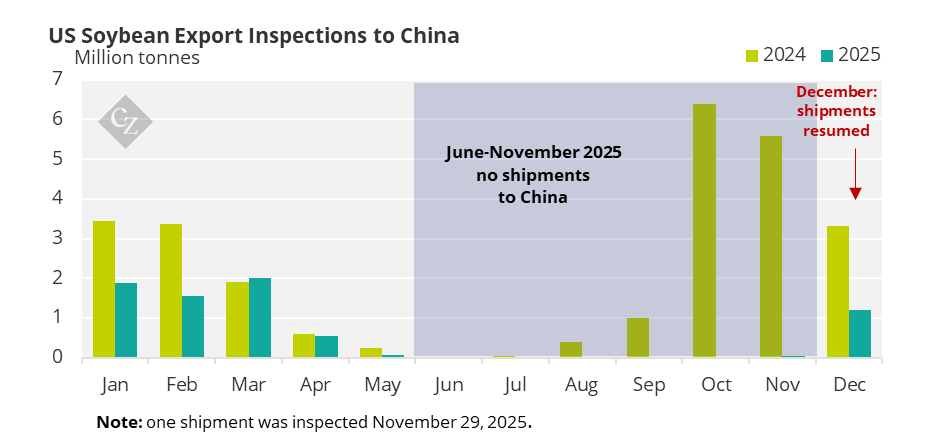
Meanwhile, the US shipped no soybeans to China during August to November—normally the peak months for exports of the new soybean crop. Beans that normally would have gone to China piled up in US bins and storage facilities.
Chinese buyers returned to the US market in late October 2025 as China cut its retaliatory tariff and the US government reported that it had committed to buy 12 million tonnes of US soybeans by year-end. As of mid-January, China has purchased an estimated 8 to 10 million tonnes of US beans, but physical shipments lag purchase agreements. Export inspections showed 1.2 million tonnes had shipped to China during November-December 2025. Purchases in January are expected to be shipped in April-May.
Source: USDA, Agricultural Marketing Service Data
There was some reshuffling of sales as US exports to non-China destinations increased year-over-year—the mirror image of Brazil’s shrinking exports to non-China markets. Gains in US shipments to Egypt, Bangladesh, Algeria and Taiwan during 2025 stood out, corresponding to declines in Brazilian exports to those destinations.
However, the gains totalling about 3 million tonnes were not large enough to make up for the decline in US exports to China. Overall export inspections for the 2025/26 market year through December totalled 16.4 million tonnes, just over half the pace of a year earlier. Meanwhile, exports to Pakistan from both the US and Brazil boomed during 2025. Both the US and Brazil saw declining shipments to Germany, Italy and Türkiye, and Brazil saw a drop in exports to Russia and Iran.
Source: USDA, Agricultural Marketing Service Data
China’s soybean imports set monthly records from May through November, despite importing negligible amounts of soybeans from the US during those months. China’s imports through November reached 103.8 million tonnes (74% from Brazil) and are expected to exceed 110 million tonnes for calendar year 2025. China still had unusually low prices and high inventories of soybeans and soybean meal in December.