Insight Focus
Record US and South American crops weigh on soybean prices. The USDA raised its forecast for a record 2026/27 US soybean harvest, while favourable weather supported planting and production prospects across Brazil and Argentina. Stronger US exports and resilient Chinese feed demand provided support, although Brazil continued to expand its dominance of China’s soybean import market.
Record US Crop Pressures Prices
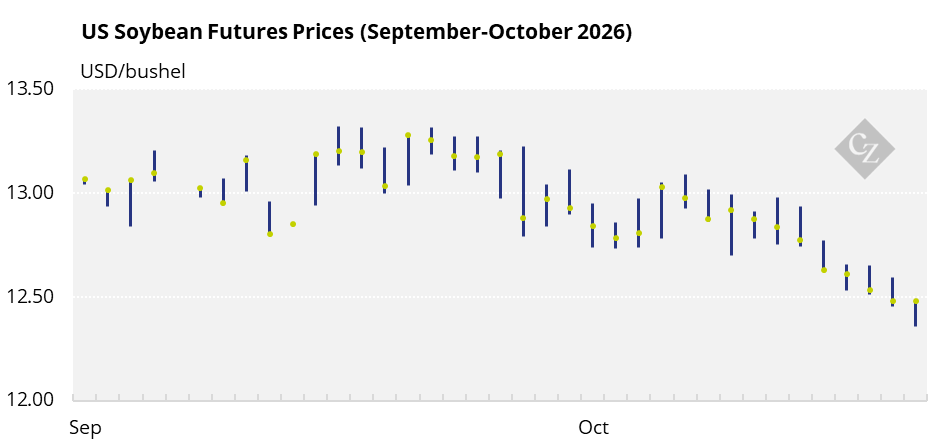
US soybean prices declined from about USD 13/bushel during the first week of October to less than USD 12.50/bushel by October 20. Despite an improved pace of exports following China’s return to the US market this year, USDA’s prediction of a record US crop weighed on prices. The Super El Niño has not yet impacted the planting of large soybean crops in South America.
Source: Chicago Board of Trade
The USDA’s October 9 WASDE raised its estimate of the 2026/27 soybean crop to a record-high 4.56 billion bushels. This was 1% higher than its previous estimate and up 7% from the previous year. The previous record for US soybean production was 4.46 billion bushels in 2021. A chart presented by USDA at the October WASDE release showed that this year’s production estimate was higher than most industry analysts’ projections.
The USDA’s estimate of the soybean yield was raised by 0.6 bushels from the previous estimate to a record-high 53.1 bushels/acre. USDA estimated a small year-over-year increase in yield that masked differences across states. USDA estimated year-over-year increases in yield in Eastern Corn Belt states such as Illinois, Indiana, Michigan and Ohio; declines in Western Corn Belt and Great Plains states (including less than 1% in Iowa); and increases in yield for most states in the Southern and Eastern regions.
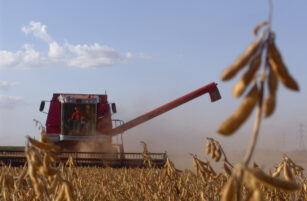
Drier weather permitted a faster pace of harvest, reinforcing expectations of a large crop. The US soybean harvest was 64% complete by October 18, up from 46% the previous week.
South American Crop Outlook Remains Favourable
This year’s “Super El Niño” weather has not yet impacted the South American soybean crop. Rainfall was above normal in parts of Southern Brazil and Argentina, and below average in Northern Brazil, in line with projected El Niño impacts, but weather conditions did not seriously impede planting.
In Brazil, soybean planting was 30.1% complete as of October 16, up from 15.6% the prior week. Planting progress is ahead of the five-year average of 26.4%. In the key state of Mato Grosso in Northern Brazil, planting progress reached 60.8%.
CONAB’s latest estimates for the 2026/27 Brazilian soybean crop project a 0.7% increase in production to 181.6 million tonnes from the previous year. CONAB projects a 1.4% increase in Brazil’s planted soybean area, offset by a year-over-year decline in yield.
Argentina’s soybean planting began in October. The Buenos Aires Grain Exchange projects a 1% increase in Argentina’s soybean area to 17 million hectares. The biggest gains are expected in Argentina’s northern regions, where leafhopper infestations have discouraged corn planting. The Exchange projected 2026/27 soybean output at 53.6 million tonnes, up 7% from 2025/26.
US Export Demand Strengthens
On the demand side, the US National Oilseed Processors Association (NOPA) reported a 13-month low in US soybean crush of 196.9 million bushels for September. Many analysts interpreted the low crush as reflecting a shortage of soybeans ahead of the new harvest rather than weak demand. Analysts will be watching the next report, expecting an October rebound in crush as supplies from the new crop become available.
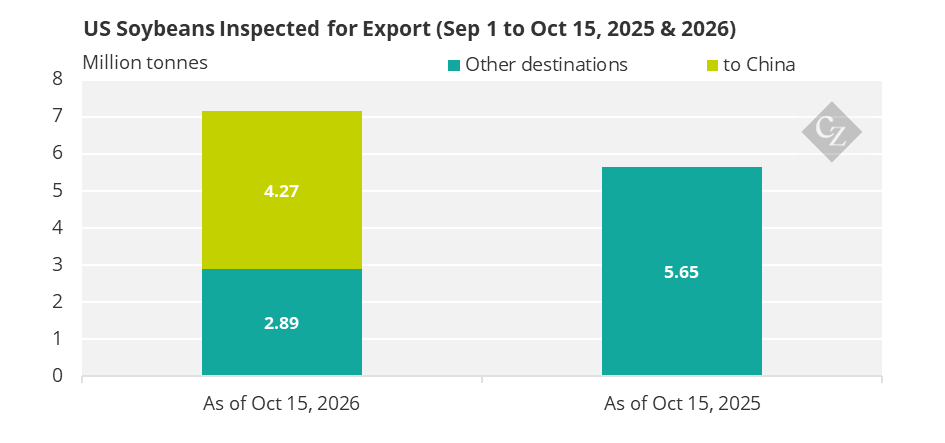
US soybean export sales and shipments are ahead of last year. China had purchased a total of 13.4 million tonnes from the 2026/27 crop, accounting for about half of all sales, versus none a year earlier. As of October 15, USDA reported cumulative export inspections of 7.2 million tonnes for the 2026/27 market year, up from 5.7 million tonnes a year earlier. Of this year’s total, 4.3 million tonnes was inspected for export to China. In 2025, there had been no exports to China by October 15.
Source: USDA
China’s Soybean Import Patterns Continue to Shift
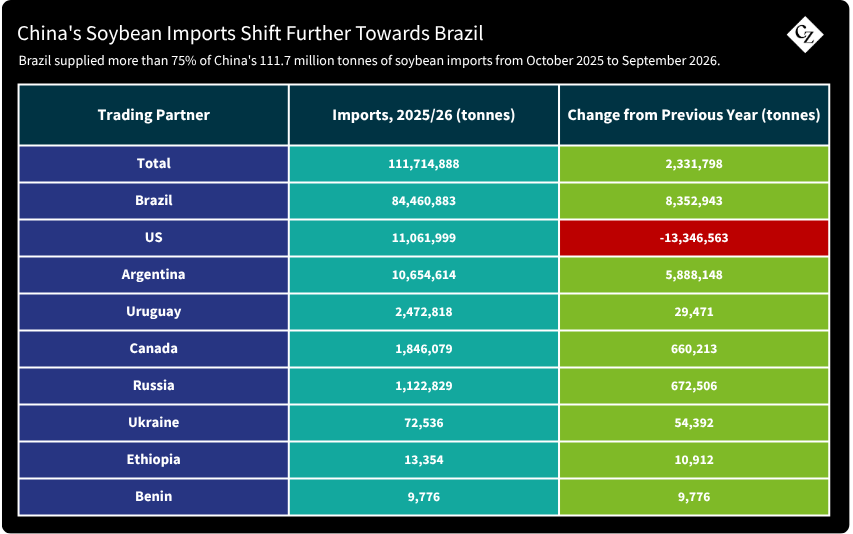
China’s customs administration reported that China imported 11.88 million tonnes of soybeans during September, of which 90% came from Brazil. That brought China’s total imports for its October 2025-September 2026 market year to 111.7 million tonnes, up 2.3 million tonnes from the previous market year.
China increased its imports from Brazil by 8.35 million tonnes between the 2024/25 and 2025/26 market years. The share of imports coming from Brazil rose from 70% to 75.6%. Imports from Argentina increased by 5.9 million tonnes, bolstered by a temporary suspension of Argentina’s export tax on soybeans during September-October 2025.
Increases in imports from smaller suppliers including Canada, Russia, Ukraine, Uruguay, Ethiopia, and Benin combined for an additional 1.4 million tonnes. These increases more than offset a 13.3 million tonne decline in imports from the US.
Source: China customs
The USDA projects an increase in China’s soybean imports to 115 million tonnes in 2026/27. China’s Ministry of Agriculture and Rural Affairs projects a decline in imports to just 95.5 million tonnes.
Feed Demand Remains Supportive
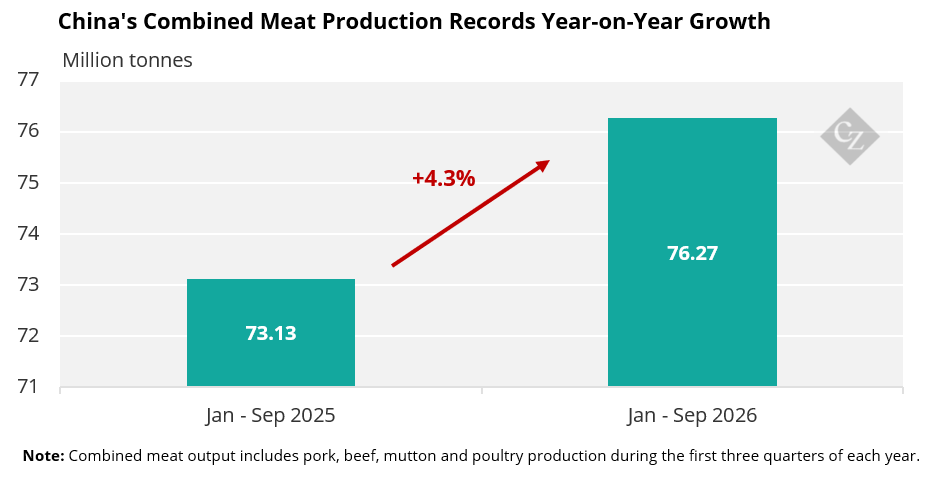
Growth in China’s swine and poultry sectors supported demand for soybean meal. In an October speech, an executive from China’s largest state-owned edible oils company estimated a 4.9% increase in soybean meal consumption for 2025/26. Industrial feed output for the first eight months of 2026 was reported at 223.2 million tonnes, up 2.9% year over year. In the first nine months of 2026, pork output was up 3.2% and poultry output was up 9.3% year over year.
Source: National Bureau of Statistics of China
Hog producers began cutting back sow herds in response to a 20% decline in hog prices. The sow inventory at the end of September 2026 was down 10.6% from a year earlier. However, trends toward higher sow productivity and heavier carcass weights will partially offset the decline in sow numbers, supporting feed demand. Poultry production has been stimulated by rapid export growth despite a relatively weak consumer market.
In her October speech, the edible oils company executive noted a slowdown in China’s edible oil consumption and identified export markets as an opportunity for Chinese crushers, given growing use of edible oils for biodiesel in the US, Brazil, and Indonesia. China is now a net exporter of soybean oil. China’s soybean oil exports grew to 1.1 million tonnes in 2025/26, a tenfold increase from 2023/24. India is its largest market. USDA projects soybean oil exports of 1 million tonnes in 2026/27.