Insight Focus
Dairy markets are increasingly competing on timing rather than supply. Global milk production remains strong, but delayed buying programmes and concentrated demand are tightening availability in specific shipment windows and origins. Product that is compliant, uncommitted and able to arrive on time is commanding a growing premium, even in markets that appear well supplied overall.
Supply Is Growing, but Availability Is Not Uniform
Last month, we examined why additional milk was not translating evenly into the products buyers required. That allocation problem has not disappeared. However, a further constraint is now becoming more visible: even where the required product is being produced, it may not be available in the origin or shipment window in which buyers need it. New Zealand milk production remains exceptionally strong, with August collections rising 3.3% year on year on a milk solids basis. Fonterra collections increased 3.0%, while non-Fonterra processors expanded even faster at 4.4%.
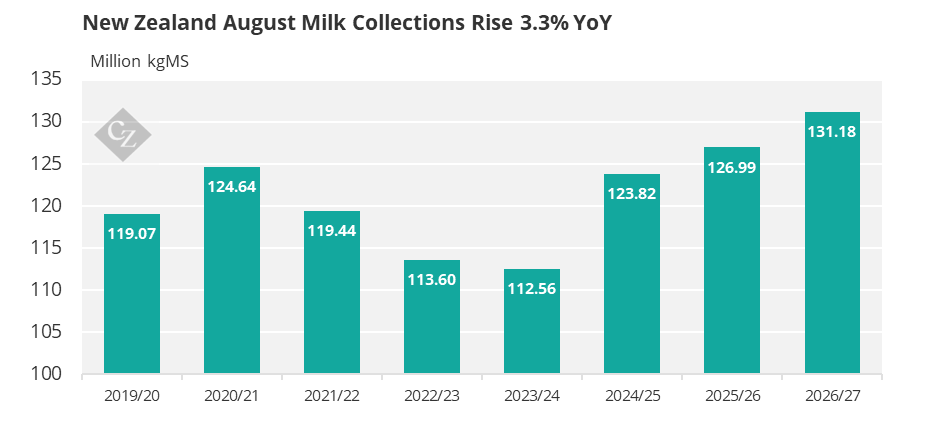
Strong production would normally imply comfortable product availability. Yet suppliers are already reporting tight availability for some nearby WMP shipment periods. This highlights a distinction that is becoming increasingly important across dairy markets: total production and prompt availability are not the same thing.
Milk can be abundant while export availability remains constrained. Once production is committed to existing contracts or specific manufacturing programmes, the volume available for new business can tighten quickly. As a result, buyers are placing greater value on product that can be shipped within the required window rather than product that may become available later in the season.
Algeria Returns and Buyers Need Product Sooner
The clearest example of this dynamic is Algeria. After months of delays, sanitary derogations have reportedly been issued to a broad range of grocery importers beyond the country’s traditional buyers. These import licences had been anticipated since April, leaving many buyers with limited forward coverage and creating a strong bid for milk powders, particularly WMP.
Attention is now shifting to the next ONIL tender. Market participants generally view ONIL as maintaining a minimum of around six months of physical inventory in-country. With current stock coverage reportedly extending only until August 2027, purchasing activity may soon need to focus on securing arrivals from February onward.
The timing could prove significant. If ONIL seeks February-to-April arrivals, New Zealand suppliers would broadly need to allocate product for departure between December and February. That matters because several suppliers are already reporting limited WMP availability during these nearby shipment periods. ONIL and newly licensed private buyers could therefore compete for the same relatively small pool of prompt product, allowing nearby shipment periods to command a premium over product available later in the season.
Time Is Becoming a Competitive Advantage
The challenge for New Zealand exporters is increasingly not production cost alone, but time. New Zealand remains one of the world’s most competitive dairy producers, supported by strong pasture-based systems and another healthy production season. However, buyers in Africa and other import-dependent regions are becoming more sensitive to arrival timing and shipment certainty.
This changes how dairy products are valued. The most attractive offer is not necessarily the cheapest tonne of product. Instead, it may be the tonne that can arrive within the required delivery window while remaining compliant with local import requirements.
As delayed demand returns to the market, logistics and timing are becoming larger drivers of value. Product that is uncommitted and available for prompt shipment is becoming increasingly scarce despite strong underlying milk production.
Futures Are Pricing Weather Risk, While Physical Markets Price Timing Risk
Another interesting divergence is emerging between futures markets and physical trade.
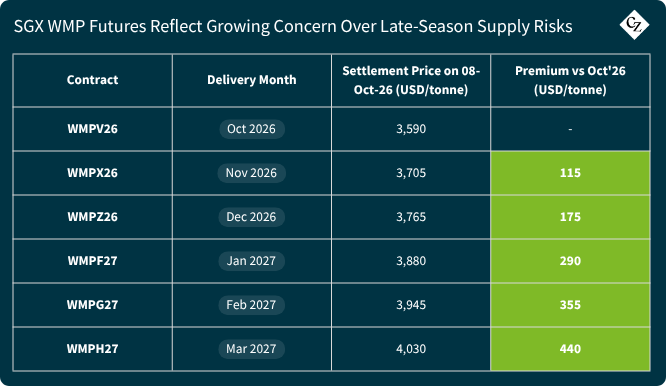
SGX WMP futures are pricing a substantial premium into later delivery months, consistent with market concern over potential late-season El Niño-related production risks.
Source: S&P/NZK Indices
However, strong opening milk flows, favourable current pasture conditions, elevated feed availability and supportive milk prices may improve farmers’ ability to defend production if conditions become drier.
The result is a market pricing two separate risks. Futures markets are focused on future production uncertainty, while physical markets are increasingly responding to near-term shipment availability and concentrated buying demand. The curve is pricing future production risk at the same time that prompt physical availability may tighten for entirely different reasons.
Structural Changes Continue Beneath the Surface
New Zealand’s strong milk production is occurring alongside continued changes in processor market share.
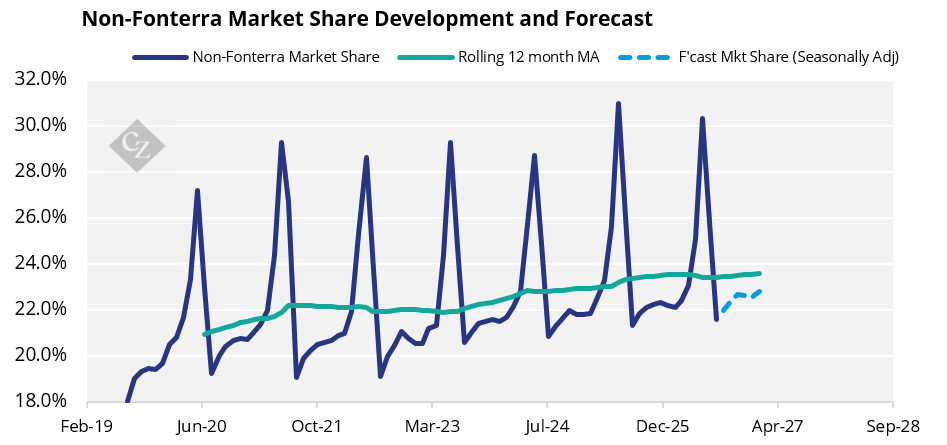
Fonterra appears on track to lose a further 0.3 percentage points of milk collection share this season. Its market share has been declining over a much longer period, although the pace of erosion has been notably steady at around this level for a little over two years. While the annual changes remain modest, they highlight the increasingly competitive environment for milk supply.
Geographical conditions are also becoming more mixed. Soil moisture indicators show parts of the North Island beginning to dry faster than seasonal norms, while the South Island remains comparatively wet. Current conditions are not yet threatening production, but they warrant monitoring as the season progresses.
Elsewhere, changing trade relationships may create additional shifts in product flows. The proposed EU-Philippines Free Trade Agreement could alter sourcing decisions within Southeast Asia, potentially creating new opportunities and competitive pressures for exporters.
Demand Signals Are Not Always Where Markets Expect
Headline discussion around Chinese dairy demand remains heavily focused on weakness. However, weak demand can still coincide with constrained local supply.
Market reports indicate that at least one major Chinese supplier had sold out of both SMP and WMP by early October. This should not be interpreted as evidence of a broad recovery in consumption. Rather, it shows how limited local availability can create pockets of apparent strength even when underlying demand remains subdued.
Butter markets are also showing signs of differentiation. GDT butter prices appear to be flattening, while premiums for New Zealand-origin butter outside the auction platform are reportedly expanding. The widening gap suggests that softer auction pricing is not passing uniformly into executable physical offers, particularly where buyers require a specific origin or shipment period, despite generally comfortable supply conditions.
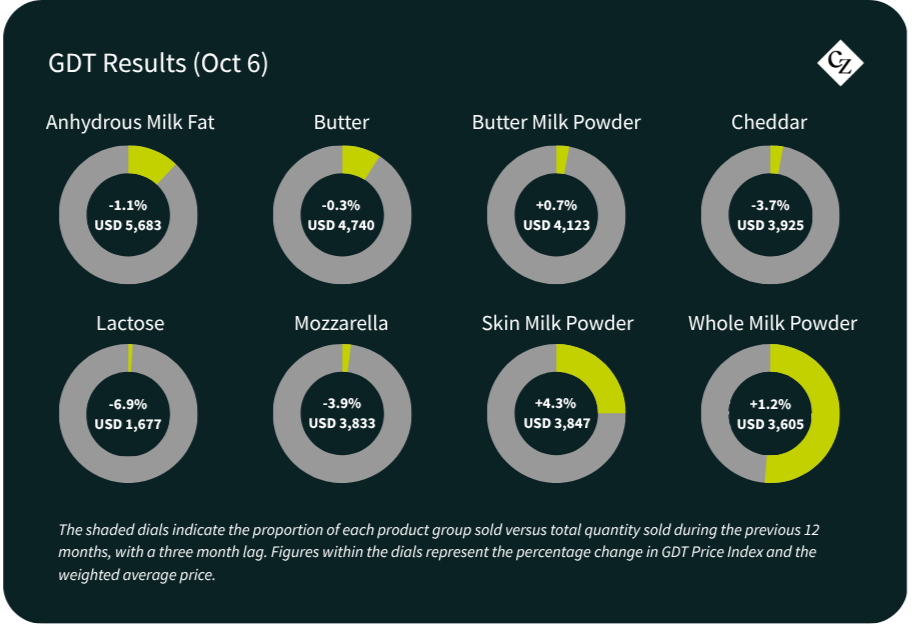
These examples reinforce a broader theme emerging across dairy markets: aggregate supply tells only part of the story. Timing, origin and product availability increasingly matter just as much.
The Market Question Has Changed Again
Last month, the key question was whether higher milk production was being converted into the dairy products buyers required. Today, the more important question may be whether those products are available in the right origin and shipment window.
Algeria’s return to the market demonstrates how delayed demand can collide with limited prompt availability, even when milk production remains strong and global supply appears comfortable. Buyers are increasingly competing for product that is compliant, uncommitted and capable of arriving on schedule.
Dairy markets may no longer be defined primarily by shortages of milk or product. Instead, they are increasingly being shaped by the value of timing. The right product in the right location is important, but the ability to deliver it at the right moment may be becoming even more valuable.