Insight Focus
Record milk production in New Zealand has created plenty of whole milk powder (WMP) for near-term delivery. But as milk output falls after the seasonal peak, processors may make less WMP and use more milk for skimmed milk powder (SMP) and milkfat products, which currently earn better returns. This could mean plentiful WMP now but tighter supplies later, until weaker butter and anhydrous milk fat (AMF) prices change the calculation.
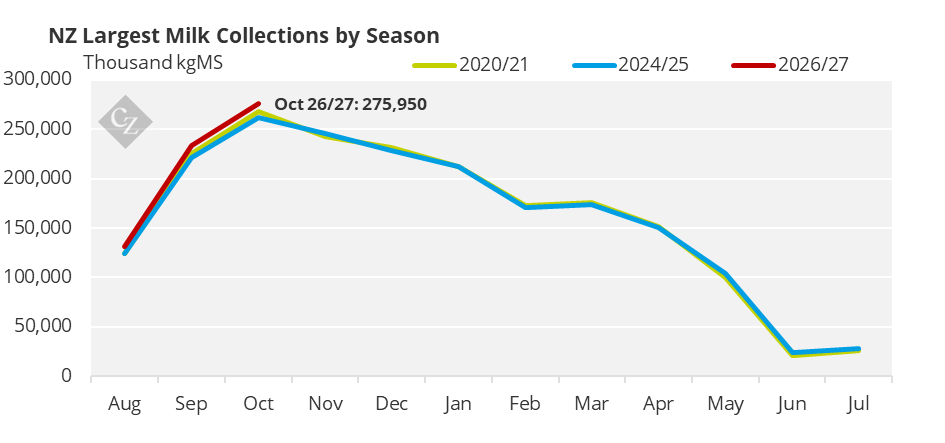
New Zealand collected 275.95 million kgMS in October. That was 2.6% more than a year earlier and 1.8% above the previous October record, set in 2018. From August to October, collections totalled about 640.46 million kgMS, 2.5% more than in the same period last season.
This was clearly a very strong month for milk supply and is likely to have increased production across New Zealand’s main dairy plants, including WMP plants. The more important question now is what processors will make as milk volumes decline after the seasonal peak.
Record Milk Has Created Plenty of WMP for Nearby Delivery
At the seasonal peak, processors must focus on handling very large volumes of milk, not simply on making the most profitable product. WMP plants can process particularly high daily volumes. Even if other products offer better returns, processors cannot send all the milk to those plants if they are already full.
October’s record milk volume therefore almost certainly created a large amount of WMP. This points to generous near-term supply and may put downward pressure on prices, especially because WMP prices rose by less than futures markets expected at the latest Global Dairy Trade (GDT) auction.
The chart shows how unusual the month was. Milk collections in 2026/27 were higher than in both 2024/25 and 2020/21 during August and September, before reaching a new record in October.
After the Peak, Profitability Matters More
The October record tells us how much milk has already been processed. It does not automatically mean that WMP supplies will remain high in the coming months.
New Zealand reached its peak milk day earlier this season, particularly in Waikato. As daily milk volumes fall, processors no longer need to run WMP plants simply to handle the amount of milk arriving. They have more freedom to choose the products that offer the best returns.
We estimate that making SMP together with butter or AMF currently earns about USD 0.35-0.45 more per kgMS than making WMP, after allowing for reasonable processing costs. The combination of SMP and butter is near the top of that range. This makes WMP less attractive to produce after the peak.
This creates two different market pictures. Record October production should keep near-term WMP supply high. After the peak, however, WMP production could fall faster than total milk supply if processors use more milk to make the better-paying SMP and fat products.
Strong SMP Returns Are Creating More Milkfat to Sell
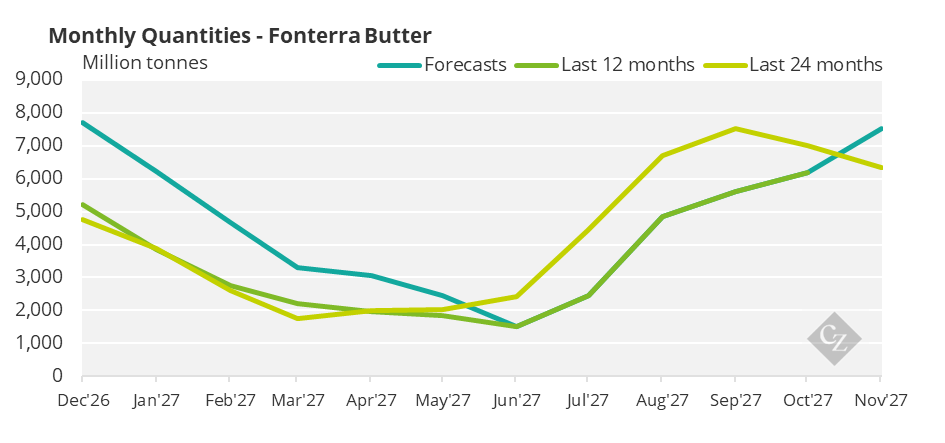
Demand for SMP remains strong. Fonterra has added about 5,000 tonnes of butter, an increase of roughly 10%, and 1,000 tonnes of AMF, about 1.5%, to the volumes it plans to offer through GDT over the next 12 months. It has not announced a matching increase in SMP.
This suggests that much of the SMP is already committed to buyers, while the milkfat produced alongside it still needs to be sold. Lower demand for New Zealand butter from a large US supermarket chain is adding pressure by sending more fat into the bulk market. Storage space is reportedly filling, while cheaper US and European butter is competing in markets including Egypt.
New Zealand’s butter plants are thought to be operating close to their practical limit. If processors make more SMP, the extra milkfat is therefore more likely to become AMF than butter. The key question is whether buyers will absorb that extra AMF without prices falling so far that the SMP and fat combination loses its advantage over WMP.
Source: Fonterra
The Same Shift Is Changing Global Trade
The contrast between valuable skim solids and weaker milkfat is not limited to New Zealand. European SMP has traded at about EUR 3,700-3,800 per tonne, while spot butter has fallen towards EUR 3,500-3,600/tonne. European suppliers report limited SMP availability into early 2027, even as butter prices remain under pressure.
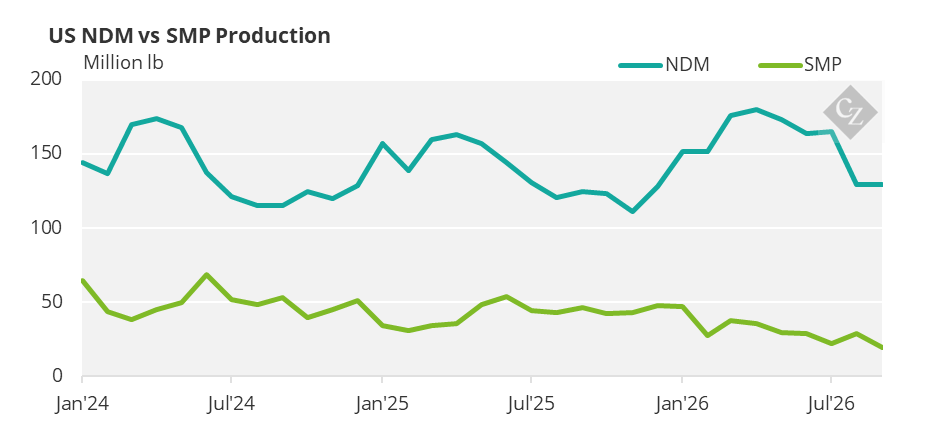
US manufacturers are making similar choices. In September, non-fat dry milk (NDM) production rose 3.7% from a year earlier, while SMP production fell 58.8%. Combined NDM and SMP output fell 13.3%. US powder exports to Mexico rose 19.2%, while shipments to the Philippines fell 39.8%, as higher-priced US skim solids were sold to domestic and nearby NDM buyers.
This is already changing trade flows. Many South American buyers are looking to Europe for SMP instead of buying from the US. Strong returns for skim solids are therefore changing both what processors make and which producing regions supply price-sensitive buyers.
Source: CLAL
WMP Supply Looks Different Now and Later
Demand for WMP remains mixed. China accounted for about 62% of purchases at the latest GDT auction, and Chinese domestic milk prices appear to be rising. Both developments make imported powder more attractive to Chinese buyers.
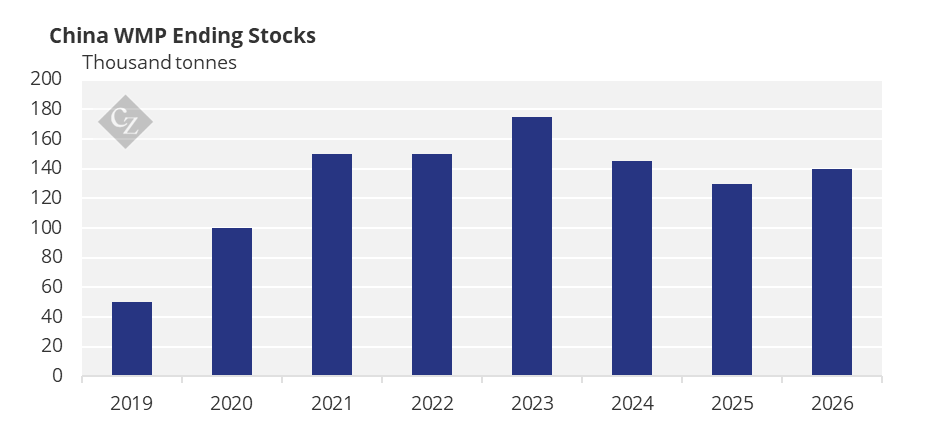
However, reported WMP stocks in China remain high, and prices at the latest auction rose by less than futures markets expected. China may be buying enough to cover its needs without competing aggressively for extra supply. This supports the market but is not yet strong enough to drive a major price rise.
Demand outside China has helped absorb global supply, although that growth may slow. Many physical buyers are purchasing only what they need for the short term because they are unsure where prices will be later. This caution limits price gains now, but it also means buyers may need to return quickly if New Zealand’s post-peak production slows or processors make less WMP.
Source: USDA
El Nino Is a Risk for Later, not a Cause of Current Supply
El Nino could still affect the second half of New Zealand’s milk season. In the past, strong El Nino events have reduced national milk collections by about 2-6%. Futures prices can react to that risk before any fall appears in official production figures.
For now, however, the evidence does not point to a weather-related shortage. Soil moisture is above normal in important North Island regions, especially Waikato and Taranaki, and pasture conditions remain favourable. October’s record milk collection confirms that El Nino has not restricted production so far.
The weather risk is mainly about the later part of the season. If conditions become much drier, milk output after the peak could fall at a time when processors already have less need to make WMP. If conditions stay favourable, strong milk supply would create even more butter and AMF, which could push their prices lower and eventually make WMP more attractive to produce.
Weaker Milkfat Prices Could Shift Milk Back to WMP
The current advantage of making SMP and milkfat will not last forever. Every extra tonne of SMP also produces milkfat that must be sold. If butter and AMF prices keep falling while WMP prices hold steady, the profit difference will shrink, and processors may use more milk to make WMP again.
The order of events matters. Strong SMP returns first encourage processors to make less WMP after the peak. This creates more butter and AMF, putting pressure on their prices. As those prices fall, the original reason for favouring SMP becomes weaker.
Strong SMP returns are drawing milk away from WMP, but weaker butter and AMF prices could eventually bring it back.
That change would make WMP more attractive to manufacture but would not necessarily raise its price. If processors move more milk back into WMP, the extra supply could limit price gains. The key question is whether butter and AMF prices fall enough to close the profit gap before cautious WMP buyers need to purchase more for future delivery.
Near-Term and Later WMP Supply May Move Apart
October’s figures point to plentiful WMP supply for nearby delivery and may put downward pressure on prices. Record milk volumes required New Zealand’s full processing network, so processors are likely to have made a meaningful amount of WMP even though SMP and milkfat offered better returns.
The picture for later delivery is less certain. The pressure to process peak milk has eased, SMP and milkfat remain more profitable, China is buying without urgency, and many physical buyers have covered only their short-term needs. WMP production could therefore fall faster than total milk collections immediately after the peak.
Further ahead, lower butter and AMF prices could reduce the advantage of making SMP and encourage processors to make more WMP. El Nino could delay or strengthen this change, depending on whether today’s favourable soil conditions continue into summer.
New Zealand has produced more milk than the market expected. The next major move in WMP will depend less on that headline figure and more on how much of the smaller post-peak milk supply processors choose to use for WMP rather than the currently more profitable SMP and milkfat products.